
 Continue with onX Maps
 Sign in with Facebook






The Fulgurite Thread


|
|
Greg Cameronwrote: I'm not convinced that the stinky white ones that have streaks down the wall are lightning related. I'm not a geologist though. I'm not saying that I am correct, and I think it would be awesome if the white holds that stink that I have come across are actually these fulgurites, but according to the link below the bushy-tailed woodrat's habitat is up to 14,000 feet. Middens can be inhabited for 50,000 years, allowing for a lot of material to precipitate over time. Would a lightning strike have a pyroclastic flow of white rock down the wall? If a lightning strike formed that much material, I would expect an explosion due to the physics of expansion/off-gassing, not a nice flow down the wall. 14,000': https://en.wikipedia.org/wiki/Bushy-tailed_woodrat Middens to 50,000 year: https://en.wikipedia.org/wiki/Pack_rat |

|
 |

|
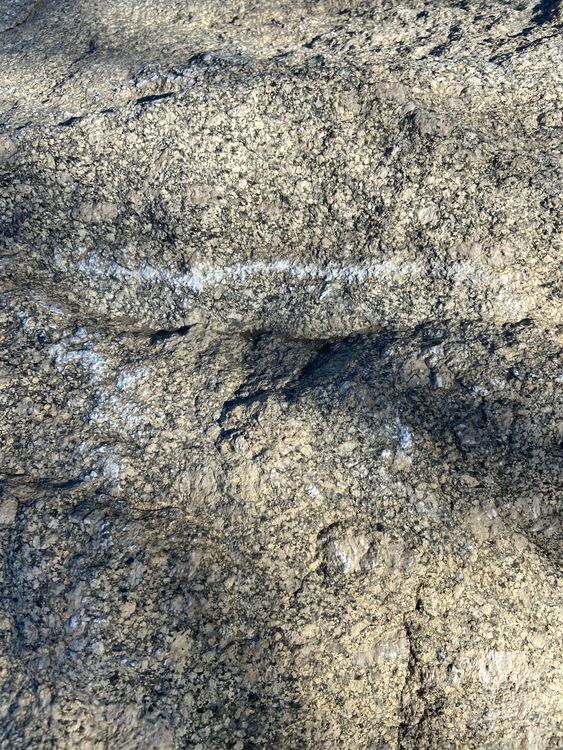 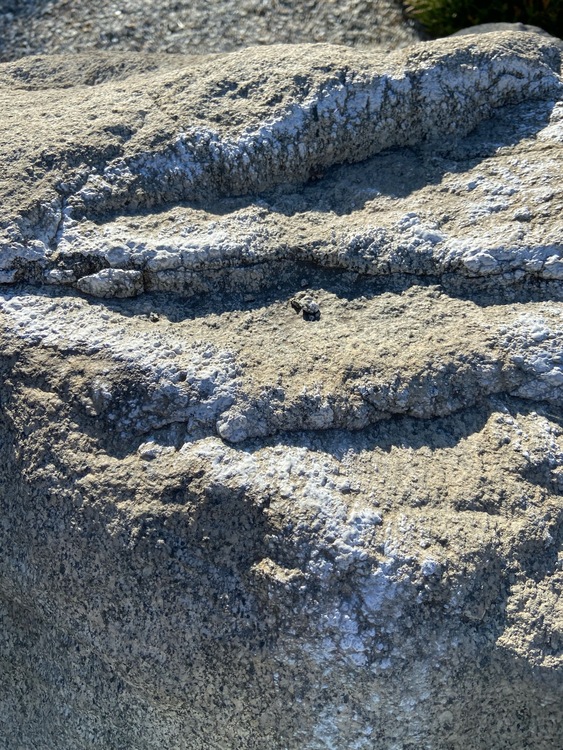 I have some medium size boulders in my front yard that have deposits that look like fulgurites. It's definitely not bird poop. It's definitely a mineral crust. And it's not all over, just near the top. I doubt the boulders have been hit by lighting in situ in my yard, they were installed after the house was built in 1989. I live at 2000 feet and we almost never have lightning here. But the boulders were probably up near Mt Ontario or Cucamonga or Baldy (all high peaks near my house) before moving downhill over geologic time. Still, I need a fulgurite expert to distinguish if this is just some kind of rain/mineral leeching phenomenon or a real fulgurite. |
|
|
Skyler Mavorwrote: A good geologist would lick the white spot to differentiate between fulgarite and poop. |
|
|
They’re all over devils tower. They look like black and white bullseyes on the sides of the columns where bird poop wouldn’t accumulate. Saw a bunch while climbing el matador over the summer |
|
|
Well, let’s get straight what we are all discussing here. Not every white mass on rocks is a fulgarite, nor is every white mass bird poop. And some can be a combo - like Variscite which is actually a mineral cum half-assed gemstone that can form from water and bird poop percolation reacting with the substrate rock. I am sceptical of those Vedauwoo pics being fulgarites. That definitely appears to be water wash. Fulgarites don’t remain molten long enough, and are too viscous to flow like those pics. Either way, something formed those things in a secondary process (not direct laid poopage). It’s still interesting. (Kinda) |
|
|
Pretty sure most of those are calcite and calcium oxalate deposits which leach from the urine of various bird species and especially from that of pack rats. Pack rats have a thick pee which crystallizes rapidly in the heat, forming a shiny, viscous shellac known as amberat. Over time, the calcium leaches from it and can form white deposits that exhibit flow like characteristics. Amberat, can usually be seen near them. It’s a dark, usually sticky, like dried tree sap substance. Can’t miss it. These are common and almost everywhere. If you smell piss and poo, the surface is chalky and it’s located on a nice perch, like where a bird or pack rat might like to chill and soak in the view. Then it’s most likely a calcium deposit. Pour a little vinegar on it if you’re unsure. It should cause the surface to bubble slightly. |
|
|
Okay, so I myself might have been among the skeptical had I not spent so much time looking at fulgurites near Mount Evans where there are no rodents or roosting birds living in the cliffs and towers, I've got dozens of pictures. But here's the deal. I'm going to go to Vedauwoo tomorrow with the express purpose of getting some samples of the white stuff that I am calling fulgurites. I'm going to bring a bottle with dilute hydrochloric acid to at least determine if it is in part carbonate. I hope to get a chunk big enough for a rock thin section. I'm not exactly sure how I would determine whether or not it is organic. Does anybody have any ideas? It would seem to me that it should be able t be determined without necessarily doing a full XRD or XRF analysis. By the way, here's a common texture seen in the Mount Evans fulgurites -- that central raised ridge. Another texture that is common is shown in the next photo. I don't even know what to call this, but I see it in several fulgurites. 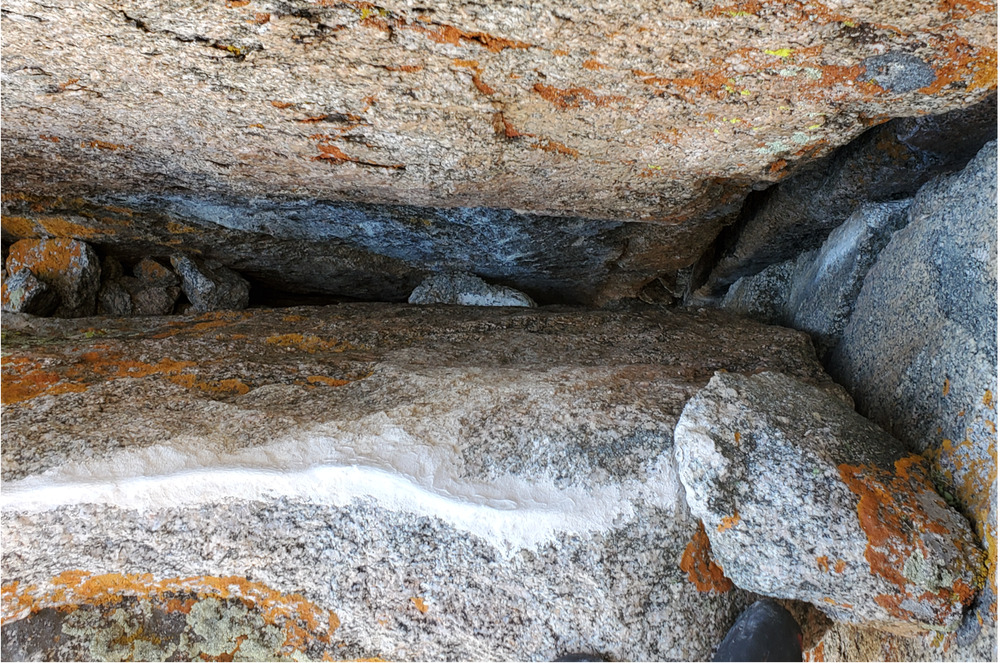 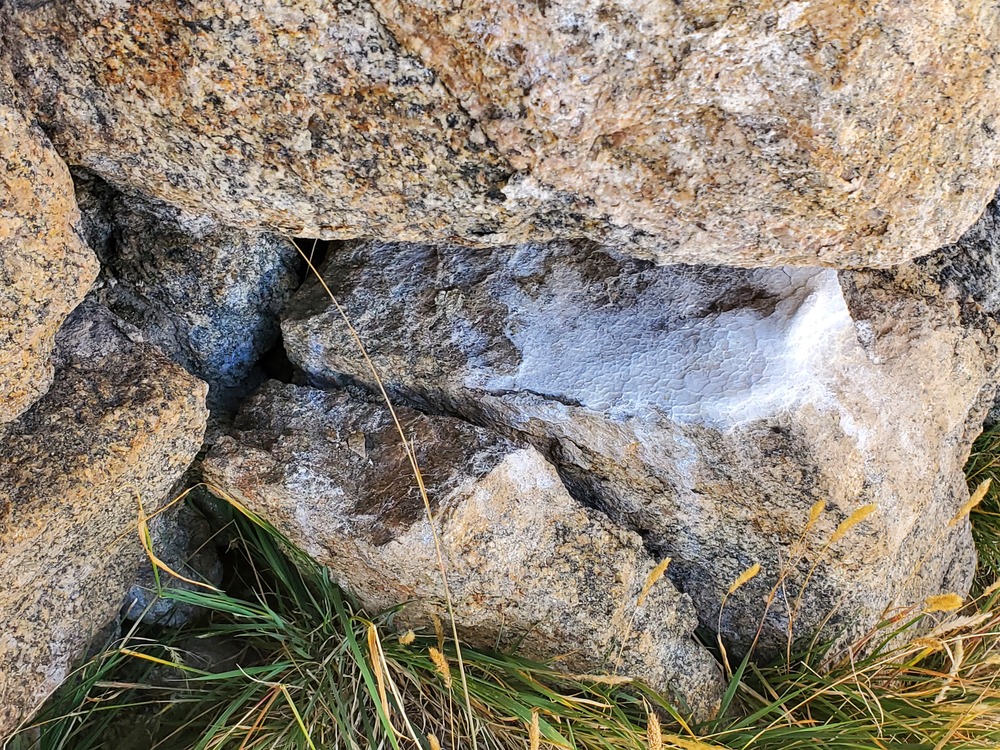 |
|
|
that's really interesting and cool tfpu! |
|
|
It is important to realize that these 'granitic fulgurites' can be thousands upon thousands of years old. As a result, the layout of the land when they were formed my or may not be quite different than what is there now. In this way they are like the pack rat mittens found around Vedauwoo (like at the base of BG Crack) which are often mistaken for bat guano: the mittens look out of place because they can be thousands upon thousands of years old, and the boulders they were once placed around/under are no longer where they were when the mitten was originally formed. |
|
|
The first photo in my last post is some of my best stuff with respect to pictures that tell a story. Remember how I started this thread with the orange lichen/fulgurite relation? I would say that photo highly suggests that the relationship goes 1) orange lichen grows, 2) lightning strikes, forming both the fulgurite and a zone around the fulgurite that is not hot enough to melt rock but is hot enough to vaporize anything organic. You see that newish-looking surface, free of lichen, a few centimeters from the actual fulgurite contact (at least on the lower part of the photo) -- that is within this zone that I am proposing. I mean, it only makes sense that there should be a zone like this. Of course this brings up why some of those thumbnails in my opening post show no intervening "bake zone". It also brings up whether the lichen somehow attracts the lightning, since lichen holds moisture and water conducts electricity. Hey I'm still studying this. And frankly, I'd like to spend less time defending my views and more time analyzing pictures from others.:> Somebody mentioned up thread that my fulgurite pictures don't look like some they saw on the internet. This is true. A fulgurite is just a surface melt. If the underling rock is a gabbro or basalt, you are likely to get dark fulgurites. In the three areas that I have noticed them (Mount Evans, Vedauwoo, and Eldorado), they are typically white, although it may be that I have not recognized the darker ones at Eldorado, which has clayey layers with darker minerals and sandy layers with lighter minerals. JNE, I posted my last post before reading your post. I will say this -- that I am prepared to be wrong about the Vedauwoo "fulgurites" -- which is why I am sampling. tomorrow I have been up-front that I am basing my diagnosis on studying this phenomenon on superficial similarities between an environment where it seems highly unlikely that the source is a rodent with the Vedauwoo occurrences. I do happen to know that Vedauwoo is known for its fulgurites and has a nearby University with professors who are aware of this. |
|
|
Greg Cameronwrote:
|
|
|
JNE, I deserved that. |
|
|
I'm thinking that what I've seen on the cliffs here in CA are mineral deposits from guano/urine. Especially when there is a funky smell, guano/droppings/midden adjacent, and in a location (small ledge) where an animal would hang out. As to the lichen nearby, that would be explained by the nutrients in the urine/guano - fertilizer, no? Lightning strikes the top of Half Dome all the time, but I don't recall seeing these up there. A simple test of the composition of the white "glaze" could tell you if a particular specimen is melted granite or petrified piss. Or maybe just take a lick - taste test, if you will :) |
|
|
Greg Cameronwrote: Here, I fixed this for you. |
|
|
I'd assume fulgurite from granitic materials would have a much higher hardness than any organic precipitate? Maybe some basic hardness testing could rule out them being any kind of organic material. |
|
|
Greg Cameronwrote: Lichen? The stuff that's basically like rock dandruff? I doubt the tiny amount of water molecule held by lichen has any statistically significant attraction to lightning. Of course that's just my wild guess. All of this is very interesting though, I am now very curious to learn what this white stuff really is. |
|
|
It's a cool and interesting thought, but I'm skeptical its fulgurite - probably some piss precipitate. It just doesn't look even remotely like fulgurite from reviewed sources. Do some hardness tests like Ross suggests. He's a smarty pants geologist! Most of the rock up at Mt Evans is granodiorite (looks to be in your photos), which has a relatively high amount of silica. I would guess that at least some lechatelierite, amorphous glass often found in fulgurite, would probably form in this. Lechatelierite is around 6.5 on the hardness scale. I would guess that a knife (4-5 hardness) shouldn't be able to scratch anything fused from granodiorite. These are just some thoughts (could be totally wrong!). Also, I think your idea that lichen attracts lightning is kind of silly, sorry. Curious to know more though, keep us posted on your tests! |
|
|
I am an avid mineral collector, one thing I can say definitively is that identifying minerals etc based off of internet photos is never accurate and can be highly misleading. For example these two pictures below are both the exact same mineral, Barite, in a crystalized form yet look completely different. Most, if not all, internet photos of fulgurite are going to be of the collectible form that happens when lightning hits sand and not solid rock. The result is a beautiful tube like structure. For obvious reasons a fulgurite formed by lightning hitting solid rock will look very different. Its entirely possible these are fulgurites, but I have no idea. Its an interesting question as I have seen this stuff all over and never really thought about it. It should be very easy to find out if it is organic, I suspect not. Waiting on Greg's tests! Hardness would theorteically be much harder than organic material. 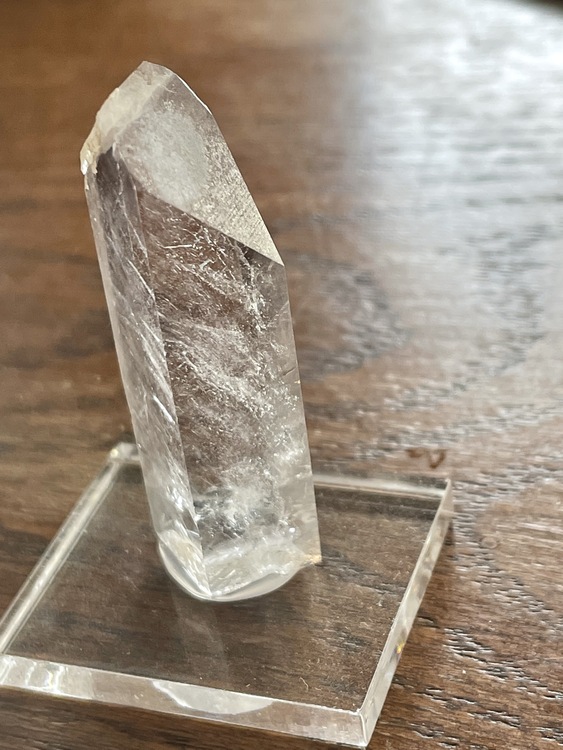 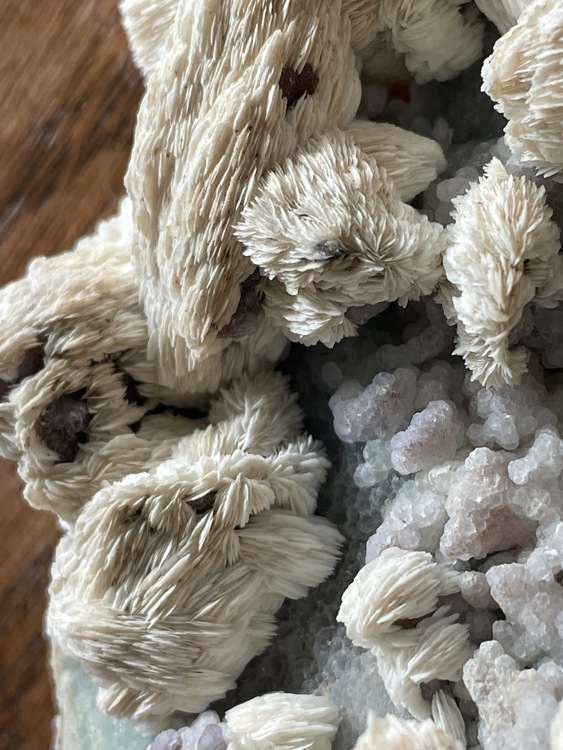 |
|
|
A priest a Mennonite and a fulgurite walked into a bar... Not everything white is a fulgu-rite, not everything white is a fulgu-rite, not everything white is a fulgu-rite, All work and no play makes Jack a dull boy, all work and no play makes Jack a dull boy. I must say, I feel like I got schooled looking at the "fulgurites" at Vedauwoo today. As a matter of fact, it was at Vedauwoo that I was first made aware of them by Jay Anderson. And I was vaguely aware that he, Mike Friedrichs, Dennis Horning and other Laramie locals knew about them. I assumed that, because some of them were geologists and went to U of W that, it must have been a well-known thing at the geology department at U of W because of its proximity to Vedauwoo. Lots of assumptions on my part I now realize. That's why I gave a nod to JNE. I realized it then. Today I went to the Maze at Vedauwoo, one of the place that is full of these what I will now call "features", and I think the second place where fulgurites were pointed out to me. And might I say that what you see there is indeed super-interesting. However, whatever they are, they surely would seem to be caused by critters. The indications of this being the living space of rodents was easy to see. Often, there were actual little rodents poops on top of the "fulgurite". Because I have no shame, I'm willing to become an expert on rodent pissing protocols rather than fulgurites if that's which way the wind is blowing (I just want to be an expert on something!). I mean these pictures are kind of mind-blowing in their own right. I mean, I still don't understand the obvious spatial relationship between white an orange lichen. Check it out.in my next couple of posts. 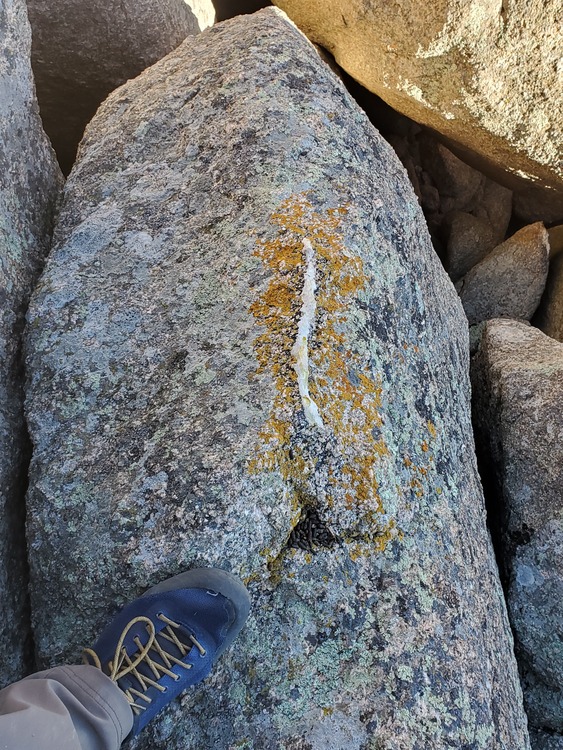 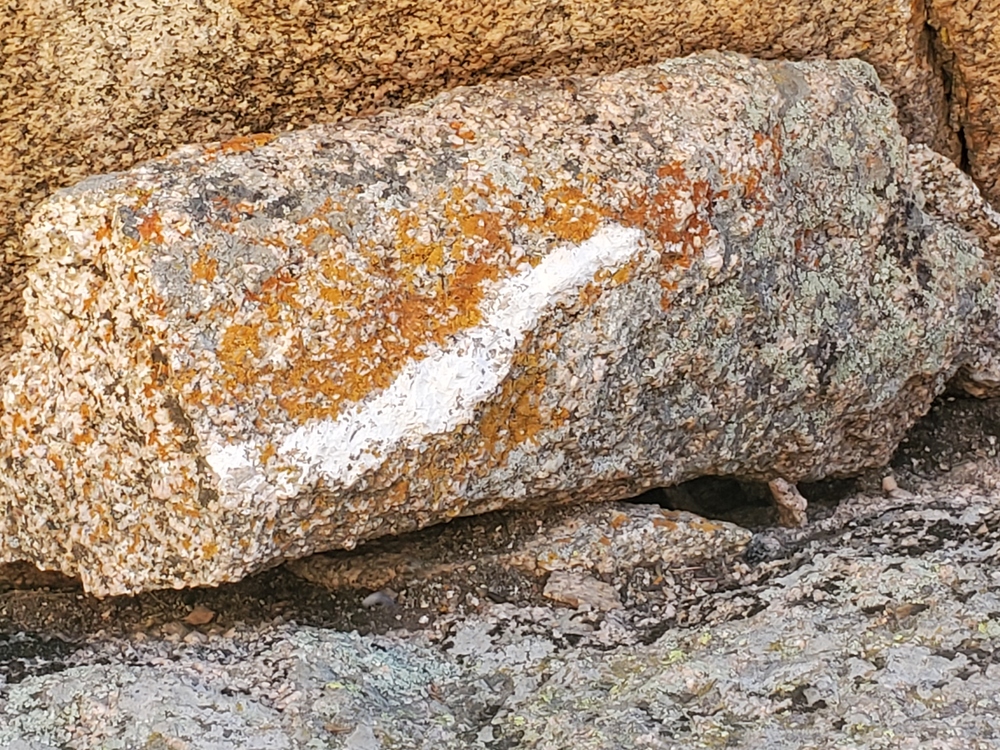 |


