
 Continue with onX Maps
 Sign in with Facebook






Why didn't the YDS remain decimal?



|
Alexander Blumwrote: So according to your ticks that would make you an advanced novice |
|
|
Marc801 Cwrote: In trad, it is intermediate, perhaps advanced intermediate. In sport? Entry level. |
|
|
Dan Schmidtwrote: Even if novice, intermediate, advanced, expert and pro (or world class) are words one might use to describe climbers who climb at different ratings, it seems as if from typical usage of the word "intermediate" that that would describe someone at or around the median of the distribution of abilities climbed by all climbers. If I remember my math definations correctly that would mean of the estimated 35 million climbers worldwide, half of those climb 5.12c or above. I kind of don't think that's the case. It doesn't bother me personally that there are people who describe 5.12 as an intermediate rating, but I think using the word in that way is a re-definition of the word. |
|
|
“When I use a word,” Humpty Dumpty said in rather a scornful tone, “it means just what I choose it to mean — neither more nor less.” ---Alice in Wonderland |
|
|
The median of this distribution in this analysis is 5.12c https://medium.com/@buckthecanuck/climb-through-the-data-with-me-80fb144ea408 Of course those logging at 8a.nu is a small subsection of the total. However where do you draw the line? Asking how hard do most people climb requires you to decide whether to include all comers or just people who have climbed regularly, outdoors... Ideally a rating system will be useful for kids at a birthday party as well as Adam Ondra |
|
|
Alexander Blumwrote: I don’t think it is that clear. I know some beginners that are super strong and climb really well but don’t know anything about the craft of climbing. Ie how to be safe on a sketchy pitch. They can hang holds I can’t dream of but when it is serious it is not them on the sharp end as they are still novices. So quite tricky to define levels. Also in my mind a 5.10 climber should be able to do most climbs of that grade, trad ,sport, runout, crack, slab, roof, short, long etc. same for 5.11 or 5.12. Allrounder 5.12 is impressive to me. |
|
|
I think MP is more representative of the full spectrum of climbers than 8a.nu. That site appears to focus on cutting edge sport climbing, and likely attracts a segment of the climbing population that aspires to that. Just the name of the site alone implies as much. Nothing wrong with that, but if you’re looking for data that determines a median max grade level for all who call themselves climbers I think you need to look elsewhere. |
|
|
I see a ton of “climbers” ON 5.12 and up, but I hardly ever see a no-falls/hangs - on those climbs. Heck go to someplace with traditional climbing- most folks climb below 5.10. |
|
|
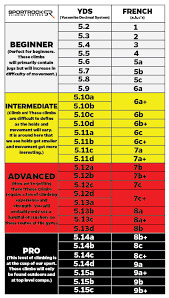 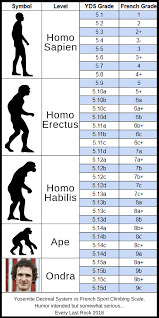 All your questions answered in two easy charts. ;) |
|
|
Kevin Worrall wrote: 100% using 8a.nu as your source to determine skill levels of the climbing populous is pretty silly. As a personal observation I know a lot of climbers that claim to climb 5.12 because they've redpointed like 3 soft sport 12a's. In addition outside of Creek climbs, 5.11 trad is for sure advancted. |
|
|
Alexander Blumwrote: Yet at almost every crag in the country there are waiting lines for 5.8 - 11 and largely empty 12's and above. |
|
|
Josh Rappoportwrote: Everyone is so insecure about being called intermediate but that dataset is super wonk. The distribution by gender is a bit of a red flag that it should not be generalized to the general population. I agree with Marc that 5.12 is not average, there are climbs where after talking to the FA they think I am one of the first to repeat their routes 30 years later .... |
|
|
People are hyper-sensitive because they're reading more into the designation (novice, intermediate, …) than it's meant to convey. The grade doesn't give you credit for things like style, rock type, old school vs. new school, danger factor, rope skills required, etc. — it's just a physical difficulty grade. And yeah, you can be an expert climber in a lot of ways who nevertheless "only" climbs 5.9. I'm not much of a rope climber so lemme relate this to bouldering, which I know more about. Footprints in Bishop, CA and Girls on Film in Lake Tahoe are both rated V9, but Footprints requires a million times more climbing skill than Girls on Film. If you fall on Footprints, you're getting massively messed up. But if all you look at is the grade, they're equal. I think this is fundamentally why so many people just dismiss grades entirely — they don't capture critical elements of skill, commitment, etc. I don't think that's a reason to dismiss grades, though; that's just a fundamental limitation of using a single number to convey what is actually a composite of multiple skills: technical climbing skill, physical climbing strength/endurance, ability to cope with objective danger, technical/mountaineering skill, etc. The Risk-Intensity-Complexity (RIC) model used by some setters tries to address this in a competition/indoor setting. As far as where to draw the lines, I think you have to limit your population to people who are actively trying to improve. People who go out every weekend to get mileage, but never really risk failure or insecurity, are not playing the same game as people who go out every season trying to climb the next grade. Doesn't make sense to include the former in your subject pool. |
|
|
Jordan Wilsonwrote: I know that guy... he'll be climbing 13's by the end of the season! |
|
|
I gotta agree with the idea that climbs in the 5.12 range are not "intermediate" climbs by any normal/common understanding of "intermediate". Compare, for example the ratings for down-hill ski runs: green circle (beginner), blue square (intermediate), black diamond (advanced), double black diamond (expert). I climb 2-3 days a week most of the year -- outdoor when I can, indoor when I can't. I do one ski trip a year (not the last two due to Covid) for a week at Whistler-Blackcomb (though as teen and young adult, I did ski more often). I will expect to be able to comfortably ski any and all of the "intermediate" runs I want on that trip (unless conditions are horrendous), and some of the "expert" runs. I would expect an athletic person with a background in related sports (e.g. ice skating) to be able to ski intermediate runs on their first or second day on skis. Whereas for climbing, I expect to on-sight 5.10a sport about 50-60% of the time, and, similarly I would expect a reasonable athletic person with overlapping skills (for example, gymnastics) to be able to climb somewhere around 5.10 on their first day or two climbing. 5.10 is a reasonable range for "intermediate" in climbing -- 5.12 is most definitely not. |
|
|
A true little gem. Read page two in this historical PDF for the inception of the YDS. https://faculty.ucr.edu/~currie/The%20Southern%20Californians.pdf 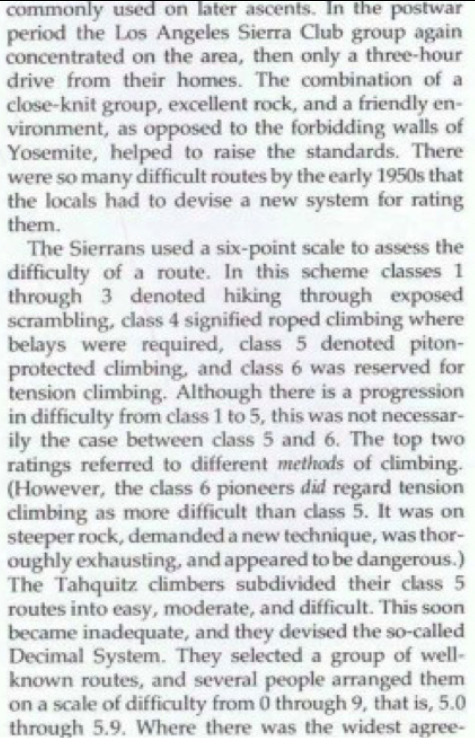 |
|
|
The account mentions but doesn't fully emphasize that the Sierra Club system (before its decimalization) defined the classes by the gear used rather than by any intrinsic evaluation of difficulty. This reflected a naive perception of climbers having a relatively uniform level of ability and a uniform tolerance for risk, so that the gear they chose for safety predicted or determined the difficulty of the ground they were climbing. What is nowadays generally thought of as genuine rock climbing difficulties were all c9ncentrated in Sierra Class 5, which produced 5.0, 5.1, ... 5.9, and so led to the utterly superfluous 5 in the current grading system. |
|
|
That’s a great history piece, thanks for posting that. If you break down the current population of people that call themselves climbers into groups, and apply basic level definitions of beginner, novice, intermediate, expert, pro, with roughly equal numbers in each group, I’m guessing intermediate would be in the 5.9/5.10 range, including 10b/c, and that would call for competence to lead sport and gear protected climbing of all types at that grade. If anything it seems it would be a lower level. If Silence is 33, in the Aussie system, and your only concern is the ratings, intermediate would be in the 12b/13d range. So everybody’s right! |
|
|
Kevin Worrallwrote: I think Silence is a lot more than 33 in Aussie system- more like 38/39. Grade ranges are different so hard to know- would have to ask Ondra, but 34 is the current hardest and that is only mid 5.14. But I climb 10 grades less so what do I know. |
|
|
I didn’t bother to do the math, I’m sure you’re right - it doesn’t change my point that there are different ways of determining where intermediate lies |


