
 Continue with onX Maps
 Sign in with Facebook






Why didn't the YDS remain decimal?


|
Ewebank system FTW! Fuck letters and +/- |
|
|
cubist Awrote: I blame Dewey. |
|
|
To OP. read up on the clases 1-5. |
|
|
Greg Rwrote: I’m my mind we would be more like Canada which maybe a Canadian can chime in according to this their Lumber is just converted.
Yeah but if your retrofitting a house made with 16’’ on center and now everything has to be converted back for 90% of homes that would be inconvenient.
What’s the benefit to the average joe who doesn’t go on climbing vacation to Italy but goes to at mt Rushmore on vacation.
I guess, if it were up to a vote I would vote for metric but my reply was mostly directed at the comment implying Americans are dumb because they use imperial. To the original discussion I don’t care if we use yds or euro but if we change we should aim for the best system not just better. |
|
|
Actually, there were very few 5.11 routes when Bridwell publicly suggested the abcd sub grades in his 1974 Brave New World article in Climbing Magazine. He had already popularized it within the Camp 4 crew. In 1972, there were New Dimensions, The Nabisco Wall, and arguably the first pitch of The Slack, freed first by Pat Ament that had earned the 5.11 rating. Valhalla at Suicide, the entrance exam for the Stonemasters was one of the only 11’s outside of The Valley in California at that time. That was it, a few more were put up, and no 5.12’s of course, before Hot Line was freed in 1975. As an example of the dynamic at the time, I did the FFA of The Bircheff Williams in 1973, and was hesitant to rate it 5.11, today it’s considered 11+ by most climbers. The very reason the letter grades were initiated was because climbers had been even more reluctant to break into 5.11 grade than they had been to break the original decimal system from its highest free rating of 5.9 into 5.10. So 5.10 evolved to span a broad range of difficulty from the easiest to the hardest routes of the rating as a result. |
|
|
Joffy J wrote: One of the unsung impacts of the British system is the way it reduces the pressure to bolt or retro bolt. There is so much more glory in doing an E4 than an E2; I'm not sure this quite so with a 5.11b R becoming a 5.11b PG, but maybe I'm wrong? It is the best system I've come across for average grade trad as it kind of measures the climber and the totality of the climb. However, given the nomenclature, it was never going to be an export product. |
|
|
Climbing Grades are so cool. |

|
Kevin Worrallwrote: This is exactly the case. The one correction would be that Bridwell's "Brave New World" article appeared in Mountain Magazine, not Climbing It should also be noted that the YDS was originated at Tahquitz Rock (the Decimal System) in the 1950s and first appeared in the 1956 Edition of the Climber's Guide to Tahquitz Rock by Chuck Wilts. 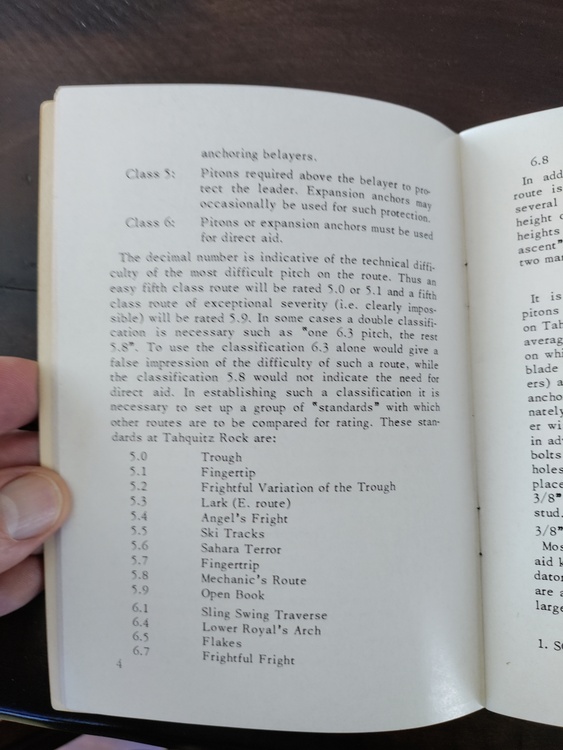 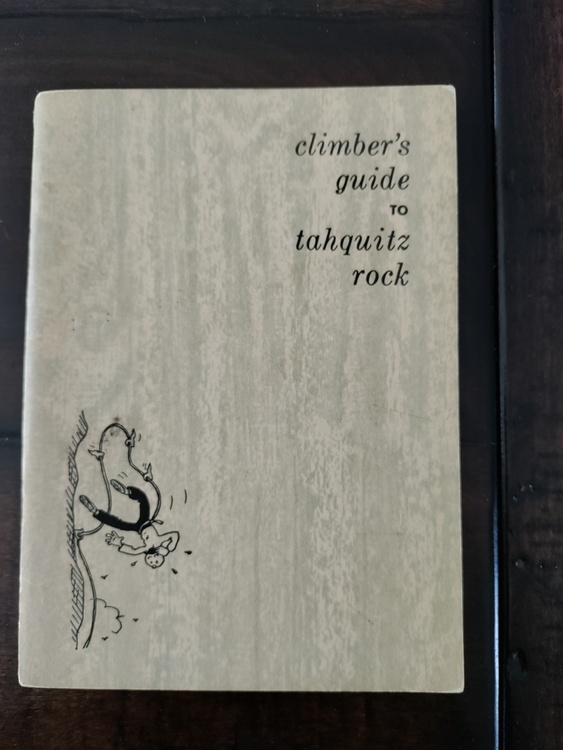 |
|
|
cubist Awrote: The main technical reason why the YDS did not remain decimal was Y2K. In the final moments of 1999 the prophecy (foretold back in 75' by the infamous Randy Leavitt) came true. It was very bleak indeed. Because of the fast thinking of he (and other climbers at the time,) the YDS was saved. I believe the letter grades were first proposed by a Canadian when he stated "It time to go, eh?" |
|
|
Randywrote: As stated by Randy. Though it should be noted that this was a 'modification' of the pre-existing Sierra Club--1-6 grading system--which categorized '5th Class' climbing as using ropes and intermediate protection (4th class being roped and belayed but supposedly with no intermediate protection being placed by the leader), while 6th Class was aid climbing. This modification was introduced because, with most of the rock climbs (in contrast to mountaineering objectives) then being done being in the 5th Class category, there was no way within the existing system to differentiate between the wide ranges in difficulty being encountered. The Sierra Club system itself was one of many 'interpretations' of the original Welzenbach 1-6 system which originated in Germany in the 1920s. The YDS is not the only or oldest grading system to use letters for sub-divisions within a grade. The system in the Dresden (Elbe Sandstone) area--one of the oldest, uses Roman Numerals (I-XI now, I think), with a, b, c sub-grades, at least from VI and up. |
|
|
Forgot all about Mountain Magazine - you’re right I stand corrected As to Class 6 - I didn’t pay much attention to the evolution of aid ratings because I wasn’t that interested in aid climbing. It seems the A system appeared first in Roper’s 1971 Yosemite Guidebook |
|
|
Andrew Ricewrote: Ah, then you want UIAA grades. :) |
|
|
cubist Awrote: Well, first of all, because the same system with class 5 subdivided into ten categories had direct aid climbing, which was class 6, divided into ten categories. Saying the system is illogical is wrong. It continues to quantify grades in a way most users understand. The use of numerical notation that no longer corresponds to the way numbers are notated is of course wrong, although really a very minor complaint. The obvious cure is to drop the 5, which in any case is based on an old Sierra Club system that was equipment rather than skill based and so never made sense from the very beginning. We're still using the terms "third class" and "fourth class" from that system. |
|
|
Interesting history. the NCCS system was used as late as 1987 in Volume II of the Teton guide book, which of course was written by Ortenburger. But by the third edition in the 90s even he had given up and used the YDS. |
|
|
To those praising the British tech and adjective grading, it's terrible, honestly it just leaves you guessing it tries to tell you a lot about the route but you have to actually be able to see the route or be told about it, and even then the actual E grade has so many parts to it it's kinda dumb. Having PG, R and X rated makes far more sense. The whole tech grading system is also ridiculous the difference between 5a and 5c for example is insane. |
|
|
Why didn't YDS remain decimal? "Ours not to reason why, ours but to do or fly." Alfred Lord Fivetennyson |
|
|
Alan Rubinwrote: Thanks Al! Good to know the history. |
|
|
that guy named sebwrote: I'm afraid I have to completely disagree with this. I've always found that the adjective grade - Severe, Hard Severe, Very Severe, Hard Very Severe, Extremely Severe [the latter subsequently split up into E1, E2, E3, E4 ........E11] gives a pretty reasonable assessment of ones chances of leading a particular route; and as such it can stand alone, without further information. The technical grade - 4a, 4b, 4c, 5a, 5b, 5c, 6a, 6b etc, but not to be confused with similar-digit French grades - was a mid/late-1960s add-on which provided a bit more information and possibly, but not always, identified the crux pitch; on a long E2, for instance, the poorly-protected 5b pitch might actually be a harder lead than the safe 5c one - but if you were an E2 leader you knew you had a pretty good chance of coping with either. And you also knew that while you might be able to lead a 5c pitch on an E2, you were probably going to have to up your game to lead a 5c pitch on an E3 - certainly if it happened to be the crux pitch; and that this would very likely be a harder lead than a 6a pitch on an E2. Whereas I would struggle to choose between a 5.11aX and a 5.11cR as to which was actually the harder lead - the slightly easier terminal one, or the slightly harder merely serious one. |
|
|
Pretty much all of the rating systems blow. Australia had the best idea IMPO-Just keep counting up as things get harder. Side note for and imporvement that will never happen... A better use of +/- would also be to use "+" for sustained for the grade and "-" for one-move wonders. |
|
|
Andrew Ricewrote: 01001001 00100000 01100011 01100001 01101110 00100000 01100011 01101100 01101001 01101101 01100010 00100000 01101001 01110100  OR: 01001001 00100000 01100011 01100001 01101110 00100111 01110100 00100000 01100011 01101100 01101001 01101101 01100010 00100000 01101001 01110100 00101110     |


