
 Continue with onX Maps
 Sign in with Facebook






Lead Belaying With a Super 8??


|
I’m climbing at a crag yesterday when a late-middle aged man walks up to a route near by with his family. His, what seemed to be daughter, ties in on the sharp end and leads the route which is an area classic 5.8. There were many unsafe things I witnessed but what I’d like to specifically address in this post is his belay device: the Super 8. I realize the 8 was commonly used as a belay device back in the day and assume mainly used as a rappel device today, but it seems strange to me that it is still used for belaying and lead belaying at that. I’ve never used it but I assume it having similar safety levels to that of an ATC. Maybe I’m wrong? I always use an ABD in any climbing scenario so if my partner whipped out a super 8 I would have some issues. I had an extra GriGri but I didn’t want him to get all crusty with me by telling me about all his climbs back in the day long before the GriGri came out. There were many other pretty sketchy things their party was doing that I didn’t mention too, so I’m not entirely sure he was experienced after all. Main questions: 1. Is the super 8 as safe as the ATC in a single pitch setting? 2. Should I have offered him to use my extra GriGri? 3. Would you accept a super 8 lead belay from your partner? Edit: This is the second time I have seen this in the area. The other time was by a party that looked and climb like novices. |

|
Did anyone die? |
|
|
It's called a figure 8. |
|
|
Figure-eights for belaying were more popular in Europe than here, I think, and that didn't last long. They have inferior friction compared to (a modern) ATC, especially nowadays with thinner ropes and slippery coatings. If his daughter was wearing gloves she might have been able to catch short falls, and of course, if there is enough friction in the system, any device will work, but to answer questions 1 and 3 directly no, an eight is not as safe as an ATC and he shouldn't be putting the responsibility to save his ass on his daughter, who will blame herself when she fails because of an improper choice of device. This pronouncement, like almost everything in climbing, does need some qualification. There are ways of rigging an eight that increase friction that might have been in use by the party. Unfortunately, most of those techniques decrease handling, especially the ability to pump out slack quickly. Edit 2: Check out Jim Titt's post below, which indicates I'm wrong about the eight's friction properties, Whether to intervene in such situations is a complex and controversial topic that has and will probably continue to occupy many pages. Personally, I think each situation is unique and has to be judged on the spot. Calling a leader out in front of their family or significant other is probably going to provoke sullen or angry pushback. If there is a chance to get them aside and say something quietly, they might at least consider the advice. But you can't just hand a Grigri to a belayer who might never have used one, so that option seems to me to be out. |
|
|
rgoldwrote: I will pay 5$ for someone to get this tattooed on themselves |
|
|
I see eights still used occasionally in ifsc comps. |
|
|
No, definitely not, and it depends. |
|
|
Wes Farrarwrote: For a super soft catch. |
|
|
It sounds like in the OP the daughter was leading? In some ways this makes the situation likely better since I assume late-middle aged man was significantly heavier than her (although I could be wrong). In any event, I would not interfere based on them using a figure 8 alone. Arguably it is safer than using a munter, which has "safely" caught lead falls before. Edit: Here is a thread of some people's experience lead belaying/getting caught by figure-8s, mountainproject.com/forum/t… If I saw someone using a munter, I would probably proactively offer a belay device though since I would assume they simply lost their belay device. :P |
|
|
The Trango Belay 8 is different from other figure-8s because it has a constriction that pinches the brake strand when the brake hand pulls down on that strand. Although this device doesn’t provide an auto-assist, it does easily stop a leader fall. Feeding slack to the leader is amazingly easy. No, this device is no longer available. And yes, gym insurance policies won’t officially allow me use it. |
|
|
Belaying thru the small end like an ATC works fine with fat ropes. Caught falls that way many times before ATC's came along. A step up from the hip belay or a link of chain. Some now come with the smaller hole rotated to a position to work with the belay loop on modern harness. 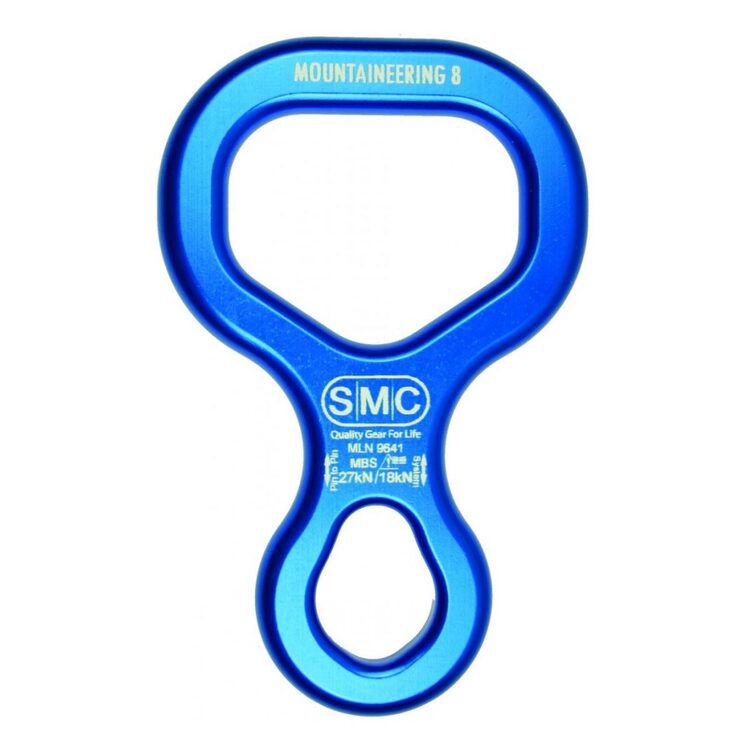 |
|
|
Ben Horowitzwrote: Where is your data that supports this assertion? If you are going to make safety proclamations, be really careful that they are true. All of the test data I am aware is shows that the Munter hitch has more friction than an ATC, which in turn has more friction than an 8. Multiple reports support this, see: Titt, Belay Device Theory, 2009 Fuss and Niegl, Understanding the mechanics of dynamic rope brakes, 2010 |
|
|
Yup. No way a figure-8 is safer than a Munter. |
|
|
rgoldwrote: Actually they have quite good friction, certainly on a level with an ATC and with really thin ropes they are better than nearly everything else. In Bill Strongs tests even beat the Smart using a 9.7mm rope. |
|
|
Kyle Tarrywrote: I am not making a safety proclamation, just saying there is an argument that it is safer than a munter (hence "arguably"). For example, when I searched "munter" on Accidents in North American Mountaineering here was the first accident to pop up: publications.americanalpine…, where a munter seemed to open the gate of a carabiner and pop out; this failure mode is much less likely with a figure 8. The next accident in the list is this one: publications.americanalpine…, where it seems like the leader was pulling up rope too hard and the belayer was unable to feed out slack efficiently (perhaps related to the fact that the munter hitch has more friction than a figure-8!) Safety is not merely a measure of the resistance the device provides, if it were the belayers should just have a series of backup knots tied to our harness we undo periodically as the leader climbs. Obviously one can make an argument for or against any device or system and pretty much all systems will be "safe" if used correctly. Personally I fall into the camp of whatever the person I'm climbing with is most comfortable with. In situations where I expect to fall a lot, like projecting some sport route, I might be more biased towards an ABD-type device. |
|
|
Jim Tittwrote: Well then I stand corrected. I can't at this point put my hand on what I recall as multiple tests suggesting the eight's inadequacy. |
|
|
Black Diamond calls theirs the "Super Eight" Screen shot of their instructions. Note belaying is different config than rappel. 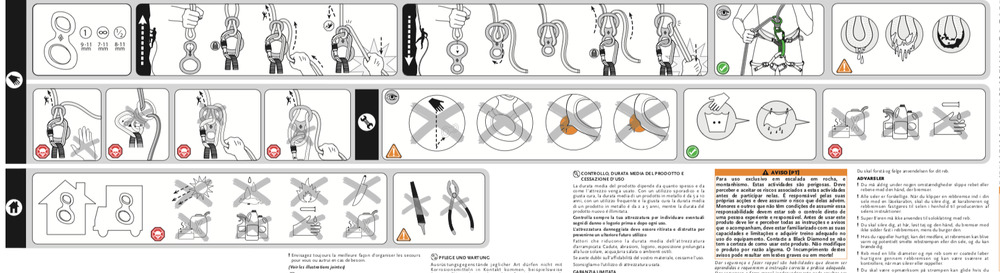 |
|
|
OP, living in Rexburg, you'll see more of these (and other things) than you might elsewhere. Eastern and southern Idaho has a strong scouting tradition, and often, also big families, so that's the super simple answer. This simple, inexpensive device was a go to for scouts, and by extension, the families too. There's often an abundance of these at my used gear store in Boise, so maybe they are going slowly extinct? Dunno if this is still what scout type programs use, or not. No idea, now, but I've also seen these out there, in family situations. At any rate, the device or method doesn't automatically mean someone is incompetent. And, handing someone a grigri isn't a good way to go either. That grigri complacency has been fatal when people had no idea what they were doing, and a grigri thrust in their hands cuz it's "foolproof". Lulls people into stoopyd, imo. When you see something that gives you pause? Ask politely! Often, you will get great information and learn something new. Don't assume it's "wrong" just because it doesn't fit what you expect. If you know it's a disaster about to happen, or already in progress? That's a whole other thread, when and how to intervene. Best, Helen |
|
|
Ben Horowitzwrote: Per the accident report, it was while rappelling, not belaying. They also say that the Munter may not have been used with a locking carabiner. Per the article "More likely is that he depended on a non-locking carabiner for the Munter." It seems unfair to point to a rappelling incident where a climber switched ropes mid-rappel and may not have used a locker, as evidence that a munter is less safe than a figure-8 for belaying.
A poor belay is hardly cause to blame the device. A Grigri can lock completely solid if you feed rope through it incorrectly, but it would be a stretch to suggest that a Grigri is a less safe tool for lead belaying than a figure-8 because of this. |
|
|
Kyle Tarrywrote: In case it wasn't clear in my other posts, I'm not claiming definitely that one device or technique is better or worse. Simply saying that one can make an argument that one device is better or worse in various instances. I don't think there is a clear obvious reason why a Grigri is "safer" than a figure 8, or that a munter is safer than an ATC, etc. Every method has a way you can screw it up, pretty much all methods are safe if used correctly. In these instances people screwed up using a munter correctly in a way that would be less likely to fail if they were using a figure 8. I'm sure there are plenty of cases of people screwing up using a Figure 8 in a way they wouldn't with a munter. No method is best in 100% of cases and there are always tradeoffs that affect various aspects of "safety"... Maybe it was unclear, but my point about offering someone using a munter a belay device is not because I think the munter is "unsafe" but because it is relatively uncommon to use so I would assume they are using that method out of necessity, not choice. Obviously I could be wrong and they would prefer the munter over the belay device for whatever reason, in which case I would drop the issue there. EDIT: Also, per your original claim that the most relevant statistic for safety is friction of the device, it seems like Titt has already chimed in himself saying that the figure of 8 has the most friction of any device with smaller diameter ropes. So yet again, another reason why one could argue that the figure of 8 is the "safest" belay device. I would not myself make that argument however as, to stress again, overall safety of the device is a combination of many factors and there is no "safest" device for all situations. |
|
|
1. Yes 2. No 3. Yes |


