
 Continue with onX Maps
 Sign in with Facebook






How do the classic "buttcracks" form in granite?


|
I can't imagine they fracture that way given how homogenous granite is. Do they form as a a weathering product? ie. splitter crack gets formed/exposed -> weathering more easily erodes at the square edges -> slowly forms the flared butt crack feature? Or is it some other process entirely? |
|
|
Troll plumbers, caught out in the sunlight and turned to stone. |
|
|
Stresses (compression, shearing, temperature, etc.) on the granite after it’s cooled produces joints/fractures along weaker planes of the formation. Then weathering, freeze/thaw, expansion, etc. erodes the joints, makes them wider/smoother, depending on the mineral composition and process, etc etc etc. so your thoughts are pretty correct. |
|
|
Yeah, I think you're right about it being a weathering thing. The fact that the granite areas most prone to 'buttcracks' are areas with older rock that has been exposed the longest such as JTree, Voo, SPlatte, etc seems to support this. Coastal or alpine areas where the granite has been glaciated or exposed relatively recently (geologically speaking) usually don't have the same kind of features. |
|
|
OK, a laypersons explanation, down below the links. Check out If you consider a sharp-edged crack, chemical weathering can attack that edge on two sides of each side of the crack. Because of this the edge wears faster than the inside walls of the crack where only one plane is exposed for chemical weathering. And if that crack splits the a boulder from bottom to top, and that boulder is buried in sediment, chemical weathering also attacks from the top and the bottom. So at those junctions, chemical weathering attacks from 3 planes; the two planes forming the edge and the 3rd plane representing the top or the bottom. Thus, those areas, attacked from 3 sides, weather the fastest of all. The result is rounded edges on boulder cracks, that flair sometimes dramatically at the top and bottom of the crack, producing our plumber troll caught out in the sunlight. Most of this happens subsurface, like for example a boulder transported down in an alluvial fan, mostly buried, where water can do its chemical erosional work, and then subsequently exposed for our bouldering pleasure. ps. Forgot to add the piece of how chemical weathering attacks granite, specifically. Consider this bit, lifted from the internet:
One grain at a time. So for a flat faced piece of granite, there is one plane available, for the edge of a crack, two planes, and thus the feldspar crystals near the sharp edge go faster, etc. |
|
|
Cherokee Nunes wrote: Ok rad, pretty much what I was thinking. Interesting that most of it happens underground. What spurred the thought are those images of the salathe headwall and the pitch to the left of the enduro corner, which I guess have just been exposed for a good while https://climbingzine.com/wp-content/uploads/2018/01/Pete-Whittaker-Freerider-Solo-El-Capitan.png THAT thing has some eroded edges |
|
|
A nice butt in the Baja sun 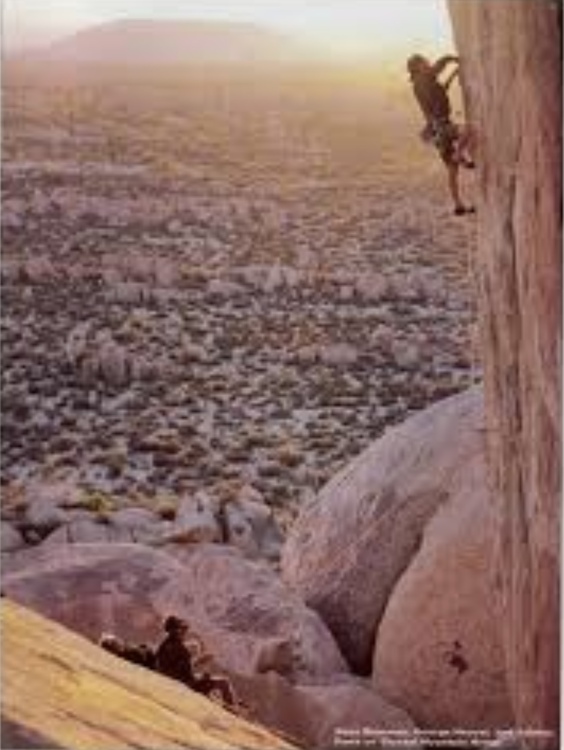 |
|
|
Kevin Worrall wrote: Is that Catavina? |
|
|
Yes, the photo is from a story I wrote for Climbing. I had at least 10 different photos of that ultra obscure pitch published, one in Climbing’s calendar, several in European mags. It is a great, sustained pitch on the best rock Cataviña has to offer. That is The Crystal Mountain Arete, 12a, George Hoover climbing. An impressive number of guys I show the photo to, unprompted, comment on the butt formation before anything else. |
|
|
Lousy image I pulled off the web, 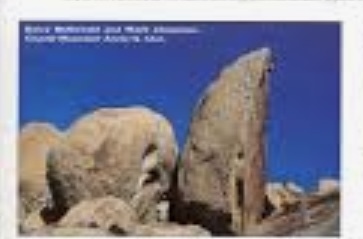 |
|
|
Kevin Worrall wrote: Kevin, would you have a link to that article, I've driven through that section of the baja dozens of times and always wondered about the climbing there. |
|
|
"Climbing" magazine August-September 1995 iirc, the article was titled "Cataviña, La Mysteriosa" https://www.amazon.com/Climbing-Magazine-August-1-September-1995/dp/B073PNLPZJ |
|
|
We did 40 or 50 pitches in the boulder field, made around 10 miles of new road. The climbs tend to be in clusters, basically all bolted. I have seen a few additions by unknown climbers. It’s an awesome place to camp and wander in the spring, and the climbing is good too. Lots of Indian sites. |
|
|
Hey Kevin Worrall .... I'm working on a project identifying photos from the 1976 film 'The Edge". Word has it that you might have been involved with that film. If that is so, would love to get in contact with you. |
|
|
Yo Terri i did work on a film with Tom Frost and Bob Carmichael around that time, but it was on The Diamond. I met Kevin Donald up there, and spent some time climbing in Eldo with him afterwards. Don’t recall what the movie included, could have been the production you’re speaking of. Kevin Donald is/was an Eldo local, he still has a house in the canyon, but lives in Oregon. He was just there a couple weeks ago. I can ask him. |
|
|
Idk about buttcracks but in areas w/ lots of prospectors sometimes you can find buttholes in granite. 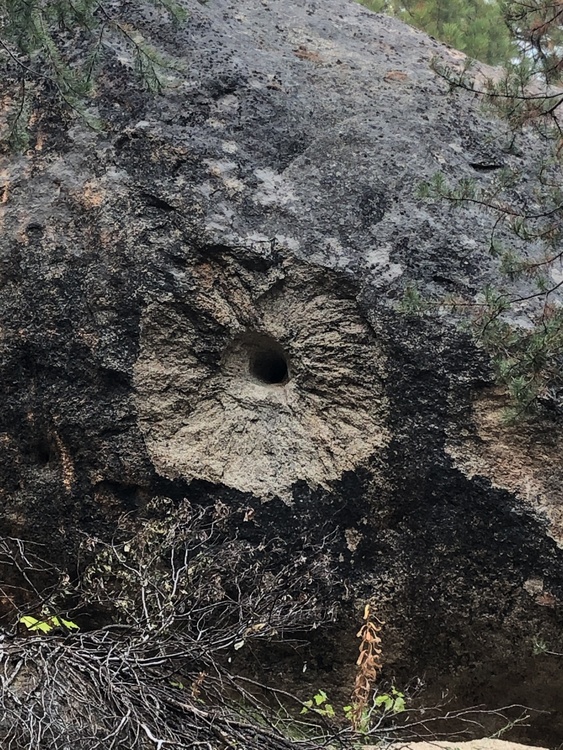 |


