
 Continue with onX Maps
 Sign in with Facebook






Best Practice: Extended Rappel vs Belay Loop Rappel?


|
|
Now I'm really confused. Does one need a fourth hand for the knife? |


|
Derek DeBruin wrote: I feel like we've maybe debated this on MP before? But don't really remember. I personally don't really ever have a problem with twists occurring below my rappel device. I pay attention to how the rope is feeding through the device and then correct the brake strand positioning to stop twist from occurring (a couple other factors also contribute, like style of device and biner used). As far as I can tell, rappelling technique is more likely the cause of twists than having the ends of the rope fixed. I can't tell you how many times I've rapped fixed ropes and get to the lower anchor and there are no twists. Then my partner comes down and the rope is twisted up in some crazy mess! I often have fixed ropes up for months at a time that get rapped by lots of other people and it sorta becomes obvious it is technique causing the problem. |
|
|
Here are the pros and cons as I see them. 1. Friction. Extending the device allows for extra friction because of the rope angle of the brake strands. If you are rapping with fat fuzzy ropes, this wouldn't be a consideration. A situation that sometimes occurs is that the rappeler discovers, too late, that they don't have adequate friction for their rappel. Various body wraps are possible but can be painful and even excruciating. With an extended rappel, it is easy to add significant friction to the system, without body wraps, even if free-hanging. 2. Function. The main reason for rap extensions is to increase the reliability of the third hand prusick/autoblock. There are three potential gotchas if the autoblock is on a leg loop and the device is on the harness belay loop. (1) If the leg loop has a buckle, the autoblock has to be positioned so that it can't pull open the buckle. See for example blog.alpineinstitute.com/20…. (2) If the autoblock sling is too long, the autoblock can collide with the rap device and then will not work. (3) Even if the autoblock sling seems to be correctly proportioned, it is still going to collide with the rap device if the rappeller's body position isn't the usual vertical orientation, So the backup won't work if the rappelled somehow gets into a horizontal position (leg slipped or reaching in for something on an overhang), or for some reason inverts. None of these are issues with an extended rappel. 3. Interactions. A comment in this thread notwithstanding, an extended rappel is far more likely to grab hair, unless the extension is above the head, which seems too far in terms of handling. When I extend, the device is typically at head level and hair is a real problem. Make sure it is all tucked away (and know what to do if it gets caught). Another problem is the extended device can get hot and burn your cheek or a bare shoulder. (Sad personal experience.) Of course, if your hair is long enough, you can get it caught in a belay loop device too. Both extended and non-extended devices can grab loose clothing, although the belay-loop devices are more likely to do this in my experience. Make sure all clothing is well tucked in the harness if using a belay loop device. 4. Going over lips. If the anchor is very low, getting started with an extended rappel can be a tribulation. The worst case is getting off a pinnacle with the anchor already over the edge on the wall below. You don't want to be taking a factor 1 fall on your extension tether. There are all kinds of tricky tricks for this, but perhaps better to switch to device on harness for such situations if that isn't your SOP. Another situation that seems to me to be more of a psychological thing than a real danger is dropping over ceiling in mid rappel. The extended device can be pinned against the wall above the ceiling and will grate down until it is freed. |
|
|
I have been rappeling with an extended rappel for about 30 Years, it is above my head but easily within my reach. The only time I have gotten my hair( just stray bits around my face not my braid) caught in my belay device has been rappeling directly off my belay loop which I do occasionally if there is a lip at the top of a rappel |
|
|
june m wrote: Fair enough; I think above the head is too high. Makes various low-anchor starts tricky, harder to keep away from the wall above ceilings, doesn't allow extender sling to do double duty as extender and tether. That's what I meant by "handling." |
|
|
Mikey Schaefer wrote: Maybe we have? If so, I'm not trying to dredge up some old stuff or be a jerk. And frankly, I agree with you and use that system in the case that rope isn't a twisted mess. I concur about fixed lines insofar as the rope wasn't already twisted in some way. I find that rappelling with a tube tends to push any existing twists to the end. Often I'm simply rappelling on a twisty rope because it's not my rope. In that case, I find clipping both ends can be problematic. I'm probably just getting curmudgeonly as I age, but I'm getting to the point where I just bring the rope, even if my partner offers, to avoid these sorts of things. If there's anyone else interested, here's the techniques I use to help keep the rope straight. With a GriGri, I feed the rope straight out of my GriGri instead of over the braking lip on the right side (which seems to induce curling). With a tube, I keep the left strand as the left strand and the right strand as the right strand when loading the device. I keep my hand below the device instead of off to the side in most cases. I'm also intentional with tying the autoblock such that it doesn't induce twists. Mikey: you have any other specific techniques you use? Happy to learn new tricks, and maybe this one thread will prevent all twisty fixed lines forever! |
|
|
Old lady H wrote: How would extending NOT put the rap device closer to your head? Why on earth would you want yor device that high. I definitely hope you dont get your hair jammedbin you rap, you wont be able to reach above it and throw a prussik on. Slow, painful death... |
|
|
slim wrote: Damn slim, just give it a try already. |
|
|
slim wrote: Right? Makes sense. I dunno, my wife has only got her hair stuck a few times, and they were all with the device at the waist. Never extended. Fortunately she managed to avoid death from having her head slowly pulled through the belay device like an 80s horror film. I don't have an opinion about which device position is more hair dangerous myself. All my hair seems to be escaping from my head and migrating toward my butt crack. |
|
|
James Jen wrote: Lolz, can somebody draw a diagram showing just how extending the device gets it farther away from your hair? Yeah, i didn't think so... |
|
|
JonasMR wrote: Your wife sounds like a mess, hopefully a hot mess though ;) Edited- wait, you're that guy from tahquitz that always has accidents happening around him. I think your wife is probably ok but you might be bad luck. |
|
|
slim wrote: Definitely.
Not that guy, nope. But not ruling out the possibility I'm still bad luck. |
|
|
slim wrote: 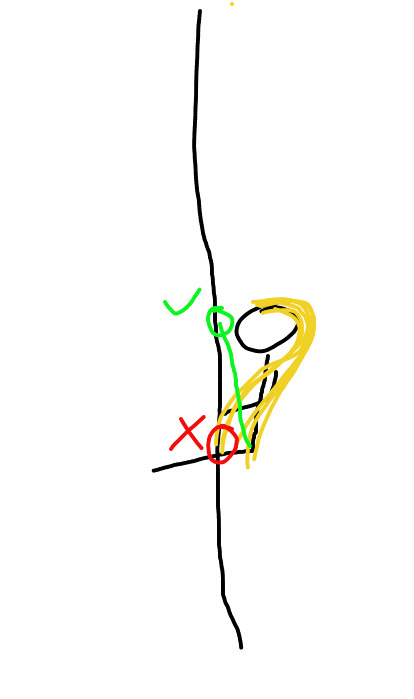 Here you go slim, it's not drawn very well but with long hair in ponytail you're worried about the end of your hair which can be somewhere around your waist. Extending the rappel moves your device away from the end of your hair and the hair on your head is unlikely to get sucked in because it's tight to your head and you should be wearing a helmet anyways. |
|
|
I can't believe this has turned into a thread of a few posters basically stating people with long hair are dumb (or rather "moronic") for extending a rappel; and have no idea how to handle their own bodies. This is absolute insanity; the fact that one of them is an admin not even following guideline #1 puts it over the top. |
|
|
Nick Orticelle wrote: Hey man, never having experienced something shouldn't hold you back from authoritatively offering opinions about it. I'mma go rate all the climbs I've never done. (Incidentally, "admin" doesn't mean here what it sounds like you think it means. Admins are free to be ignorant.) |
|
|
Serge S wrote: Perfect application of a locker draw! or better yet, chop the PAS and use one of the loops as the dog bone for a versatile locker draw that's the perfect setup for an extension |
|
|
Extending rappel setup became the flavor of the day because guides use it to pre-rig their clients. I see no other benefit. |
|
|
Idaho Bob wrote: likely because you have never encountered the situations where it's indeed useful... how many times have you had to pass a knot on rappel or tandem rap with an injured partner? both of these become much easier with an extended device... |
|
|
Rapping with a haul bag, or other heavy load, is a perfect example where extension is a clear-cut benefit. The key to all these techniques, imo, is to understand the tool and its application to your (our) use cases. Its a tool in our toolbox, much like a screwdriver. A screw driver can be used to open a can of beans, but is it the best tool for that? No. Would knowing how to open a can of beans with a screwdriver be useful knowledge in certain circumstances. I can say for me, yes. Same with various rappelling techniques. The tendency all of us may have to one degree or another is to continuously search for the one tool to rule them all. For me, extension is not such a rule them all tool. It has its place, l know how to do various forms of it and I've used it to great effect. There are lots of times, like last weekend, where I don't extend, I don't 3rd hand it, and I don't care that "I could die" if I lose control of a rap. So be it, that's my choice and my life. |
|
|
I think rgold pointed out that, at least in this particular case, the best practice may be to know both methods and know them well. Understanding systems and why you'd use one over the other will make you an all around better and more component climber (not to be confused with climbing harder.) You can then switch between the two of them depending on context or taste. Doing things "because that's the way we've always done them", without actually knowing why that method is better or not, or why it's that way to begin with, seems closed minded to me and doesn't leave room for opening one's horizons. Remember, extending or not extending is, or at least should be, context dependent. Using a PAS or Tether in the first place is often context dependent to begin with as well. Try not to fall into the trap of doing X thing all the time, especially if X thing isn't the right tool for the job at hand.* Instead, learn and understand the tools at your disposal and how, when and why to use one over the other and learn how to switch seamlessly between them; or not.  Jeet Kune Do of Climbing *to contradict myself, sometimes doing X thing all the time is in fact the best thing to do. And some people are set it and forget it kinds of people and maybe that's why they're unwilling to try something new, even if that new thing is (potentially) better (in many or some cases) and that's okay too. Because to each their own. And if you haven't figure it out yet, the answer to this particular question is just that, to each their own. |


