
 Continue with onX Maps
 Sign in with Facebook






Hooking crimps at DL


|
A generic discussion, moved from the route comments of Cheap Thrills. |
|
|
 |
|
|
what tony said |
|
|
Why? It's clean aid. |
|
|
When it comes to an established free climb, it doesn't seem clean to me. Hooking crimps can break them, even on quartzite. |
|
|
What tony means is: i'll kill the bastard,he is going to make the climb easier !!! |
|
|
I don't think sky-hooking is going to have any impact on Baraboo quartzite. Cam-hooking, however, generates enough force to smooth quartzite edges every once in a while. |
|
|
The impenetrable baraboo quartzite trope strikes again! Even at the lake, holds break. I broke a foot on this route when I was on it. I'm not the climbing police, and keeping sharpened steel objects off of free routes doesn't feel like such a hot take. |
|
|
So free climbing has done more damage to this route than aid climbing ... |
|
|
That's why I'm switching to dry tooling. Better for the rock. |
|
|
While baraboo quartzite is very 'hard' is is also brittle when force is applied in the right direction. It just seems like good sense to avoid hooking small edges on established free climbs. |
|
|
Gee Ben, that's the first time I've ever heard the claim that Baraboo quartzite is brittle - would you care to elaborate? I agree with Tony's opening statement, "this isn't a rampant issue at the lake". I can't think of a time I've stood on a skyhook at the Lake that it's left a mark, whereas I have seen skyhooks peel off small flakes of Yosemite granite. And given how few people aid at the Lake, I think free climbing has likely removed more rock than aid climbing. |
|
|
Unlike the many times that Pete offered up some sage advice to us miscreant savages, perhaps heeding his advice from years ago about “not” changing the character of certain routes with metal things is wise. He once told us that nuts leave scars in the rock and that all the holds on certain routes were “much” larger now making them easier than when he first did them. Baraboo quartzite no less. |
|
|
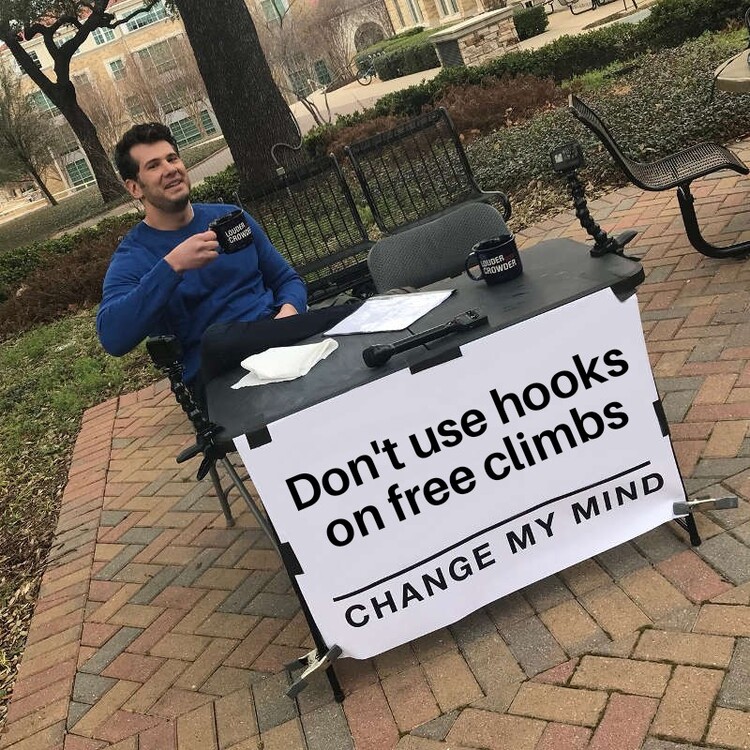
I like the photo, Tony! |

|
Doug Hemkenwrote: Rock in general is a brittle material. It is also not homogenous, and small inclusions/microfractures/grain boundaries/etc can cause fractures when a large tensile force (such as one could apply with a hook) is present. |
|
|
You've missed the point entirely Doug. I think aid climbing is totally fine and people are free to do it in the park. I don't, however, think that using hooks on established free climbs (not sure I can make this part any clearer) is climbing responsibly. There's plenty of unclimbed rock in the park where people can go hooking. They can even go do it on hard projects if they want. I'd prefer they not, but like I said I'm not the climbing police. I've got a great compromise though, I'll go drill bat hook holes on any route somebody wants to practice hooking on. |
|
|
Hmmmm....an issue perhaps but not a rampant one. I can't think of many holds that would break under a hook at DL. Aid is aid. |
|
|
Has this route been damaged by hooking? |
|
|
Irrelevant. This is a "generic discussion". Has any route been damaged by hooking? Yes. Has any route been damaged by free climbing? Also yes. My point is that it happens at a much higher rate while hooking. |
|
|
Which climb has been damaged by hooking? |
|
|
It's a shame that this isn't a discussion of how everyone should do their best to leave the rock intact. I'd be 100% with you on that. Instead it's about excluding one form of climbing in order to privilege another, based on a speculative concern about it's impact. Precisely the sort of logic-without-evidence that got climbing banned from SNA's. I think you need to go back to Nick's question: "Which climb has been damaged by hooking?"
You've got a long way to go to convince me that scolding and brow-beating aid climbers is justified. |


