
 Continue with onX Maps
 Sign in with Facebook






Equalizing 2 pieces on lead



|
Dan, your system is not doing what you think it’s doing. The top piece essentially equalizes till there is no load on the bottom piece —until the top fails! Just clip, clip, girth. Clip into both pieces normally with a sling, pull tight in direction of fall, pull girth thru biner and clip rope. No advantage and several limitations to your system as shown |
|
|
I think RG (edit: and MP) have something like this in mind, which also eliminates the extension issue: 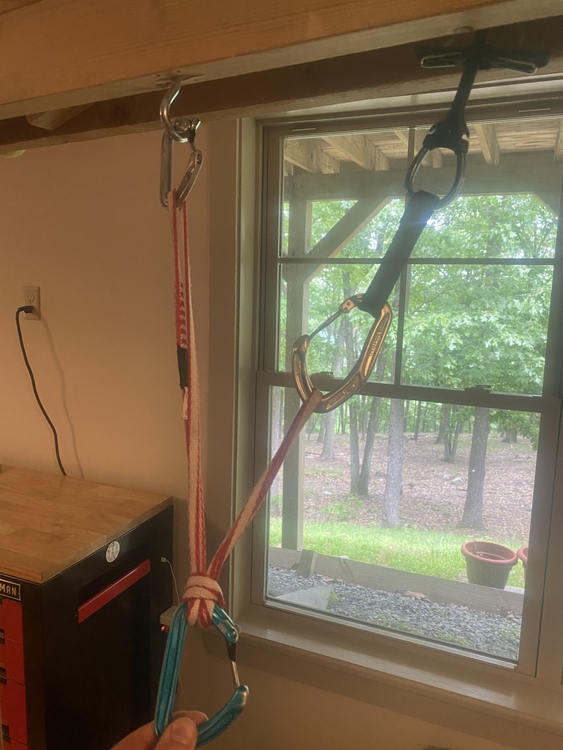 |
|
|
Andy Wiesnerwrote: Exactly |
|
|
Pretty useful info on the old "AAC Article on Anchors" thread. Especially related to "equalizing". |
|
|
It is just another tool for your kit. Sometimes a 2ft runner won't work in Andy's photo, but this will. |
|
|
Dan Greenwaldwrote: If you're going to argue significant load-sharing, you'd need info from load cells on the pieces. In the absence of that, I'm sticking with the physics, which says no load-sharing. In fact, I'm not so sure about my remark about friction over the top carabiner enabling some load-sharing, so that may not operate in the rigging's favor. In the absence of friction, your system imposes an equal but opposite load on the lower piece with the result of no net load at all. Moreover, if the positioning of the bottom girth hitch is a little off, all the load will go to the bottom piece, so even another bit of adjustment to get right one-handed under stress. So the choice is between a method that theoretically equalizes, and we have to live with the deviations, or a method that theoretically loads only one piece, and we have to hope for the deviations. That's a very different perspective than just saying no methods equalize in reality. Meanwhile, there's a simpler to rig and overall better method available, as in Andy's picture above, whose only downside is that it consumes more sling length. In such cases---and probably in all cases---rather than attempting equalization rigging, it's a lot easier to use slings/draws to get the two rope-end carabiners at roughly the same level and then just clip them sequentially. (As a half-rope user, I usually clip one strand to each piece, which gives a measure of equalization if the pieces are nearby without any anchor extension if one piece fails.) |
|
|
Topher Donahue's Advanced Rock Climbing has a cool trick on p. 95 for adjusting sling length w/ a slip knot for just this purpose. 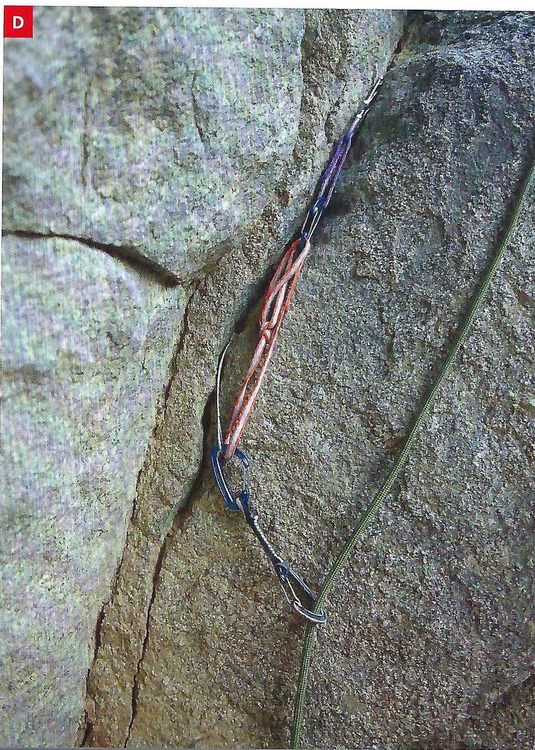 |
|
|
I would aim for a sliding-V as the load-distributing element, with additional slings in case a piece pops: 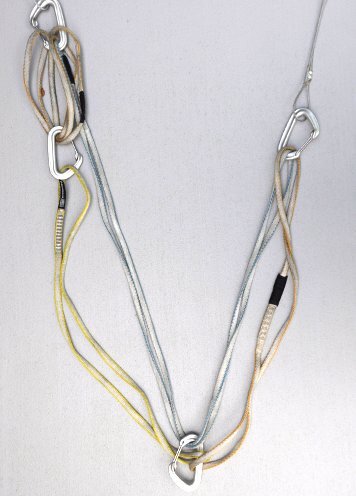 |
|
|
Serge Swrote: Yeah, but I'm not so sure about the "on lead" bit. |
|
|
Serge Swrote: You may aim for a sliding-V, but you missed it that time. |
|
|
Follow up to my post last week: This technique is just an option and not the only or best solution, but it does have its place. Most people climbing hard thin routes are not using half rope techniques (except exceptions like Gritstone) or are dealing with 4ft slings with one hand while on lead. If you set this up and attach a weight to the bottom girth hitched carabiner and hold one carabiner in each hand, then you can easily “feel” and “test” it. Attached is a photo for those who want empirical data. (Approximate 26llbs load with 13lbs load on each “piece”.) 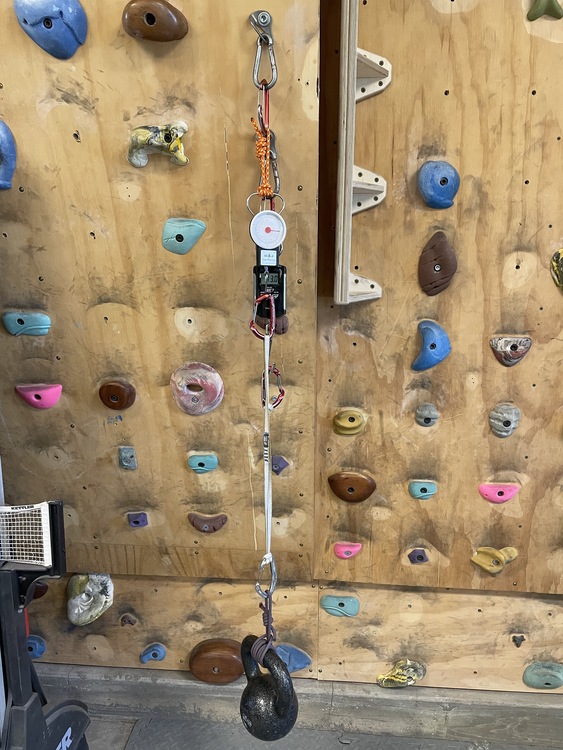 |
|
|
Dan Greenwaldwrote: Although that is a nice image showing good equalization, it hardly represents a real world application. That demonstrates what you would see in the real world after a leader fall has been arrested and is dangling straight down. If you were to lift that weight and move it a half inch in any direction and then drop it, the results would be all over the place. The initial loading of a piece from leader fall is rarely straight down. The fall would have to be so precise, not to mention the rope coming from the previous piece would have to be dead vertical as well to give the resultant vector straight down. Additionally, that rig adds as much as 2 feet of extension to the top piece which results in 4 feet of additional freefall. That represents a lot more kinetic energy needed to be arrested by the gear in the first place. |
|
|
Greg Dwrote: The point of the set-up, and the reason that the girth hitch at the bottom is critical, is that the system doesn't extend if the top piece fails. The load distribution shown in the picture can only happen if the friction in the top carabiner prevents any significant pulley effect---i.e. friction binds the sling at the top carabiner---and the girth-hitched carabiner at the bottom is perfectly situated. In this case, we essentially just have two independent arms, one to each anchor point, which is what you get with the simpler and stronger method posted by Andy. If the bottom girth hitch isn't just right (remember this is a one-handed operation in the field), then only one piece will be loaded, either the lower piece if the girth hitch is too close to the lower piece or the upper piece if the girth hitch is too close to it. (In the latter case, the lower carabiner will be lifted, unloading the lower piece.) In either case, a small amount of slip in the girth hitch might be enough to even things out, but maybe not... This issue is not unique to this method and is also an issue with the simpler two fixed arms approach, so it can't be counted as a drawback vis-a-vis other approaches, just something to be aware of. As I said earlier, in the absence of friction at the top carabiner, the lower piece won't be loaded even if the bottom girth hitch is perfectly situated. This is very simple mechanics; the load from the top carabiner is equal and opposite to the load from the weight on the lower carabiner, assuming the rigging splits the load from the weight 50:50, as is reasonable. In the case of climbing ropes over a carabiner, friction typically removes about 1/3 of the load; I've never heard any numbers for slings. If 1/3 is also right for slings, the top carabiner ends up with 83% of the load and the lower carabiner gets 17%. The higher the friction loss over the top carabiner, the closer the system gets to two independent arms and the more nearly equal distribution associated with that configuration. If the carabiner efficiency is only 10% rather than the 67% figure for ropes, then the lower carabiner gets 45% of the load rather than 50%, for example. Since it appears that binding at the top carabiner is giving the observed results, it might be interesting to try to activate sliding rather than static friction. Perhaps lifting the weight and dropping it little would produce different results? |
|
|
Franck Veewrote: I was actually thinking this is easier to do with 1 hand than anything involving knots. |
|
|
Placed two little dmm peenuts next to each other in the vertical seam under the roof on p2 of Airy Aria on Saturday and thought of all of you. Clipped 'em both to the same sling, breathed a sigh of relief, and moved on! |
|
|
j.henrywrote: Something I've been thinking about recently, and maybe i'm over-thinking it. I'm a relatively new trad leader. I realize that it's probably very context dependent, but what are some of the ways you accomplish getting 2 pieces more or less equalized when you only have one arm available to use at a stance? Especially when the placements are in separate features? Let's say you have 2 lengths of slings - 60cm tripled as alpine draws and a couple 120cm around your shoulder with a carabiner. Hi, I note that in the title you say "on lead" and in the text "at a stance". Most people seem to have addressed the first. I'll take the second. Build the anchor with the rope as the pieces are marginal. Learn to tie cloves one handed. On the general point of equalisation, sliding X or otherwise. Just in case this hasn't been mentioned. For equalisation to be of use, the following must be true: 1. neither piece can take the force by itself. 2. BOTH pieces can take at least 50% of the force. The reason being that otherwise one fails then the other. That is a very small window. Point 2 often seems to not be mentioned in climbing text books. This assumes the force vector bisects the angle between the pieces, and that the angle is small. With a larger angle, the window shrinks. At 90deg, each piece must be able to hold 71 percent of the force, but no piece 100%. |
|
|
^ agree. The whole concept of trying to dynamically equalize pieces with sliding/adjustable features should just be tossed out of the climbing consciousness. Backing up and/or balancing loads as best as possible with fixed points (knots, girth, clove) should be the goal. Per OP topic/application, I use something more along the lines of Topher’s pic with the slip knot, to tie two small or questionable pieces together, but I just use a clove. To me it’s range of adjustability is greater and a bit easier to adjust/tie one handed (just one clove). 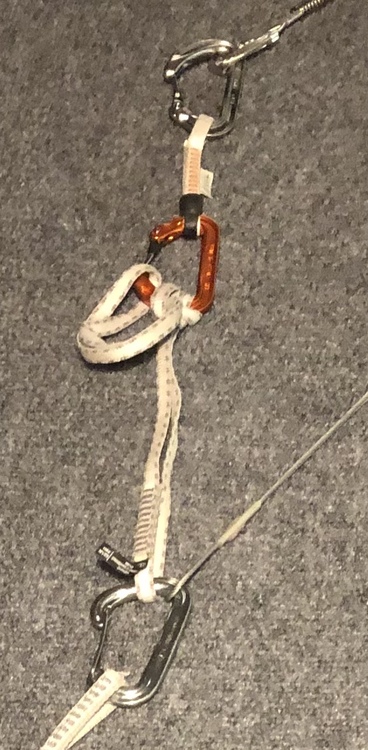 |
|
|
rgoldwrote: Yes, I get the intent of the setup. But, the rigging inherently creates extension by moving the rope attachment point perhaps 2 feet lower than would be by simply clipping the top piece normally, extending a leader fall 4 feet or more. So, the rigging guarantees extension by its mere existence. One extends the rope clip point in order to prevent extension. Hmm.
Perfectly situated is essential what I said. Perfect relative to the fall, the load direction, making load sharing very unlikely.
Which is essentially what you get by simply clipping the pieces independently, without the guaranteed extension. If the top piece holds, the fall is shorter and the load smaller. If the top piece blows, the bottom piece gets loaded, perhaps at a higher location, hence shorter fall, than with the rig.
Superimposing some vectors on the photo Andy posted from Topher would show it to be less impressive than it appears, especially when the pieces are situated at an angle, not vertically aligned.
Agreed, that was my point. |
|
|
Andy Wiesnerwrote: One thing about the this photo that is worth asking is what happens if one pulls just a few degrees off centre: the load goes almost 100% onto on single piece. I'm guessing the direction of pull (the finger) was determined after the knot was tied. In a real fall, the force is not normally straight down. The previous piece is likely to be a few degrees to the side, and the force vector will lie between this and straight down. This is rather hard to get right on lead. Hence people tend to just clip pieces independently. As a general point, this is why it is kind of wrong for people to worry too much about making the angles in anchors small: the smaller the angle the greater the likelihood that all force will be on one piece. Hence a small angle can be worse than a much larger one. This is not in the text books, or rather it is only in one text book. :) |
|
|
David Coleywrote: This is a statement. I feel it may or not be true (Unless you have some data/references that supports that statement). Also it may or not be a good thing. |


