
 Continue with onX Maps
 Sign in with Facebook






Equalizing 2 pieces on lead


|
wivanoff wrote: We know that the Sliding X doesn't do what we thought... with clutch effect and all. I thought I remember reading from Long's Climbing Anchors book that the clutch effect was sort of random? That the (vast?) majority of the time it didn't happen, but then, here and there, for no apparent reason, it does. Am I getting that right? |
|
|
Optimistic wrote: I thought I remember reading from Long's Climbing Anchors book that the clutch effect was sort of random? That the (vast?) majority of the time it didn't happen, but then, here and there, for no apparent reason, it does. Am I getting that right? Dunno. I understood "clutch effect" was just part of the problem. |
|
|
rgold wrote:I buy it in theory, but I don't think there is any practical consequence, because (1) there is no reliable equalizing mechanism and (2) the very nature of marginal pieces means we really don't have a good handle on how good they are, and if they differ greatly in holding power, then equalization could be a worse alternative. I'm supporting the use of the x in this topic. |
|
|
I've placed nuts that would probably rotate out as I climbed above them, that is, without an opposing nut providing the tension to hold it in place. |
|
|
Craig Childre wrote:I've placed nuts that would probably rotate out as I climbed above them, that is, without an opposing nut providing the tension to hold it in place. Toward the OP's question, I'd go sliding X. Like others here, I have trouble imagining a scenario that it would apply. Just to tie these two ideas together, a sliding X will NOT provide the opposition to keep a wonky nut in place. |
|
|
wivanoff wrote: "We did a lot of testing with Sterling and found that binding was a bigger factor than first suspected, especially with sliding X, where a sling is basically hitched around the biner, less so on somethng like a quad, where anchor point biners are clipped though a comparatively wide loop. " - John Long 9/23/14 This seems to go directly to my point, thanks. Interesting. |
|
|
rgold wrote: In that situation half ropes are a substantial advantage, because you can clip a questionable overhead piece and not pay a big slack penalty if it blows. In any case, it is a lot more important to work to keep potential falls short than to equalize. One of the biggest advantages of half ropes for me, is that I can place marginal gear with the idea i'm not going to impact my entire system, just one strand and my fall is going to be shorter if the piece below the marginal piece is good. |
|
|
Gunkiemike wrote: Just to tie these two ideas together, a sliding X will NOT provide the opposition to keep a wonky nut in place. I was thinking the same thing. Either clove them tight, or I've seen people just triangle of death them. Which would seem to work, in some cases though I've never done it like this myself. |

|
Craig Childre wrote:I've placed nuts that would probably rotate out as I climbed above them, that is, without an opposing nut providing the tension to hold it in place. As Mike said, a sliding X is of no use at all in this situation. Most other methods (eg clove-hitching) are hard to do one-handed and often can't be made tight enough to be effective. 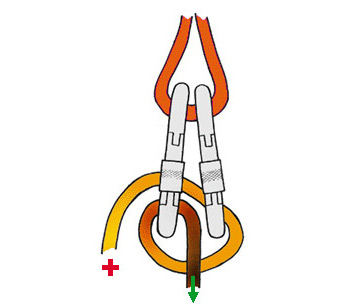 give it a good tug, and you've got a down-tensioned set-up that is going to be about as tight as it is possible to get, one-handed and very fast. (Note: the strand that, in the picture, curves under both biners has to be pushed back up on their spines in order for the the "knot" to engage and hold tension.) |
|
|
theres realistically 2 scenarios |
|
|
Another option if it eases your mind to have two pieces "equalized" with out "shock loading" on lead with only using one hand is the following method: 1. Clip the sling to the lower piece. 2. Using the one handed clove hitch method, clove hitch the lower piece and pull tight. 3. Clip the sling in to the upper piece. 4. Pull the sling down and tight. 5. Girth hitch a carabiner on the bottom the the sling. 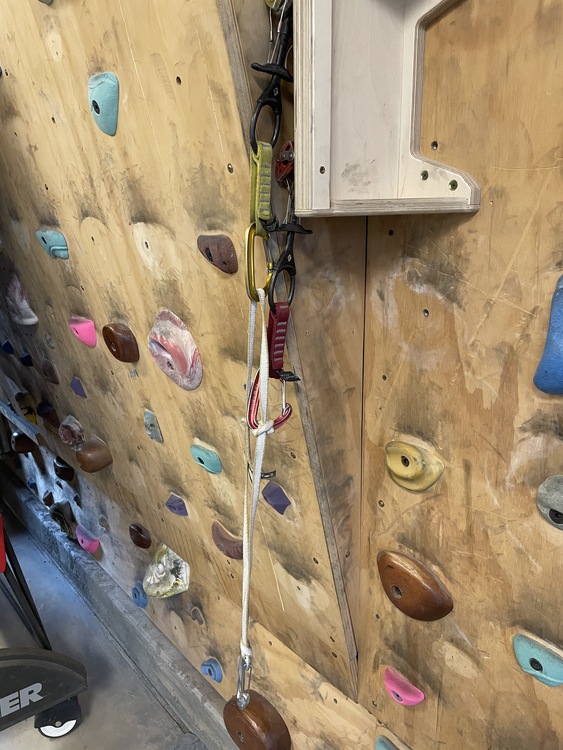 |
|
|
That’s a cool solution. |
|
|
Dan Greenwaldwrote: Well that's a nifty solution. Doesn't do much good though if you don't get it setup in the direction of fall exactly. That's the tricky part too is often a fall isn't going to load a piece exactly in one direction but more over the course of an arc. I assume the peak force will be at the bottom of that arc though. |
|
|
It would be more omnidirectional if you eliminated the bottom girth hitch wouldn’t it? |
|
|
Mark Hudonwrote: That’s the first thing I thought when I looked at it. It’s a slick set up, but I think I’d do it without the bottom girth hitch. |
|
|
One handed placement...bomber... 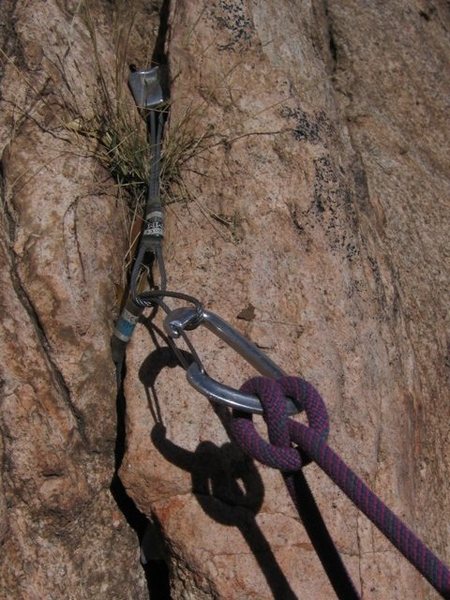 |
|
|
Dan Greenwaldwrote: I’ve done similar on small wires, but skip step 2. Why the clove? Just Clip-clip-girth (in the fall line). Any worry of a piece blowing and pulling thru the girth is needless worry, plus this two strand girth is about twice as strong as the single strand girth.
Be fun to run some statistical simulations or analysis to prove out the theory. What’s better the majority of the time — better equalization at risk of shock vs less equalization with no shock risk. |
|
|
Dan Greenwaldwrote: This prevents extension in case either piece fails, but doesn't get anywhere near equalizing, If the top carabiner was frictionless, the bottom piece wouldn't get any load unless or until the top piece failed. Friction of the sling over the top carabiner means slightly less than equal load in the strand to the lower piece, and that small differential is all the lower piece takes while the anchor is intact. So all things considered, clipping a sling to both pieces and girth-hitching a carabiner at the bottom point is a better solution. |
|
|
Mark Hudonwrote: If you eliminate the bottom girth hitch, you get anchor extension if the top piece fails, and then there's really no point in the set-up. There isn't much point in any case, as a single sling clipped to both pieces with a carabiner girth-hitched at the bottom is better in every way I can think of. More versatile, eg when pieces are not vertically aligned, much better load distribution, less faffing in set-up, stronger. The only downside vs. the girth-and-clove rigging is that a longer sling might be needed. |
|
|
rgold, I disagree with your statement that it "doesn't get anywhere near equalizing." Just like anytime you are equalizing two or more pieces, you are never going to exact equalization; However some load sharing does occur. The same is true using a "cordelette" or a "quad" at an anchor. I have been using this for decades and I can tell you from the field that this system shares the load. If the bottom piece doesn't have the clove hitch and the top piece fails, then the bottom piece will be "shock loaded". In that case, you would be better off just using two separate slings for each piece. |


