
 Continue with onX Maps
 Sign in with Facebook






Quad anchor is not redundant at the clip in point?


|
|
Shock loading and microfractures need their own Snopes page. |


|
Most of you are missing the point. The point is that a quad is stupid*. Let me elaborate. It buys you nothing, but potentially kills you if Mis-applied to the wrong anchors (see the accident where those Air Force guys were training a while back and blew their anchor) To the shock loading issue, I generally agree with you guys above, when applied to most decent anchors but the takeaway from Ryan’s video was that shock loading is NOT a myth even with the rope in the system. The remaining anchor piece saw a sudden 5-6x spike in load. Or 2-3x the regular load before extension. And he only had 1/2 the climbing team loading the anchor at the blowout, not falling climber AND belayer, so his data is merely a subset of true scenarios. Sure if you have a decent anchor like SS beefy bolts, this can be trivial in terms of ultimate loads. That’s why I said earlier it really doesn’t matter what you use on a good bolted belay. But if instead of a quad, you just tied a master point knot,(or even a girth hitch) you would not see these sudden 5x load spikes on the remaining anchor. The bigger myth is equalization, and thus the quad buys you nothing. Now, to be sure, it only matters when it matters, and most of the time it doesn’t matter, but to the majority of climbers out there, they are totally blind as to when it matters. Best to just assume it matters and choose the better tool. (Not a quad) If a quad or any extendable anchor is mis-used on trad pro, where the ultimate anchor strength of any one piece is a total mystery, why choose to use something that demands 5 times the mystery strength over one that doesn’t?? A better more thorough understanding of your myths and when they matter is key.
|
|
|
Mark Pilate wrote: Is this from the video where Ryan dropped himself repeatedly in Yosemite? I don't remember this incident with the 5x loading, would like to watch that. Edit: also I don't use quads in trad. Doesn't seem a good option to me just out of convenience when building, and I agree, I limit extension as much as possible on gear. |
|
|
Not Hobo Greg wrote: Greg, did you read the rest? I’ve said now multiple times in both posts, that if you’re using bolted belays, use whatever you want, it doesn’t really matter. |
|
|
Not Hobo Greg wrote: He clearly answered that question in his original post with his asterisk and footnote. Try reading a post before you rage against it. |
|
|
Don't remember the 5X part. Got a time on the video? |
|
|
Gunkiemike wrote: If there was no possibility of mistaking the Quad for some non-redundant anchor ... this thread wouldn't exist, now would it? ;) |
|
|
aparently you can't fix stupid... |
|
|
I think it's a good system for certain aplications. especially for ice anchors where equal loading is actually important. |
|
|
Mark Pilate wrote: Equalization is only a myth with pre-equalized anchors, and to some extent sliding x's. Quads actually load share QUITE WELL. Didn't John Long do all the testing for this like 2 decades ago and record the results in his anchor building book? It's hard to believe people are even still arguing over this stuff. Mark Pilate wrote: I think everyone would like to see where you're getting this 5x shock loading figure you keep throwing out. ***Blaming the quad for the military training mishap is absurd, you have no way of knowing if another means of equalization would have changed the outcome there, the individual who built the anchor was clearly inexperience and likely both pieces and the rock were all garbage. The first rule of anchor building is to have strong pieces, accomplish that and it generally doesn't matter how you go about equalizing them . |
|
|
I am not sure if that's the test Mark is referring to, but at any rate some reference here about shock loading. One important thing to note about this video however is that it is made with the sliding X, NOT a quad anchor. It does matter, potentially a lot, in order to interpret those results, since energy increase with the speed squared, thus if you shorten somewhat the distance your systems travels during the shock loading event, you'll decrease the energy and thus force on the remaining piece somewhat a lot. So I would not consider that those conclusions are super relevant to the quad, except to say that there's reason to be cautious about shock loading in general. Close to 5kN on a #5 stopper, say, isn't a trivial load. Even if the quad would see only say 2-3kN with the same setup, it's probably worth considering. And then you could have higher initial forces to multiply. 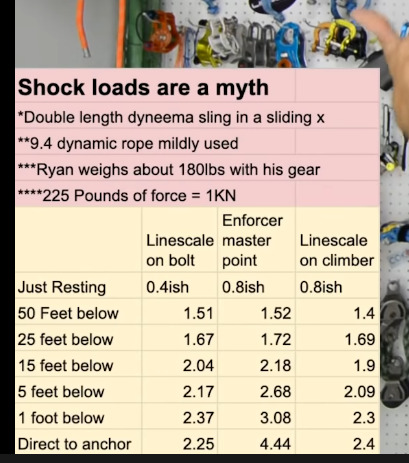 That being said I disagree that the quad is necessarily dumb on trad pieces. If you're going to equalize 2 trad pieces with a sliding X (because, say, they're OK but not great and you would really like them to share the load, or they need to work toghether for some reason), then my conclusion from Ryan's test is actually that you should instead either:
Presumably, if you're setting an anchor, you're not expecting huge range of motion in terms of direction of pull, so a fairly range-limited quad (for instance) would indeed allow you to spread the load between those 2 OK pieces while minimizing any potential shock load. IF you only have a few inches of leeway between the limiter knots, you're not going to generate much of a shock load. However you WILL decrease the chances that any of the 2 pieces will blow in the first place, since load sharing with the quad is actually decent to the best of my knowledge. The nice thing with the quad in that instance is that the loss of strength with knotted slings (esp. dyneema) is irrelevant since the # of strands makes it still plenty strong. |
|
|
pretty basic shit here. if you use a cordelete or the rope to clip into a screw anchor on multi pitch ice you get it just right so that you are weighting both screws reasonably well. then the leader takes off on the next pitch and starts dropping bombs. belay then shifts stance to better avoid icefall. the anchor is now weighted differently . one leg is completely slack and the other is carrying the entire load. murphy being the prick that he is its a guarantee that the loaded screw will be the one that hit air on the way in or the one that is getting melted out by the sun. With a pre tied quad when the belayer shifts stance everything just slides over and both screws are still shareing the load. Quad totally unnessicary for bomber bolts but great for ice screws INMOP. |
|
|
Wow, seem to have touched a nerve with some quad devotees. Stupid post limits didn’t let me respond. Too many, so let’s keep it simple and unemotional. Maybe I’ll change my own mind. “Stupid” was a poor choice that maybe just got peoples hackles up. Less Smart is better perhaps Frank’s post is the best of the thread here. He’s right about the referenced video. For you others, the 5x thing is a math thing. If one anchor is sitting there with a 0.4 kN load and it suddenly jumps to 2.37, that more than 5x jump in forces. Now to the “does it matter” question. For bolts, likely not at all. For Trad it might. Don’t misinterpret the low forces from Ryan’s video as being representative of a real situation. But then then still, why use a quad if you’re eliminating worry about a bolt or anchor breaking? Why use something that puts higher loads on a mystery piece when it counts. Shifting loads of a belayer moving around getting comfortable are trivial and not needed to be equalized for any anchor integrity. Say worst case scenario, When the shit hits the fan in a FF2 fall, the less “adjusting” or movement an anchor does, the lower the peak forces. Lots of data (Dr. Rockso you should really keep up after just reading that 20 yr old Long book, lol). I’d also ask, if the bolts are solid and no worry and “safety” considerations are trivial, then why carry a heavier, dedicated use item over lighter more versatile components? Instead of a couple of quad or triple length slings, just carry half to 1/4 the material and use double or single slings in a sliding X. You can have two independent sliding x’s at each belay for 1/2 the material of a classic quad. Or just girth a locking biner, or tie master point if you really really want a shelf. Maybe I’m thinking about it wrong, but the quad just seems like the least desirable choice out of the top 3-5 options for just about any config or scenario. Why does anyone choose it as primary? |
|
|
DrRockso RRG wrote: The rescue industry does tons of testing and analysis and they are worried way more about safety factors than climbers. There’s a reason they (not speaking for all, but generally) don’t use “equalizing” anchors and use masterpoints In the hierarchy of worries, equalization is one to throw out before extension
Answered above. It comes up in more than just Ryan’s data/video. Do your own experiments if you don’t believe it. Even shorter quad length extensions raise loads much higher than a non-extending master point
I posted in that thread, so of course no one can say definitively what would’ve happened if…. But logic and experience tells me with high probability, that that since that anchor was “on the edge”….. It held for a bit, and then sequentially failed. Each anchor point had a limit. Too low apparently. But with a quad, it’s a simple fact of physics that that limit had to be much higher than what it needed to be with a simple master point. In summary, and in general, a quad is a riskier, heavier, limited use item, but if convenience at bolted belays is the primary “care about” and the other factors really don’t matter for the climb at hand, go for it. It’s fine. I would never choose it for multi pitch trad however, not cuz I’m so worried about shock loads, just cuz there are better options. |
|
|
Mark Pilate wrote: Yeah, that book is on its 3rd edition, with the most recent update in 2013. I guess you should really keep up. |
|
|
Ben Silver wrote: haha, Seems about right. Quads were so 8 years ago. |
|
|
Mark Pilate wrote: Long isn't particularly heavy on quads or anything else from what I recall. His data on load share also hasn't changed, which was Dr. Rockso's point. You chose to mock it as out of date instead of addressing the underlying point. |
|
|
At the Climb Smart event in Joshua Tree I was taught by a guide to never use a sliding X. They showed it to us and then said never use it because of shock loading. I thought it was really cool the way it worked and was even disappointed to hear that we should not use it. But I never understood how a quad is any different. Just like the sliding X, if one of the bolts breaks there will be a short little fall until the other bolt catches. That's a shock load, right? |
|
|
Astrid Rey wrote: The sliding x would slide all the way to the end right? The carabiner on a normal quad would only move the distance to the nearest knot while the sliding x would slide all the way down, which could be 2 feet and wrap itself around the gate of the carabiner. |
|
|
Princess Puppy Lovr wrote: So the difference is just a matter of length (giggle)? But you can also put knots in a sliding x if the sling is long. If it's an anchor I would be using a locking carabiner anyway so I wouldn't worry about it opening. |


