
 Continue with onX Maps
 Sign in with Facebook





Devils Tower Rappel fail


|
|
Franck Vee wrote:Good on you for not going for that 2nd "anchor" way at the end of your rope. I think when poop hits the fan, there's often an urge to just move forward with whatever feels like a solution. Someone above asked the question as to why you didn't - I'd also be curious to know. IMO at any rate, knowing that you're off route, and knowing that if you do manage to go back up you'll be at the top was by far the safest option. Compared to being off route and going for some other anchor which may or not get to anywhere useful. As I read it David did go to the second anchor - ie the one at 150ft, so 25ft below the point from where he first saw it; unless I've misunderstood. "After descending about 125 feet (using two 60 meter ropes) I realized I was off route. I saw a (tiny) ledge with a second rap anchor at about 150 but when I got there, with no Meadows in sight, I knew I was screwed…" |


|
Thanks everyone! After having a day or two to think about it I've calmed down (and washed my underwear). A few notes:
|
|
|
Trax (or grigri) on your belay loop. Prusik or klemhiest above it for one foot. The rope runs through the trax and back up to a biner on the Prusik and then down. Stand up on the Prusik or klemhiest, pull down on the ropes (which tightens the rope on the Trax). Sit down on the trax and move up the prusik. Easy peasy, fast and safe. No need for back up knots at all. Your weight is on the trax, it’ll never slip. 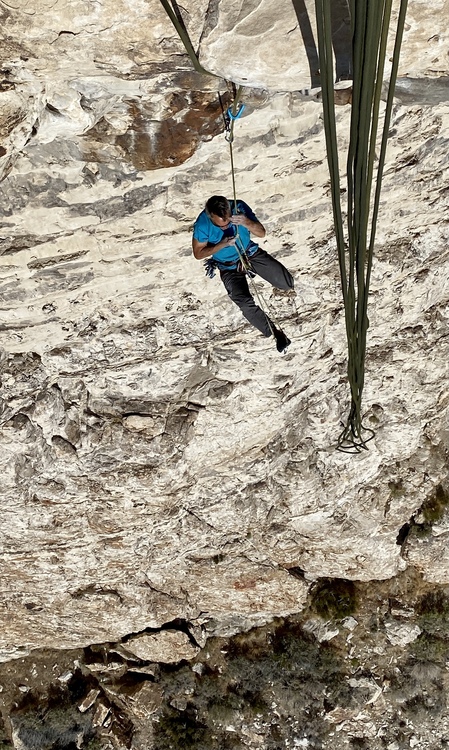 |
|
|
Christian Hesch wrote: Why is hanging on a single Prusik such a big deal? If it’s holding, is it all of a sudden going to stop holding? |
|
|
There is an interesting little detail here that, depending on the gear you’re using, could cause you a lot of grief. If you are using two Prusiks, you want the prusik to your foot below the Prusik to your waist. Imagine the sequence otherwise: you’re hanging on your waist Prusik, you slide up your foot Prusik and stand up. Your waist Prusik is now slack but you have to balance and hold on to the rope to move up your waist Prusik which is now on a slack rope and harder to loosen and slide up the rope. With the waist Prusik above the foot Prusik, you would stand up, grab the rope with one hand and move the waist Prusik up with the other. It’ll be easier since the rope is under the tension of your weight. |
|
|
I'm glad you had a way to communicate with your partner with the radios, and he was able to secure the rope in such a way that let you ascend a single strand (which is certainly preferable). In case you ever find yourself on a single-rope rappel, unable to unweight the ropes, and off route, it would be good to know how to ascend doubled ropes with prussicks and catastrophe backup knots tied to your harness (not as "jamming" backup knots). If you can manage that, you can manage anything. |
|
|
I know some people poo poo radios but I think they do have a place. I’ve got a set and hardly ever use them, never bring them to the crag. The place I have used them was alpine climbing and it’s windy and impossible to hear your partner, sure rope tug signals can work but radios take all the guess work out of it, it doesn’t replace having rope signals as a backup though. Like I said I hardly ever use them but now anytime I plan on doing a long all day climb I’ll at least throw them in my pack so it’s an option. |
|
|
Mark Hudon wrote: It won’t... but if you’re futzing with the micro, maybe you shift your weight, maybe there’s a little slip, maybe you freak for a second and grab the rope... and accidentally put your hand squarely on the prusik? |
|
|
David, So glad to hear you are ok. The title of the thread had me worried! I've learned a lot from this thread. There is one thing I don't understand though. You said you rappelled down to another anchor but it wasn't the one you were planning on going to. Why couldn't you just use that anchor to keep going down on the next rappel? Was there no anchor below the one you arrived at that would let you continue? (As in not part of a rappel route.) How common are rappel anchors that would lead to nowhere if you used it? |
|
|
David Dentry wrote: Oh I see, I misunderstood your initial account. Of course this is just guesswork, but curious about the radios - do you think you would still have committed to that anchor if you didn't have them (and hence had no real way of communicating with your partner above)? Since as long as you're still on rappel, you can reverse course, but once you've gone in direct and got ride of a strand then.... You do need the partner above. Did all that go through your mind? |
|
|
@Astrid - By the time I spotted the second set of anchors I was almost positive I was off course. At that point I had two choice 1) try to start going back up from the rappel rig or 2) go to the anchors. I knew I wasn't going to bring my partner to the second anchor but I appreciated the security of the bolts and the time it gave me to formulate a plan. I could have brought my partner down and *hoped* that there was a further rappel route below me, but that seemed silly. I knew it was going to be scary/hard to get back up, but at least I knew what was up above versus the unknown below. The second anchors I stopped at was really just to give myself a break to make a plan. @Franck - I would have gone to the second anchors with or without the radio. If I didn't have them I would have I would have had to jug up both strands while my partner was in the dark about what I was up to but the radio let me try 1) tie in and have him put me on belay so I could climb and then when that failed (about 25 feet above the anchors) 2) have him fix one line and let me learn jugging. You're completely right about the route. It looked like it hadn't been climbed in a long time. The rock was covered with lichen, each little ledge was just loose rock and there was little options to place protection if I'd wanted to try to lead back up. Continuing down was a non-starter for me. I've been trying to figure out where I was, but haven't pinned it down; on the West/South West corner somewhere. I think I was at the top of El Matador, but a column or three to climber's left. P.S. Sorry, all, about the click-bait thread title! |
|
|
At a place like devils tower that is both well traveled and has lots of cracks I would have simply stayed at the height of those anchors and traversed left to right looking for a more traveled anchor. there is a rout up almost every collum. if I did not find annother anchor that was easy to get to I would clip in to the anchor you did find and call it good. You have two ropes. 60m is a lot of time to sort things out and find the next anchor. whomever made that anchor had to get down somehow and likly didn't have as much rope as you if it was an old anchor established in the days of 50m ropes.. you actually might get in more troubble with a brand new anchor that might have been established with 70m ropes... prusicing back up most likely completely unnessicary. on a blank overhanging seldom climbed wall ascending the rope would have been the right move. |
|
|
I think I would have assumed that if there were rappel anchors like bolts with chains that a rappel with a 60 meter rope would get me down to another anchor. But luckily I never had to make that choice. Definitely something to think about! |
|
|
Intuition like that comes with time. And Devils Tower may reward that intuition more than other places Have been on and heard of many wonky rap descents in Western US a la ... “The bolted anchor makes an adequate emergency escape anchor as it is possible to rappel with 2 60m ropes, but you will need to extend the anchor as much as possible and will still just BARELY reach the ground. A 60m + 70m is probably ok.” Or “We did the standard descent last week. The thing to be mentally prepared for is that this is a pretty unusual rap route. A party that is completely new to this descent should plan on time to explore a bit between each of the first several rap stations. In other words, plan to have some day light to explore.” |
|
|
Nick Goldsmith wrote: David- happy that everything turned out OK. Oh yea- what Mark and Kevin said is golden. You should know many ways to get back up the cord. But you got down OK and that’s the most important thing and you got some real experience to use in the future. Cheers |
|
|
There was at one time a bolted - but strangely incomplete - rappel route running straight down from several pitches up the right-leaning lower section of New Dawn. I met a guy who had committed to following it - only to find himself hanging at the end of his ropes, still nearly a ropelength above the first belay of Mescalito, closely examining unadorned, blank granite! |
|
|
I've been practicing a bit this week with this scenario and having a bit of trouble. Assuming a two rope rap with the ATC extended. I use a hollowblock below it as a third hand and I'm trying to rig the "guide mode" ATC setup. If I can unweight the rope using the cliff side I can easily switch to this method, but if it's overhanging I'm still having issues. I only have one hollowblock (I'm trying to practice only using what I normally carry) on me. When using a dyneema sling above to try to unweight the ATC it (the dyneema prussic) just slips. I found this method but haven't been able to test (it's raining today). Any other suggestions? Also - the suggestions made that I should have just continued down and trusted that I could find a place to rig another rap feels sketchy. If I had brought my partner down and then we could't find a third (or fourth or fifth) rap station we'd both be stuck. I'm sure we could have built a gear anchor but then I'm leaving gear. Certainly "down" is the best (and only) solution in some scenarios, but here, where 1) I only had one rope length to go up 2) my partner was still at the top 3) I knew there was a good rap route in another location at the top seemed safest to me. Thanks, all, for the discussion. |
|
|
David- continue your journey, your quiver of tricks and skills only grows. |
|
|
David Dentry wrote: David, The sling friction hitch seems promising but let's say you don't manage to commit it to memory: 1. Tie a catastrophe knot below your third hand. 4. Use your third hand loop in a friction hitch above your rappel device for a foot loop attachment. 5. Switch to ascend mode with your ATC Guide Or similar device. One option that would work for me is that I use a piece of 5mm cord to tie my chalk bag to my waist. I would be able to convert that into a short sling to use for that friction hitch. |
|
|
David Dentry wrote: If I'm understanding you correctly, this might help: https://northeastalpinestart.com/2017/07/11/tech-tip-flipping-a-plaquette-and-giveaway/ (See: Flipping a plaquette when it is extended off your belay loop) |


