
 Continue with onX Maps
 Sign in with Facebook






Early history of Tahquitz


|
|
Guy Keeseewrote: Interesting. I guess this makes sense when you consider that rock climbing in the early days was just a technique used in mountaineering, where any method of getting up the mountain is fair game. And given the primitive state of pro, ropes, and belaying, falling at a crux was no laughing matter. If freeing a route wasn't really a concept at first, it kind of makes sense that we wouldn't have any record of whether the FA of a climb like Angel's Fright was aided or not. They just wouldn't care. I wonder when people starting thinking in terms of "freeing" a route. The Sierra Club grading system (ancestor of the YDS) does date back as far as the 1930's, and in that system class 6 was aid climbing. I imagine the distinction between 5 and 6 may have been fuzzy, unlike the clear distinction today where you either pulled on gear or you didn't. I just read a book called First on the Rope, by R. Frison-Roche, which is a 1950 novel that gives a fictionalized narrative of alpine guiding at Chamonix in the pre-war era, written by someone who was a guide. (The dedication reads "to the company of guides of Chamonix, from one of them.") It has lots of detailed description of stuff like primitive crampons, belaying techniques, snow conditions, chimney climbing, and glacier travel. I was surprised at how primitive the belaying techniques were and how seldom they placed pro. Basically the method seemed to be that if a guide was climbing with a client, they would rope up, and on difficult sections the guide would solo a pitch and then give the client a hand belay from a stance. If there was a boulder at the belay, the guide would throw the rope around it. If they were on an arete, they would cross the rope over it now and then. Of course some of the description is trying to be dramatic by describing dangerous routes where the pro was "R" even by the standards of the day. But basically it seems like the techniques they used were the techniques that mountaineers would use today when moving fast on 3rd-class terrain, but in those days they would just use those techniques for everything, including what we'd today call 5th class. Maybe for a really cruxy spot they'd look hard for a piton placement. |
|
|
Ben Crowellwrote: Sounds like an interesting read. This all reminds me of my favorite mountaineering read (non-fiction): Minus 148⁰: First Winter Ascent of Mt. McKinley by Art Davidson. They also had primitive gear by today’s standards. One of the climbers started the first guiding company on Denali |


|
Mugelnoos, as Alois noted in a post above, stayed in the Sierra Club Ski Mountaineers Section and The Cliffnotes started with the SCMA after the Sierra Club Rock Climbing Section (RCS) had to leave the Sierra Club to insulate the club from potential liability lawsuits. This was spurred by a lawsuit when a dude croaked on the Grand Teton (I think Bridwell was guiding him) and his family went after everyone. That also caused Chouinard Equipment to reorganize as Black Diamond. SCMA has been a sperate entity although it is usually where Sierra Clubbers wind up if they want to get serious about rock climbing. I picked up the Cliffnotes from Alois in the late 1990's and ran it for a couple of years. It was interesting to learn that Ruth Mendenall developed the guest editor format that Alois handed to me. In the 1930s she offen went out traveling for extended periods to Alaska and stuff so she worked out that a different member would volunteer to edit each issue and she would just coordinate. Alois ran it that way and I did for a year or so. It was still a cut-and-paste operation. I brought it into desktop publishing format in 2001 and made it into a simple MS Word file saved in PDF format. I handed it off in 2002 when my time interests shifted to Boy Scouts. Bob Carlson took over and ran it the way I had for about ten years. In the last few years social media has all but replaced The Cliffnotes and Mugeloos was last published in about 2017 (I estimate). Cliffnotes no longer gets trip reports and other cool articles, although they would be very welcome. People just post on the Facebook page now even though Cliffnotes still comes out from time to time. The Ski Mountaineers are still going but it's a pretty small group. Needs new blood. Not me, I'm too busy. The old timers still there are awesome. All of the Cliffnotes and Mugelnoos prior to 1986 are archived behind a password at Rockclimbing.org. You need to be an SCMA member to get a password to get in. |
|
|
Spider Savagewrote: Wow, I had no idea that stuff was there! So all this discussion of going to the Bancroft Library and so on was not necessary. Although I'm an SCMA member and can access them, it seems really unfortunate to me that they're hidden like this in a place where basically nobody knows they're even available. They should be out on the public web. |
|
|
Ben Crowellwrote: Ben, you'll have to excuse my mission impossible-style machinations there. As an academic, I choose the most complicated solution and then work backwards from there. It's really great to have knowledgeable people postin up here. Thank you all for making this a very informative thread. As for myself, the other era I'm personally interested in was the development of Suicide slab but we could save that for later too. I've inadvertently realized how decentralized climbing and climbing news has become over the years. From the early days when virtually all rock climbing was organized by the Sierra Club, to the heyday of the climbing mags, to today where it's personal blogs or social media -- which unfortunately, can be either hard to find or totally diluted by cliche junk...cough cough...insta-yuppy-land...oooof excuse me .... heh .... The other day I saw someone send The Pirate over at Suicide ........ pretty magical and something I expect does not happen very often. That's the sort of thing I would love to read about in a newsletter like the ones back in the day. Maybe I'm reinventing the wheel over here or just lamenting the death of something good which was inevitable. |
|
|
jt newgardwrote: :-) I went through the summer issues of Mugelnoos from the beginning up until 1940 to look for Tahquitz stuff. The single most interesting page was this summary of FA's from Mugelnoos 68, Oct. 3, 1940, which I've posted below. What we now call the friction descent was originally considered a route, and was not discovered until June 1938, a year after Mechanic's Route! During this period there were only 9 routes established, so people did them over and over. Mechanic's Route is listed as class 6, Piton Pooper as "Class 6; Class 5 with pitons in place." Everything left of the Maiden was unclimbed as of 1940, although there had been several attempts to find routes. The 1939 newsletter mentions "a strange and unknown mortal" showing up and soloing the Trough barefoot. People seem to have normally done a climb and then rapped back down, which would explain why nobody cared about using what we now think of as the standard descent routes. 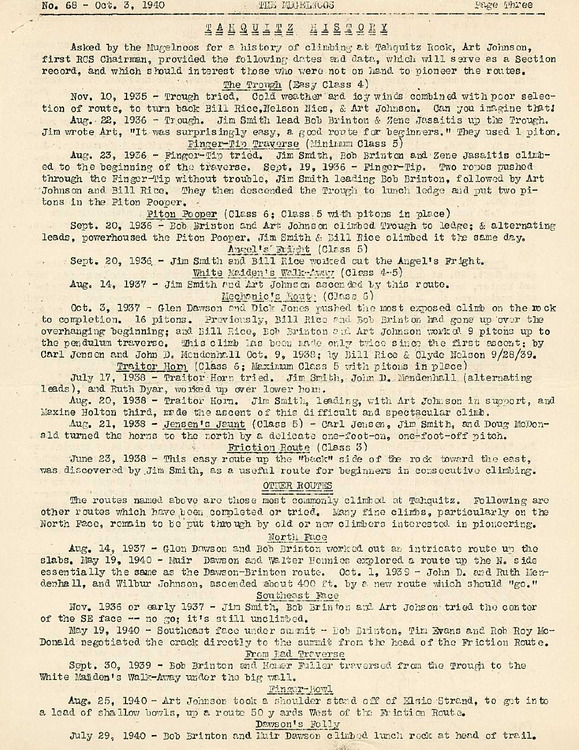 |
|
|
Well, since we are chatting about the good old days, let me add a bit. I was on the BOD of the RCS when the Sierra Club insurance stuff hit in 85/86. Out of nowhere, the RCS was dead. What to do? Nine of us decided to start a new club, as we needed to secure some climbing future for about 300-350 people. So the nine of us dropped $50 each into a hat and started SCMA. That was in 1986. I edited the newsletter Cliff Notes (part time) for about ten years, Chris Savage took over later. And yes, Allen Sanderson was there at the start as well. And there was a ton of climbing done in the 20 years I was with the club. Greg Vernon and Scott Loomis in the Sierra, RJ Secor and his guide books, Miguel Carmona, myself and Joe Lemay in the Sierra and Needles, Kathy Crandall with the first female club lead of Valhalla in 1986, Patricia Orris on sight ascent of Perpetual Motion in J Tree in 1989 (?), The Crack Climbing Workshop at J Tree, Bob Lindgren on the 5.12 variation to Arcy Farcy on Suicide (late 80s?), Peter and Rob Green on K2 in 91, Rich Henke, Peter, Rob and I on Dhaulagiri 1 in 94, a lot of ascents at Courtright Reservoir among several climbing areas, just a lot of climbing by everyday people. I served as a BOD member several times, President of the club twice. The club provided a lot of campsites for people to visit J Tree, Tahquitz, Yosemite, High Sierra, Needles, Domelands, mostly on weekends. In those years it all worked out well. Hope the SCMA continues to provide weekenders with a chance to go climbing.... Cheers, Alois. |
|
|
Andrew Ricewrote: Last year water was deep but cold! There's a spot or two up hill as well, just follow the creek(s) back a bit. Low this year though. |
|
|
Ben, Alois. This is great stuff. Thanks for posting and for your meaningful climbing community contributions. Also I quite enjoy seeing that these Tahquitz climbs date back 80-85 yrs! |
|
|
jt newgardwrote: Wow wa we wow |
|
|
Alois Smrzwrote: Alois, who were the nine? Margo Ross is one name that comes to mind. But it has been along time. I was on the fringe just attending the meetings and helping out with of the Stoney Point school. I remember you all doing lots of work to to get the SCMA going. |
|
|
Allen I don't remember everyone but, Andy Fried, Robert Somoano, Kathy Brown, Michael Feldman, those are people I do remember. There might have been RJ Secor in it too but, I would have to go back to my pile of Cliff Notes and Mugelnoos to check for the other people. The info might not be in the Cliff Notes, because when the crisis hit, we were still the RCS and Cliff Notes might have not existed at that point. Not sure about Margo Koss, she was involved in a lot of stuff but I just don't remember. It has been a while as you say... Those early times were full of turmoil, Sierra Club dropped all the insurance to concentrate on conservation issues only and that left the Sierra Club Technical Outings groups around the country in limbo. It basically invalidated the Sierra Club as outings organization/group and completely destroyed the principle that they started with. We decided to handle it by starting a new club. Some places (San Fran RCS), if I remember correctly, just folded. Many years later, I remember meeting with Mr. Brower at the dedication of Yosemite Camp 4,(he was the Sierra Club president during the crisis), he stated to me and others, that dropping the insurance was his biggest regret in all the years of heading the club. But the SCMA survived and thrived for many years and hopefully, is/will again. |
|
|
Alois Smrzwrote: Someone in the SCMA already made the effort and scanned the entire collection, from 1930-something to the present. There's some fascinating reading in there, like the brief paragraph about some kid named Royal-something that freed the Open Book. |
|
|
Alois Smrzwrote: R.J Secor was a member, though he had other groups he was active with also. My first memory of him was at the 1991 Labor Day Tuolumne trip, my first time in Tuolumne. During the Saturday night campfire he stood and informed everyone that Chuck Wiltz had passed away. Probable one of the most active members from those days is Leroy Russ, still hounding people to lead trips. |
|
|
There is a photographer B. Turney credited in a bunch of places in the Chuck Wilts Tahquitz guide. I wonder if he is alive, or if someone knows what happened to his photo collection. |
|
|
Ben Crowellwrote: That's probably correct. There's a good possibility that the headwall there was significantly different then The first time or two I did the route there was a large tooth sticking out at the headwall at the top of pitch three. It went at 5.4 then, but was harder than now. Sometime around 1970 that tooth fell out leaving the present configuration. That whole section is a bit detached and will probably reconfigure itself in the future. Mass wasting never sleeps. |
|
|
Anyone have information about a fatal fall off Tahquitz in the late60s, very early 70s? My partner's father was the survivor and we're trying to find some info. |
|
|
The AAC Accident Reports, especially during that time period, chronicled most accidents, especially fatalities. I don't believe that they are accessible online, but you can check their library in Golden and look at the back issues from those years, in case no one responds here with direct information. |
|
|
Tiffany Hauckwrote: Tiffany, do you have the victim's full name? Some of us are old enough to remember, and not so old that we can't recall. The American Alpine Club prints an annual journal, "Accidents in North American Climbing" (formerly Accidents in North American Mountaineering). The AAC keeps the accident archives in a searchable database. http://publications.americanalpineclub.org/ |
|
|
Found it. Thanks. publications.americanalpine… |


