
 Continue with onX Maps
 Sign in with Facebook





New and Experienced Climbers Over 50 #16


|
|
its just a number in the gym... go climb a rock :) 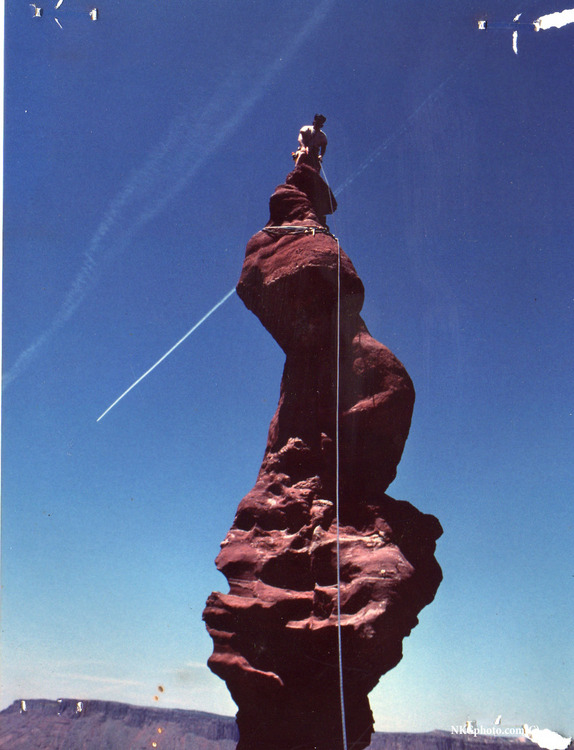 |
|
|
Nick Goldsmith wrote: Lucky you put a smily face there otherwise I'd bop you! I know, even a grade outside is just a number, but it'd be a nice little achievement to keep me at it. To be honest I know I've been coasting a bit, and it's nice to be making progress on this route after deciding to try stuff harder than I normally climb only a few days ago. I actually think it's because I'm keeping my weight and body fat quite low at the moment, too. And I just feel a bit driven to get this route. It's rainy here at the moment so climbing outside is sporadic and only on weekends... |
|
|
I get the training thing.. I spent the first half of my life training obsessivly in the arts of bopping people. when it comes to climbing I prefer to simply have fun. My inspiration comes from striking features and lines. afixing a number seems silly. I simply get obsessed with a line or a feature. I want to climb that! If That requires me to train harder then so be it I will train harder to reach that summit but no way in hell will I train to just reach a number. |

|
rgold wrote: rgold, thanks for pulling forth essentially what you wrote some thousands of posts ago. I have nudged Bob about writing a climbing book for old people, which would probably sell maybe 2 copies. However, as time goes on it is occurring to me that the learning trajectory is not so different from that of younger people... we seem to all follow the same path of learning some basics, taking some time to build strength and skill, and venturing into more and more difficult climbing. At some point early or late most people add in trad skills and/or leading. It just seems to unfold that way so long as we still have our wits about us. However, where we differ is in our native ability at this age, and the speed with which we can react, manage risk, capture ourselves before a fall. And, we have to factor in that we DON'T have the benefit of 40, 50, 60 years of climbing experience. I feel like every day I'm making compromises... sacrificing some things I really want to do, so that I can keep on climbing without injury or major foolish incident. I believe my body/mind will tell me when I'm ready to take on more. ----------- Here are some things I am hoping to learn in the next few months. Could I rescue a friend or myself if we were stuck on a route? Could I take care of someone who broke a leg, or sustained a big fall, away from emergency services? Can I safely set up anchors, clean anchors and rap whenever needed? How can I be a better partner? AND... will review the 2nd Date article to see what remains to be done there. |
|
|
Lori Milas wrote: That’s a great list Lori! You will find quite a bit of overlap in the skills needed for the climbing specific things. It’s all about understanding systems. Hopefully you never have to execute a rescue, but the skills required to do so definitely help with day to day climbing (systems management, rope work, anchors etc). I took a 3-day self rescue course about 10 years ago and learned a ton - I wasn’t leading much at the time and I wanted to be a better partner and be able to manage situations if things went bad. It helped my confidence a lot. WFA (wilderness first aid) courses are great too. Someday I’ll take the full WFR (responder) course. |
|
|
Carl Schneider wrote: Word from DownUnder is it's soft for a 24 ;) |

|
Carl Schneider wrote: You are selling yourself short. There is no reason you can't climb a 24 or even a 25 outside on real rock. Drop the endurance laps and focus on hard climbs. If you want to do it, find a couple of routes that match your strengths and get it done. |
|
|
Mark is right. My wife hadn’t sent a 24/.12a until she was 58. She’s now done several up to 12b/25. She started climbing in 1996, but what changed for her is that she started to hear the clock ticking, and as result started to train and try hard. |
|
|
Lori, honestly I wouldn't worry about leading at this point in your life unless you decide that you want that extra 'bump' that you get from doing it well. I have gone years without leading much. I have had the good luck, and honor, to climb second behind some great climbers including Mike Waugh, Dave Houser, Herb Leager, Kris Solem, Rich Grigsby and Andrew Rock. That is not to say that I haven't done my share of leading and I have lead some real horror fests, but much of my climbing career was following other climbers who enjoyed the sharp end more than I did. As to the 'scene' in Josh back in the day, realize that there were at most 50 people climbing hard in Josh and those same people were in Josh every weekend during the season. We all knew each other well. We all climbed together some if not often. And if you want to know about the MHU, ask Randy, he was one of the ring leaders along with Mike and Mari. And I will say that it was NOT responsible for everyone disappearing, that happened as people aged and got married and had kids and jobs and moved on with life. Except there were quite a few of us from that era that never did quit climbing, we just branched out and quit living in Josh all winter. Matter of fact, I would say that the majority of the Stone Masters from Josh are still climbing since one must continue to feed the addiction. |
|
|
Carl, that's great! Training, weight, working at it, all of those matter, of course! But? So does just giving it a shot. I am likely a 5.8 climber, at best....yet, I've got a 5.10 something in my ticks, and it was only about year one or two. I flailed on every inch, top rope (maybe a follow? don't remember that part) bolt to bolt, many falls...and couldn't quite reach the actual anchors at the end. But still, climbed every inch on my own power, except that bit with nothing for 4'11" to reach. How did that happen? A 10? Simple. My son decided I could do it, cheered me on every inch of the way....and told me he wasn't gonna let me come down, lol! About that same time, he got a miraculous 11 something, at the Fins no less, as a 10 climber. The benefit of being with people many grades stronger, and, a balancey, crimpy style that suited his lanky 6' well. My very last climb at a gym that closed here 3ish years ago, on the night they closed? A lead, on a wall that went totally overhung at the top. I got to about three moves from the anchor...with a full, flying jump for the out of reach hold, as my last move. The huge, beery cheering section helped a lot...the very near miss elicited a big response too. It was glorious. The stuff we can't do? For certain? The stuff you never take a shot at. The hard part is the picking and choosing, what's worth the hard training, worth the hail mary, or even worth the hike in. That is different for every one of us. And it's so good to have a cadre of folks who "get it". I am really looking forward to meeting some more of you this season!!! Best, Helen |
|
|
Lori Milas wrote: If the objective is to be more self-sufficient on the climbs you're interested in, half of it seems perfect, and the other half I don't understand. Why the self-rescue stuff? There are a lot of very complicated skills involved in self-rescue, and I just don't see how they're worth your time, or would be of much benefit for having a day out on single-pitch J Tree cragging with friends. One other thing you might consider adding to your list is learning which domes have easy access to set up topropes, and then putting in the time to get lost a few times until you figure out the approaches. Figuring out the beta on approaches/descents can be just as hard as figuring out the beta on climbs, so don't short-change yourself on this one. GO |
|
|
Russ Walling wrote: Probably, and it plays to my strengths. I know it's 'only' indoors and 'only' a number but it's motivating me so that's all that matters right now. Sometimes I feel I should stop climbing, especially considering quite significant injuries (2 snapped biceps tendons) and I feel I need motivation. A fellow I met ages ago in The Grampians offered to show me the Blue Mountains. I've never been there and the pictures look so nice. He says he'd get me up an outdoors 24. Again, I know it's only a number and only indoors but it's got me motivated, which is the main thing, for me... |
|
|
It’s a great first step and the mere fact that you are so close should be motivating! How are your redpoint tactics? |
|
|
look at the overall picture. is it worth a number for another torn bicep that perhaps never heals correctly? Is it better to save your tendons for when it counts. FA's and special climbs outdoors? everyone has their own path. Myself I feel that we have a finite number of pull ups in us, a finite number of steps. I don't want to waste all mine in the gym. This is comming from some one who was fully imersed in the Dojo and health club world for the first half of my adult life... A certain level of training is nessicary to avoid injury and be fit enough to play the game but trying to push the limits in training seems like a young persons game to me. I want to save a bunch for the long run.. 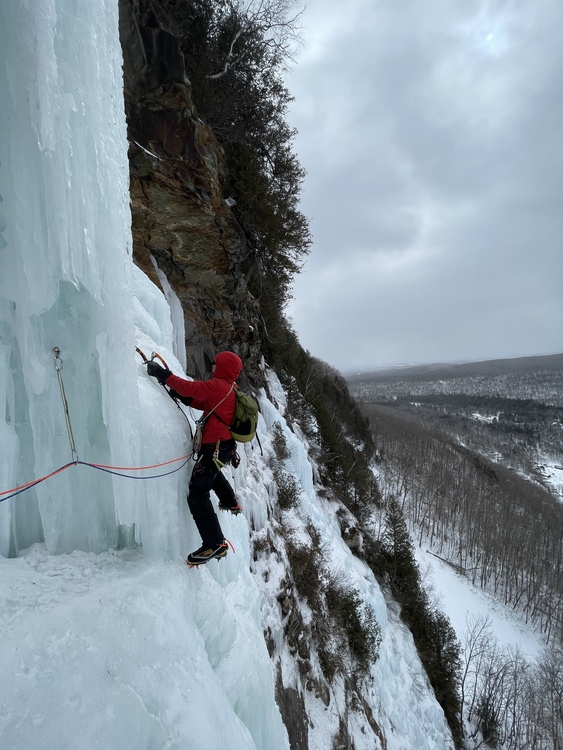 |
|
|
GabeO wrote: Gabe. Wrong, wrong, wrong! As to not needing self-rescue here in Josh—I have already needed it! Some months back I was climbing a route that had an odd twist in the rock and my rope jammed in it. It couldn’t be pulled up or down and I was left hanging there, high noon on a very hot day. That’s when I had the thought “Hey! Wouldn’t it be COOL if I had some idea how to get myself outta here before I roast to death on this wall?” (I untied and downclimbed.) That wasn’t the only time. I watched with real concern a young man whose rope got stuck on Double Cross and he was stranded there mid-route for a good half hour while he did some fancy maneuvers to change ropes and descend. He was pretty rattled when he got back on terra firma. A stranger had to lead back up and fetch his stuff. As for scoping out approaches and descents on domes: I am already positive that there are none. I set out to do that very thing last summer. I tried to hike up the backside of Cyclops, ran into a boulder field and couldn’t work around it. However there is this very cool rock off to the side. 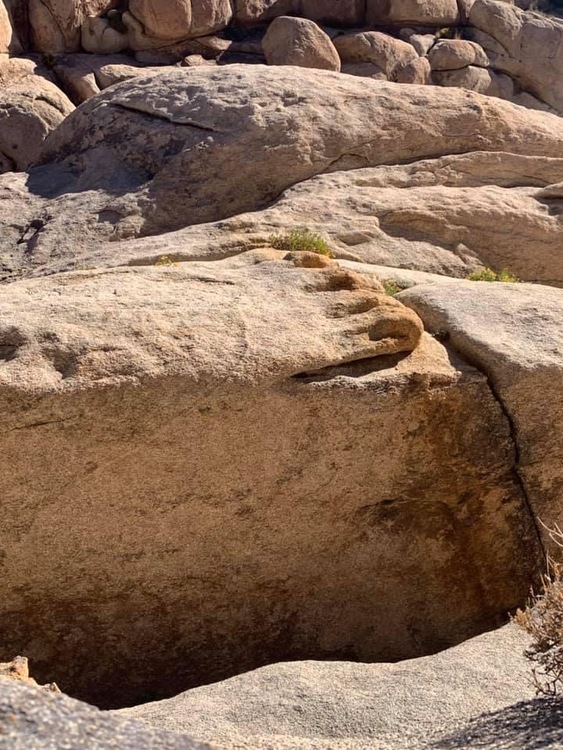 I’m still working on an approach to either of the Cave Corridor domes. Dead end after dead end. My best effort was on Bikini Whale. I spent two days trying to bushwhack to the base. A stellar failure. So now I can say with 100% certainty that any suggestion of walk on/walk offs anywhere in Joshua Tree is FAKE NEWS. I’m sure of it. |
|
|
Frank Stein wrote: I'm going to be taking a clinic with Chuck and Maggie Odette at this year's Lander climbing festival. It's called A.A.R..P, or Advanced Age Red Pointing. The ticking clock is a thing. I'm the oldest guy in my crew, but they're giving me feedback that I'm climbing better than ever, at least in the gym. I'm definitely working on 12s, and I have my sights on getting an outside 12 this season. It may be a pipe dream, but doing mid-11's then becomes part of the path. It's an easy goal to set. "I'm going to climb 5.12!" Though I do get a little frustrated with how climbing harder gets framed, as in "it's only a number". Well that's true, but it completely misses how satisfying it is to learn and execute new systems of movement, and getting up things that were previously beyond my imagination. I love the process of pushing past where I've been, seeing new things happen. And it's true, nobody cares how hard you climb. |
|
|
rgold wrote: Hi Rich! I like your comments, but for myself, I disagree. I said above that leading adds another dimension, and to me the additional dimension, which is comprised of the complexity and analysis and FUN it adds to climbing, is quite rewarding. With sport climbing, the added complexity is the strategy/analysis - which way to face the draws, what kind of draw to use to suit the terrain, estimating where the best place is to stop moving to shake out and recover. All of these play into safety yes but also complexity/ interest. For crack climbing, OMG, how much fun is that when leading? Deciding what rack to take - too much, too little? The complex game of what to place where, to best use the gear as needed and still have what you need higher up. The ART of the perfect placement. Such a frisson of joy when you see the perfect nut placement, pull that exact right size of your rack, slot it in and feel that perfect set sink in. That feeling when you place a perfect cam and think - would hold a truck. The special joy of placing a couple of pieces in opposition and the way that feels to solve that puzzle. Edited to add - route finding! another factor that adds fun. Again, all being done under circumstances where time/strength is a factor. I have never led things because I was seeking the excitement of risk, in fact the opposite. All of my mental and physical training was geared so I could lead things while feeling as little risk and adrenaline as possible. Now, I did like to challenge myself technically and physically, so I I ended up leading plenty of R rated routes, and plenty of things near my fall limit, but I always did them with the mentality of NOT falling and the feeling that the odds were in my favor. If I got an adrenaline rush it meant I made an error in judgement and that annoyed me rather than gave me something positive. Still, not suggesting anybody NEEDS to lead to get huge amounts of joy from climbing. Like I said above, if I get to the point where I think it's unsafe for me to lead, I'd still want to climb. |
|
|
Victor K wrote: I agree with everything you said. It is also true that the most beautiful and inspiring lines are generally on sustained and monolithic features, and as such, they tend to be higher in the grade. And then, well, there ARE goals... |
|
|
Nick Goldsmith wrote: Oh my biceps tendons in both arms aren't torn, they're snapped completely. So now I have two uniceps rather than two biceps. Someone I know once said "Most people start to look after themselves as they get older, but Carl seems intent on hammering his body without mercy until he looks like a cutter ship rounding Cape Horn with sails torn and masts snapped"... And here's a poem, for Lori...  |
|
|
Carl Schneider wrote: Oh, Carl... I'm so deeply touched. Poetry just has that way of getting you in the heart. You wear your heart on your sleeve. Tony has never written anything that deep. Is your wife still taking swings at you? if so, there might be a reason why. |


