
 Continue with onX Maps
 Sign in with Facebook






Inexpensive bolt extractor


|
|
Has anyone tried using these as bolt spinners? https://www.amazon.com/VEGA-Thread-Driver-Professional-145HB616-2/dp/B07P8WJGPQ Amazon won't let me buy them because I'm in Australia but they seem potentially like a lightweight 1 peice solution. Although my experience with 1/4" driven things is that they are very consumable no matter how much you baby them these might be worth a try |
|
|
Jasper Youngwrote: Looks like it would work but better to have sds connection to regular rotarty hammer. Then you only have to take one power tool to the cliff. |


|
Jasper Youngwrote: If they do not latch on to the bolt you cannot pull up to spin against the sheath to create the ledge to pull the assembly out. |
|
|
You can definitely pull with a 1/4" impact driver. I've bought some from another source and will try it out. Another thought is. If you're trying to eliminate steps why don't you just use the doodad as the middle of the spinner? thread the backside of the tool, adapt it to sds+ and just do it all in one. Never needing to connect to the bolt or disconnect from the coupler nut more than the one time spin it, grove it, twist it, pull it. |
|
|
Jasper Youngwrote: Well, I guess you could. But you would be asking your drill motor to do a _lot_ more work to sling that much metal around. Batteries are the limiting factor on how many bolts you can typically replace in a day. The drill is also the most expensive piece of the tool kit. Give it a try if you like, tho. |
|
|
Jasper Youngwrote: I am going to try this. Only have one bolt to pull, seems like it's worth a shot with my impact driver. Will let y'all know how it goes. |
|
|
I tried these after the link was first posted. Didn’t like it for a number of reasons, mostly relating to the impact driver. - the impact while pulling out on the bolt to spin would knock the cone in/out of the expansion clip making it repeatedly lock up, while also taking longer since there wasn’t consistent contact to groove the cone. The cheap sds-1/2” adapters with a coupler nut have worked the best for me. |
|
|
Peter Thomaswrote: Thanks for the reply. I found the SDS-1/2" adapters really hard to find, but I ordered one as well. You drilled and tapped a bolt head in the coupler nut or did you find some off the shelf solution to go from 1/2" to 3/8"? 1/2" to 3/8" reducers exist so I'm thinking of trying one of those, seems like an easy solution for someone that doesn't have a drill press |
|
|
The SDS adapter is a really puzzling item with regard to its availability and pricing. You can find them on eBay for $4.00 regularly. Ordering direct from the factory in China you can get them for ~$2.00. Trying to find one thru standard US hardware stores or a Google shopping search would have you paying ~$30 each! The highest price I ever saw was at the online Sears store for $64.00 each. Amazing price spread. The impact driver really does go against what you are trying to do. If you use an 18v drill, you will probably have trouble getting the bolt to begin spinning. The solution for that is to get a crescent wrench to manually turn the spinner coupling nut a couple of turns in order to get it going. This shouldn't break the bolt as long as the coupling nut is bottomed out on the bolt and not touching the rock face or a hanger - you don't want to be stretching the bolt while trying to turn it or the torsion will break it. |
|
|
Ricky Harlinewrote: These are The couplers I use for the spinner https://www.mcmaster.com/91072A166/ I get the sds adapters either from AliExpress or Amazon. If you use a doodad type tool the 1/2”x20 threads match the end of the ball screw so you can use the same coupler to spin/pull. If using a Hurley/bolt style puller you’ll need a separate 3/8” to 1/2”x13 coupler to pull them. I have a bunch of the sds adapters (AliExpress) if anyone’s having a hard time finding them. |
|
|
Peter Thomaswrote: This is extremely helpful information. Thank you! |
|
|
One important note about the McMaster-Carr coupling nut: Although they are very nicely machined, the unthreaded section between the 3/8-16 and the 1/2-20 thread is smaller than 3/8". The left-hand threaded screw that comes with the SDS adapter cannot fit thru that hole, and neither can the rusty 3/8 bolt you are trying to remove. What happens is this: without a backstop, while you are spinning the bolt it gets driven into that 5/16" diameter hole, shearing off the threads and becoming hopelessly stuck. The solution: modify it by either tapping it deeper with your 3/8-16 tap or drilling out the unthreaded middle section with a (edit to add: you could also just grind down the head of that left-handed screw in the SDS adapter so that it fits thru the small middle section. Then you could use it as a backstop. Yet another approach- You could add to the 3/8-16 side of the coupler a short, smaller bolt whose threads don't even touch the middle section. The bolt head facing the end of the rusty bolt would act as a non-adjustable backstop. The smaller bolt could be held in place with a dollop of caulk.) see below - I managed to extract the mangled stuck bolt only to mess up when I broke my tap cleaning up the 3/8-16 threads 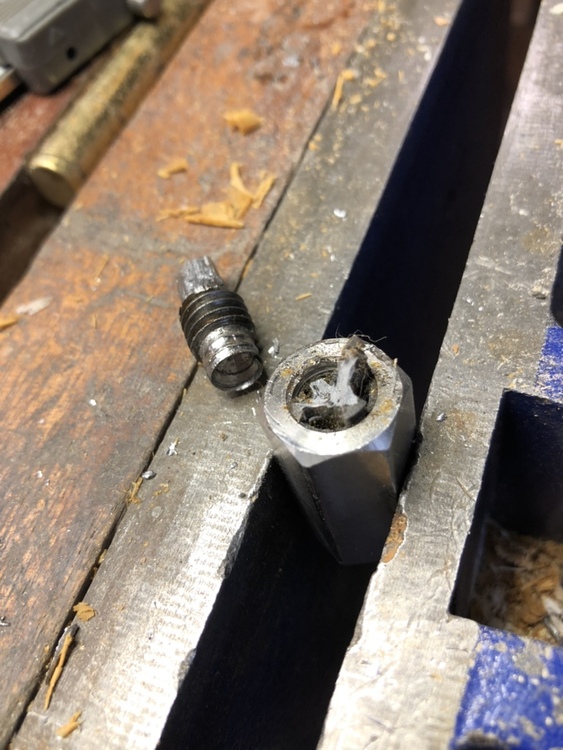 |
|
|
I just modified 20 of these. The middle section needs to be drilled out to ~0.410 if you want the left-hand set screw to get to the threads and function as a backstop. I build a little plywood jig to hold the coupling nuts in place for the drill press, but if you're just doing one or two you could use a hand drill and a vise. 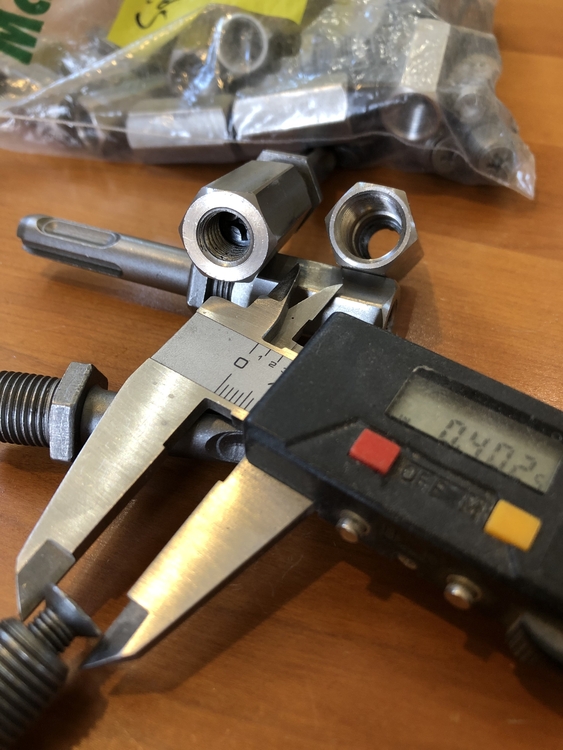 |
|
|
For the backstop lefthand screw, I bought a couple screws on Amazon (M6 x 50mm): https://www.amazon.com/gp/product/B07J4SP5DB I used a dremmel to cut and grind it down to size and add a slit for the screwdriver head to fit:   Hope this helps. |
|
|
Heliodor Jalbawrote: That can certainly work, and kudos for coming up with a solution that you like. Shortening the coupling nut with a hacksaw is much easier to do, tho. If you mark the coupling nut such that there is ~1/2" available for the wedge bolt threads after the SDS adapter is fully screwed in and cut it there, it obviates the need for any backstop screw at all. |
|
|
I am with you all on the coupling nut just being cut shorter. I find that backstop lefthand screw to get mangled, twisted, be annoying. Been having simpler and more regular success with a shorter coupling nut. |
|
|
I tried to come up with a relatively easy way to adapt SDS Plus to 3/8-16 and came up with this. I took an old 3/8" SDS bit and cut it off leaving about 5/8" or so of the reduced diameter which is a bit less than 3/8" and tried to thread it to 3/8-16. 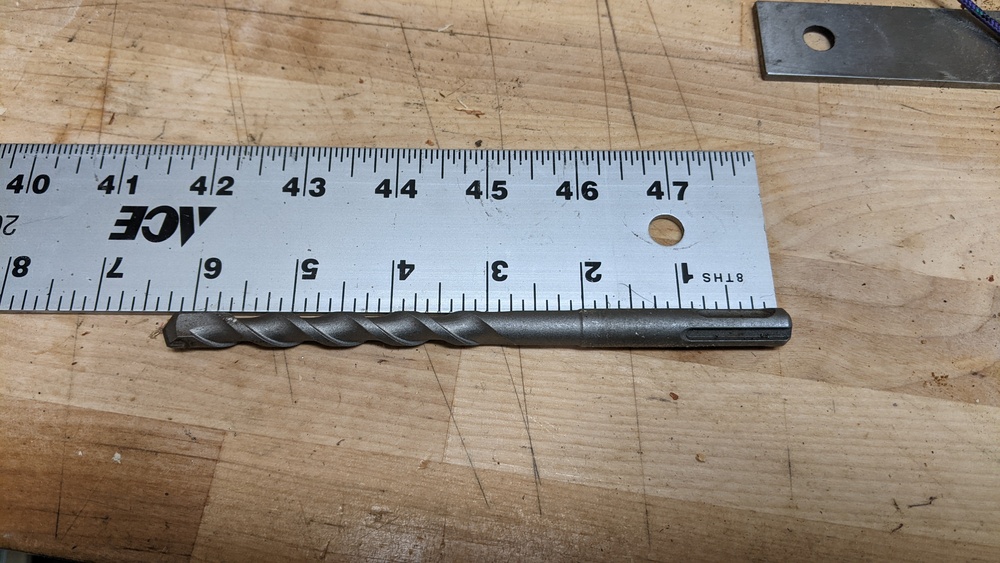 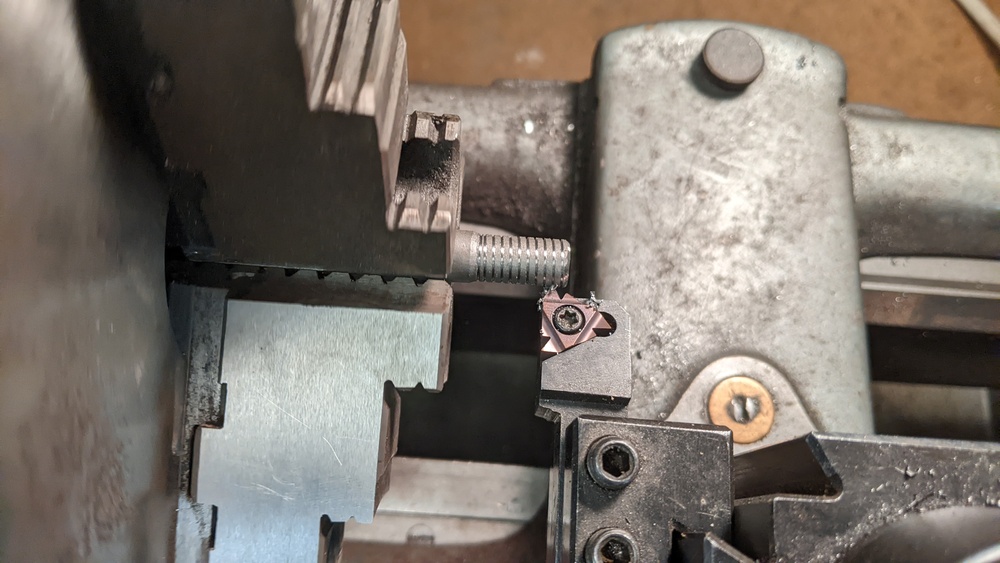 I then softened the steel by annealing it. I heated the end to be threaded to cherry red and allowed it to cool slowly. You can slow the cooling by wrapping it up in some crumpled aluminum foil. You don't need to heat the whole thing, just the portion that will be threaded. You should try to hold it cherry red for as long as you can to make sure the crystalline structure has time to change. You can tell if it is hot enough with a magnet. A magnet won't stick to it if it is hot enough.  I used a MAPP torch to heat it. MAPP gas burns hotter than a propane torch but propane might work. MAPP gas and the correct type of torch are available in most hardware stores. I think you could also do this in a charcoal fire.  I then cut the threads using a die. I did this in the lathe but it can be done by hand. The threads cut easily since the steel was annealed and the diameter was less than spec.   So it wouldn't be too hard and brittle I then tempered it in an oven at 230 C (450 F) which can be done in your kitchen oven or even a toaster oven.  It should be good to go now using a 3/8-16 coupler. Hard and tough enough to last and not shatter.  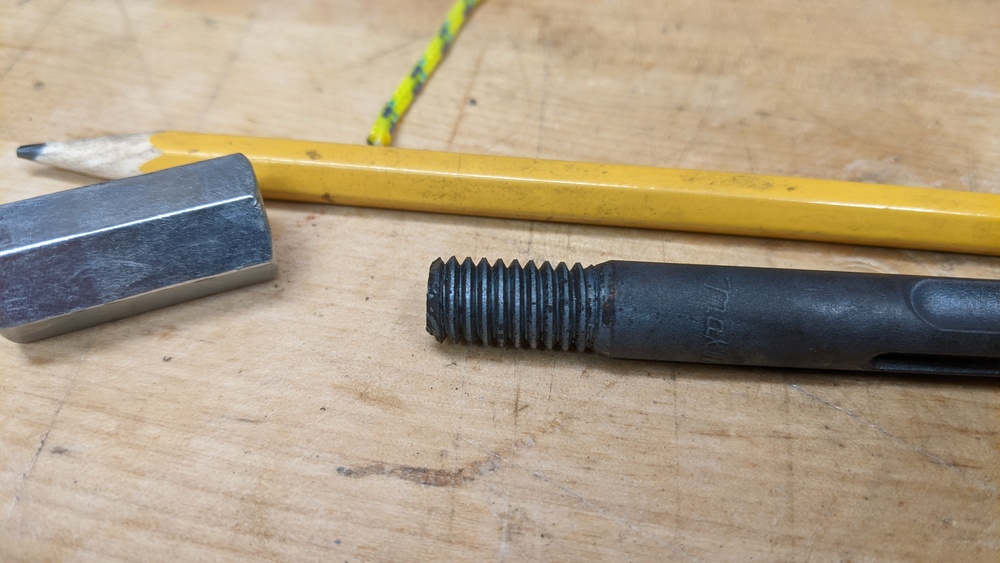 |
|
|
I have made both 3/8 and 1/2-13 to match my do dad. I did not re-harden them after threading but they have held up well. I prefer the 3/8 since the coupler is straight through easy peasy. I have fine tuned the length of the cut down coupler so I have slightly longer ones for bolts with the reduced diameter buisness end. If you are hand tapping, be sure to cut the bit as square as you can so the threads will be straight. Very nice write up Dan! |
|
|
Dan - you are a fine machinist, and more determined than I am. I tried the same a few years ago and annealed the bit poorly. There seemed to be a layer of softer metal around a hard core and when I attempted to cut threads they sheared off as I turned the die. I gave up. With my current order of operations, I prefer to have a coupling nut that fits both the spinner and the puller. Although yours is much simpler in that you have a standard 3/8-16 coupling nut, if you spin the bolt and want to start pulling it you have to use needle-nose pliers to hold it still while you screw on the end of the Doodad with it's own coupling nut. Leaving one step-down (1/2-20 to 3/8-16) coupling nut on the wedge bolt and using a crescent wrench to hold it still during the changeover is quicker for me and less frustrating. |
|
|
I have found that making custom couplers is the easiest option with the best results. It seems like about as much work as using the thread inserts. The commercially available couplers are either stainless and tend to gall, or need to be modified, and are mild steel that doesn't hold up well. A drill press is needed (along with bits/taps), but otherwise no special tools are needed. I've been using 5/8" 4140 hex bar, cutting it into 7/8" lengths then drilling/tapping so that one side is 1/2x20 for the spinner/puller and the other 3/8x16 for the bolt. The shorter length eliminates any need for a depth set, and if a little bit of adjustment is needed because of damaged threads on the bolt, or a short stickout, it can be attained by how far the coupler gets screwed onto sds adapter. The 4140 holds up well to spinning/pulling, and doesn't gall. unfortunately It is also pretty hard on my tools, especially taps. Like Greg I have found that using one coupler on the spinner and puller is a better process. Less opportunity to damage the threads on the bolt. I've been getting sds adapters that don't have a hole for the reverse thread screw, and have a slight concave dome. Using the standards sds adapters without the screw tends to flatten out the end of the bolt while spinning, making it more likely for the bolt to jam. I've been using these which unfortunately just jumped in price. I've made several hundred of the couplers, including over 100 for ASCA, and make draw studs the same way, with the addition of setup studs. For the draw studs I've been using 1215 carbon steel which is softer and much easier to drill and tap. For making in bulk I adapted a 5/8" socket with a 1/4-20 hole for a set screw to hold the "blanks". Once the socket is centered in the vise I can drop new blanks in without having to recenter. If folks are interested in making their own I'd be happy to offer more details, and lessons I've learned from making these. For folks that don't have the tools, or don't want to make their own, I have been selling them at the same cost as the commercially available 1/2x20 - 3/8x16 adapters, and have also donated many to ASCA and local climbing orgs. 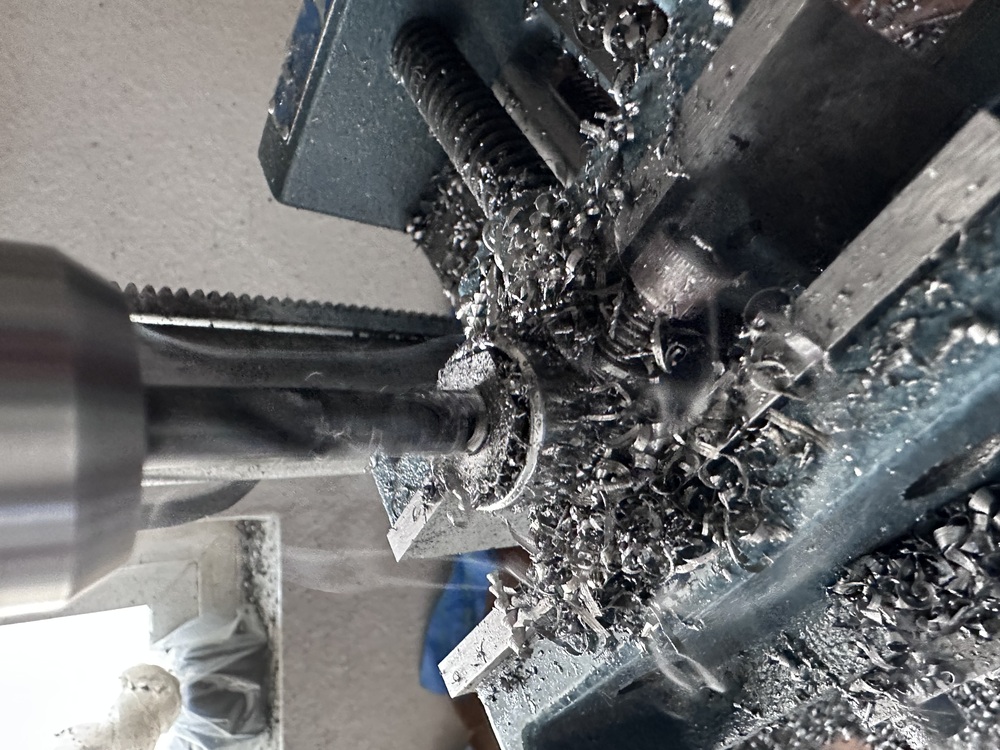 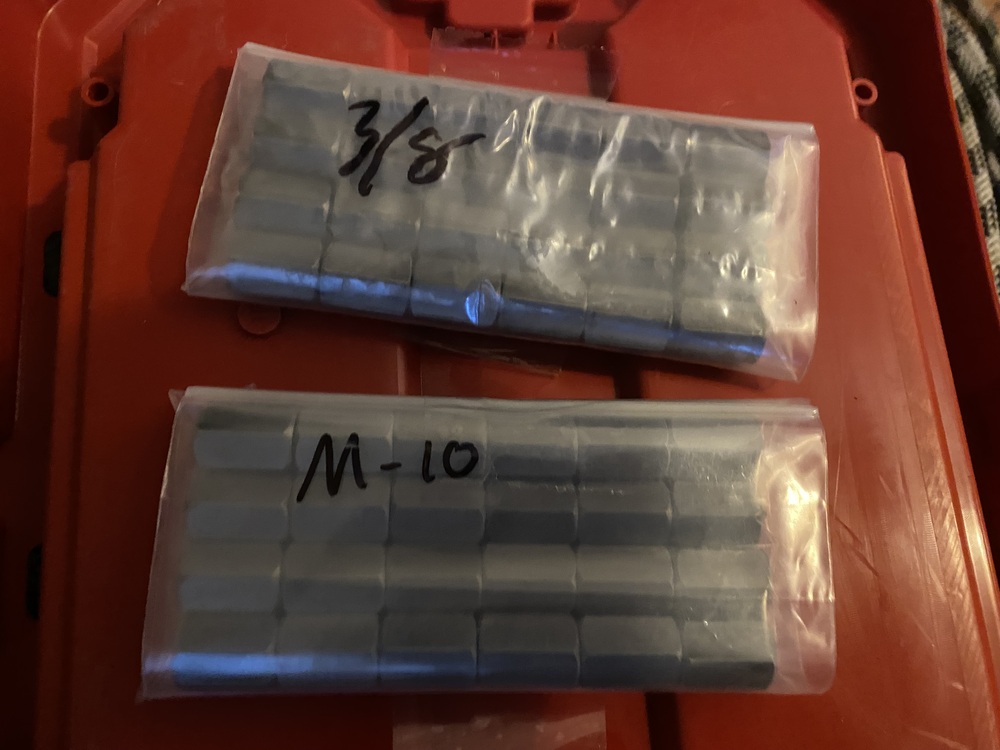 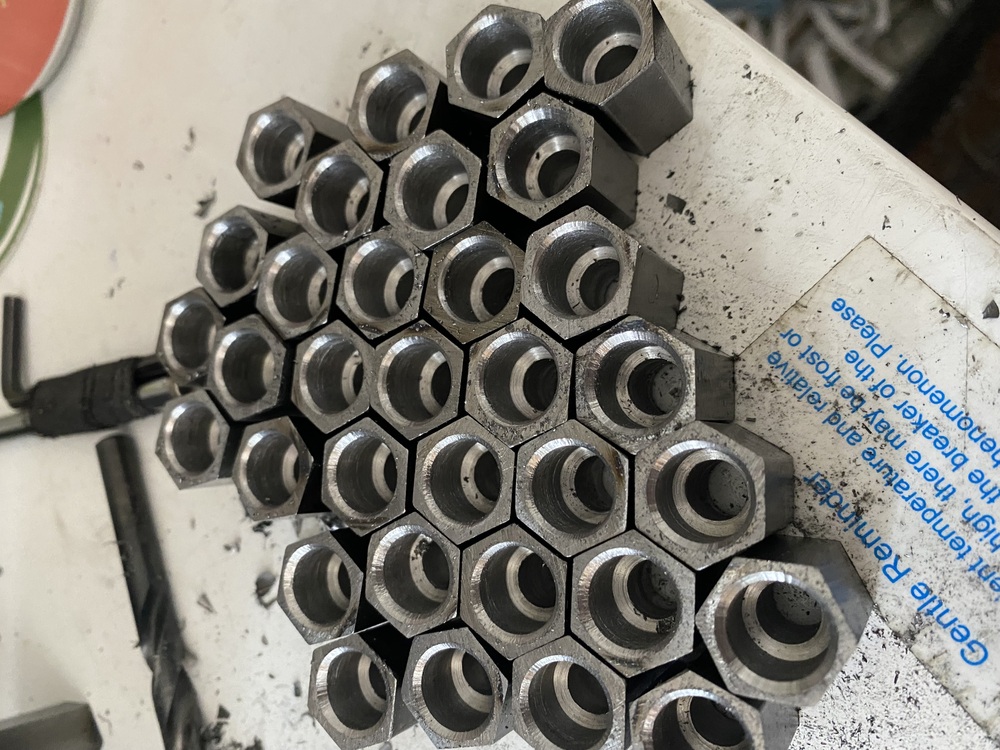 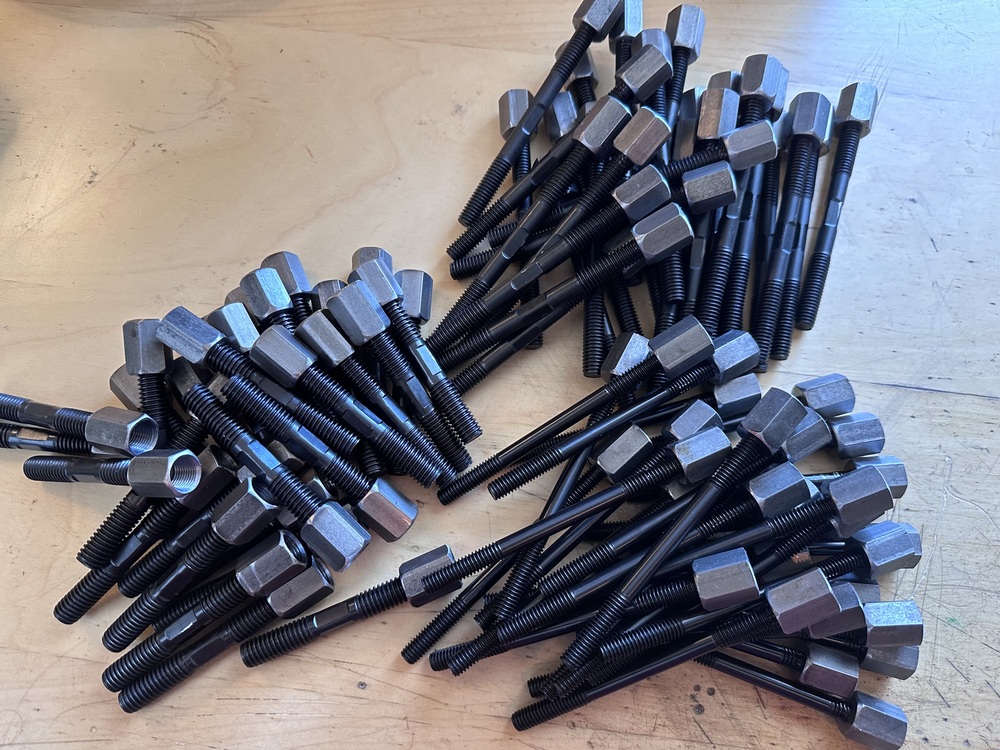 |


