Continue with onX Maps
 Sign in with Facebook






Yosemite Finish


|
|
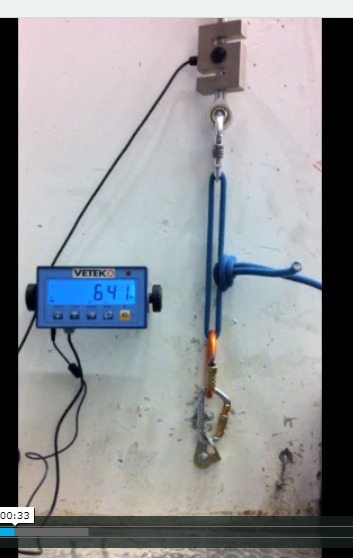
Former Climber wrote: Video above. Ring loaded Fig8. Not yet capsized, holding 641kg, which is considerably more than bodyweight. I would also like to know who ties in with a loop that big (to you /like/ getting smacked in the face with it?) and how they could manage to load it to this level and in this configuration. BTW it *still* didn't capsize. Just link the video Don is half correct, figure 8s will capsise under body weight but generally only when poorly dressed. I would also like to point out that to what Don was referring to was abseiling in the video not all the force is actually going into the knot there as there's the other side that will be taking probably about half the load so more like 320kg. This being said, people belay of their tie ins all the time in the uk with out any issues, as I said earlier in the thread I have only ever seen an issue arise from an incorrect yosemite finish. |


|
Cal Sayneus wrote: I'd worry about cross loading or shock loading the knot, it's also possible that the angle that you force the rope in at when putting it through in #1 could cause what I call microtears, basically the rope equivalent of a microfracture. These occur especially in something like the yosemite finish, where it could force all of your weight onto that one strand that the rope tightens around. I've lost a few friends to microtears, so stick to option 2 or 3. Best troll yet. |
|
|
Anyone want to do ring-loading pull tests on the “Okie Finish” that a bunch of us here have been using for the last 5 years? Instead of pushing the tail down, we push a bight. A few OKC friends taught me this knot at my first 24 Hours of Horseshoe Hell comp in 2014 and it’s been my go-to knot ever since. I’m curious how it compares to the regular Yosemite Finish in the ring-load scenario. Climbing-wise, it’s similar to the Yose but easier to untie since you can grab the tail and just pop it out. 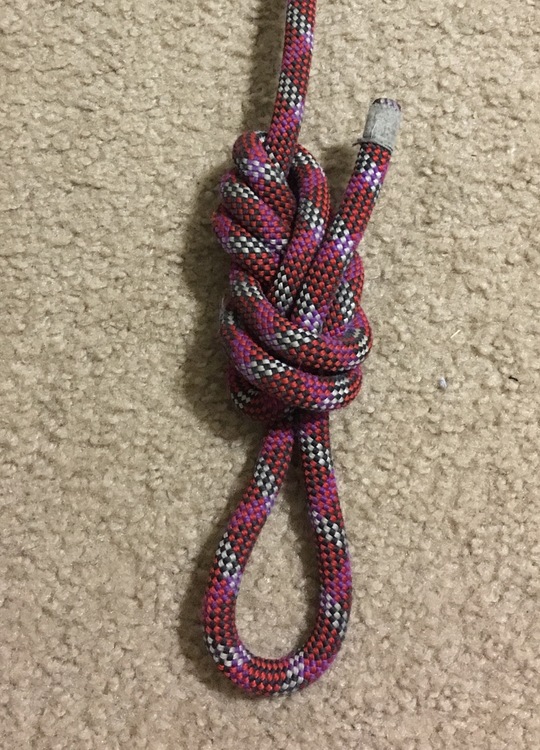 |
|
|
My question is why do any of these? |
|
|
cdec wrote: My question is why do any of these? There are two reasons why I like using the Yosemite finish: 1) the one Zach D. referenced upthread-- to wit, "people have come to think of it as tidy and out of the way" (which I think it is), and 2) I still can't quite bring myself to not do any sort of "backup" knot or extra finish, even though I know full well the figure-eight retrace is perfectly strong and safe enough on its own (so long as you have enough tail). Both are very small reasons for doing any of this, I know. Reason #2 is even irrational and purely habitual/superstitious. But I do like how "streamlined" the knot feels for fast-and-close clips. Has it made the difference between send and sail-off on some desperate project? Surely (k)not. But has it made me THINK that the clips will be easier/quicker, thereby facilitating the right frame of mind for send-sational top performance? Oh yes. It must have. :) Truth be told, I have found myself tying in with or without it depending on how much tail I have accidentally managed to leave at the end of the retrace. If I have the right amount of tail, or if I think the pitch is going to be a rope-stretcher and I have therefore been careful about leaving as little tail as possible, then I'll throw on the Yosemite finish. If I have tied in quickly and left too much tail, but it's a quick TR burn where it's not going to matter, then I'll take up the extra slack with a big ol' unnecessary finishing knot, like a half a triple- or quadruple fishermans, just to use up tail. My gym partners have noted my lack of consistency in this regard. But then again, I belay with any of at least three devices depending on my mood that day, so... |
|
|
brian’s photo is what i call the figure 9 - it’s out of the way and even stronger than an 8 while being easier to untie. the photos in the op all have issues in comparison. surely this must have been discussed elsewhere, but my google fu is weak. |
|
|
petzl logic wrote: brian’s photo is what i call the figure 9 - it’s out of the way and even stronger than an 8 while being easier to untie. the photos in the op all have issues in comparison. I’m not sure why this might be called figure 9, I thought it was the classic Yosemite finish. This thread got highjacked from how to properly do the Yosemite finish to a lot of nonsense about ring loading. There are two ways to tie the figure 8 (depending on whether the load strand comes from the lower or upper strand on the bottom loop in the knot). 1)If it’s the lower strand it is reported to be an overall stronger knot but the Yosemite finish comes out like the OP pictures. 2)If the load strand is the upper of the bottom pair you can do the Yosemite finish as in Bryan’s photo. So there are at least 6 different possible combinations and as you can see in mountainhicks Vimeo above, some will fail at much lower loads(30%). So regardless of whether you are worried about ring loading, the way you do the Yosemite finish can make a big difference should that happen. |
|
|
cdec wrote: My question is why do any of these? To get the tail out of the way. Advantage of the Yosemite is that it tucks it nice and clean UNDER your knot. |
|
|
Also use and love the “okie finish” shown above and would love to see some testing results. Probably also easier to call it a Yosemite bight finish |
|
|
#4) double bowline |
|
|
It does not matter how many times, which direction, or even if, the rope end passes around the rope leading to your belayer before passing down through the figure 8. All variations of the Yosemite finish are essentially the same knot. So, to the OP- all variations are correct. |
|
|
cdec wrote: My question is why do any of these? cdec's got this right. for my own clarification and because i saw the horse twitch.... |
|
|
Thanks for the advice this has all been very helpful! |
|
|
cdec wrote: My question is why do any of these? I like having the tail out of the way of the lead of the rope from my harness. That's the only reason for me. If you tie Fig 8 with adequate tail, you do not need a backup/stopper knot. I also dislike the overhand backup because of added bulk/interference in the instances of clipping at the waist. |
|
|
Cal Sayneuswrote: I'd worry about cross loading or shock loading the knot, it's also possible that the angle that you force the rope in at when putting it through in #1 could cause what I call microtears, basically the rope equivalent of a microfracture. These occur especially in something like the yosemite finish, where it could force all of your weight onto that one strand that the rope tightens around. I've lost a few friends to microtears, so stick to option 2 or 3. you've lost *a few* friends to microtears? That is horrifying. One single person has lost several friends to a type of climbing accident I have never even heard of? Statistically something is going really really wrong here - if you have lost several friends, that's already many many many times the normal accident death rates in North American mountaineering. Now add losing several friends to one cause? I'm confused/scared. Please clarify. |
|
|
His friends died laughing at his jokes. Apparently you’re safe Alan. |
|
|
Ted Pinsonwrote: IDK Ted, the tail is only in the way if you are on a TR or following and the rope is going up, otherwise the rope is going down away from you. I generally only leave 4-5 inches so I don't think any kind of "finish" is even desirable. |
|
|
Buck Riowrote: I used to do a picture-perfect Yosemite finish just to keep the tail nice and clean, and away from the rope when grabbing to clip on lead. Then I saw the YouTube video of the dude testing the various versions of the figure 8 for ease of untying, and I've since abandoned any finish. Tie it correctly (there are 2 "correct" versions, and one is easier to untie after loading), keep a 4-5" tail, dress it well, and it's never a pain to untie. |
|
|
i thought the long end went up my b hole |
|
|
Use to use #3 but since learning about the Competition knot 5 years ago, I've exclusively been using it unless climbing in a gym (rare). |