
 Continue with onX Maps
 Sign in with Facebook






Fixe 12mm SS sleeve bolts
|
|
What do people think of the newer Fixe sleeve bolts? While they seem like a good deal for a nice quality sleeve, I've placed a few now for soft rock and have had a tough time getting them to tighten in a couple instances, even though I am using a 12mm bit. I've tried pre-tightening them a bit before hammering them in to see if that helps them bite, but even then I've had some spin. Seems like the outsides of their sleeves are really smooth and that might be part of the issue. Other questions: the lock washer—should it be in between the nut and hanger or between the hanger and the rock? What about the removability of these? Seems like a tricky operation to pull the sleeve out with a pair of pliers. Maybe using a bigger hanger would help with this? |
|
|
I had all the same issues kbz or kb3 have made my life way easier. |
|
|
John Colliswrote: Haven't used their new design but I have used a few of their old triplex anchors that I modified to function the same way (cut the rim off the sleeve -- they were previously way too easy to remove... if that answers your other question). Also haven't used them in Moab-soft rock but rather semi-soft mica-rich schist. You're probably best off using glue-ins but if you're set on using the new triplex bolts, you might consider using a well-worn 12mm bit. This will ensure you get the tighest fit and won't increase drilling time appreciably given the softness of the rock. |
|
|
Washers always go between the bolt head and the hanger. |
|
|
One other thing I did try was taking a few of them and roughing up the outsides of the sleeves a bit on a rock at the base before using them. It was a very high tech and scientific process. Anecdotally it seemed like it made a little bit of a difference in number of spinners since the sleeves weren't so super smooth afterwards. |

|
No opinion on the new Fixe, but I will say that I've been happily surprised with the Dewalt Lok-bolts in 1/2" (stud itself is 3/8"), and have found some good deals on them. Sleeve design provides good resistance to rotation, and they've tightened down splendidly for me. Not as pretty as the Fixes or the old Powerbolts, but they seem every bit as solid as the latter. Downside is they look like they'd be impossible to remove...so I install them as such. Take me climbing in Moab sometime and I'll give you a handful. |
|
|
Logan Petersonwrote: If the hanger hole is the same diameter as the drill bit (1/2” with the 1/2” bolts you describe) Lok-bolts are often removable with very few tools (as long as there isn’t an extension tube spacer at the front of the bolt like some of the longer lok-bolts have). Unscrew the nut a 1/4” or so, tap the internal bolt in a little, remove the nut and maybe tap in slightly more, pinch both the sleeve and internal bolt with needlenose vise grips, and twist the bolt back and forth as you pull it out. I’ve done quite a few of the Redhead 3/8 x 3” version that way |
|
|
Drew Neviuswrote: do you have a good method for the ones with a spacer in front of them? I'd be interested to hear what you have to say. |

|
Note that Lok-bolts are VERY weak for their diameter. They are nice as far as not producing spinners in soft desert sandstone, but I would say the minimum diameter that you should ever consider for climbing is 5/8" (which you can use with either a 12mm or 1/2" hole hanger, the bolt core just fits through a 12mm hole). Since you'd generally only use them in soft sandstone, drilling 5/8" should be no problem. Ones without the spacer can be easy like Drew said, but if there's a sleeve spacer/extension you're probably out of luck. Some photos of replacing an old bent 3/8" one (after snapping off the head of the bolt) here: https://www.mountainproject.com/route/106538566/kashmir |
|
|
Lincoln Swrote: I’ve only tried two of those (1/2 x 3” I think). I tried treating one like a wedge bolt. Spinning it enough caused the hole to widen from the grinding and the bolt eventually came out. Slightly oversized hole was reused with a glue-in. The other one couldn’t be removed because the sleeve repeatedly re-engaged on the cone, tightening back up. I chopped the section extending from the wall, then drilled an adjacent hole and replaced with a long glue-in (similar to this: https://www.mountainproject.com/forum/message/116977340) |
|
|
Drew Neviuswrote: Cool, didn't expect that could work! Might have to try this in cases where either the bolt is long enough to have a spacer above the sleeve, or you can't get to the sleeve with needle nose pliers. With 3/8" Lok-bolts you'd need a 5/16" spinner tool. Looks like just swapping the adapter off one of Greg German's 3/8" spinner tools (which the ASCA has if anyone needs one) with one of these ought to do it: https://www.mcmaster.com/91072a150 Also various companies make bolts of this design, we're just saying "Lok-bolts" because they are an easily identified bolt from one major manufacturer. And sorry for the extensive thread drift...this has nothing at all to do with the Fixe bolts! |
|
|
Greg Barneswrote: Perhaps you have a better source of information than I, but I'm seeing an ultimate shear rating of 4860 lbs (20.8 kN) for the 1/2" Lok-bolts. Maybe it's an error, but the 5/8" have the same rating. Am I missing something? |
|
|
Logan Petersonwrote: The UIAA require bolts to hold 25 kN in sheer and 20 kN in tension |
|
|
Drew Neviuswrote: Dang, I'm glad you got it out but its a bit disappointing to hear that the longer sleeve bolts with two sections are basically the last thing that will go in a given hole. I'm curious to try the YABR on one of these things in the super soft local sandstone. I've been installing 6" sleeve bolts around here, and that cone is properly deep in the hole once the bolt is driven in. Maybe I'll try buying a long tap just to try cutting some threads in the lower sleeve and pulling that with a stud. |
|
|
Logan Petersonwrote: It's an error, supposed to be 7,200 pounds. The really concerning number is the tension (pull-out) on the 1/2" which is only 2,235lbs, or 10kN. Here's an older chart for the Lok-Bolt, not quite comparable since it's different weight concrete than on the current chart, but you get the idea: 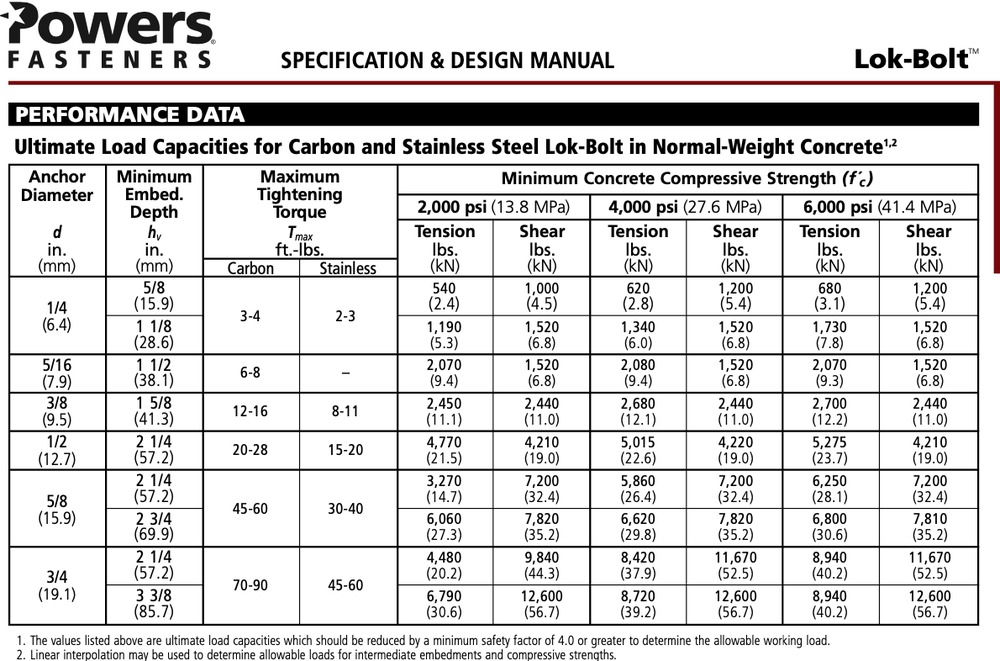 |
|
|
Greg Barneswrote:
Noted, and I thank you for the data. Will definitely avoid installing these in less-than-horizontal orientations. |


