
 Continue with onX Maps
 Sign in with Facebook






Anchoring with Rope Question


|
|
Hey there, As I get more into trad, I am trying to learn as many skills as possible for emergency situations. For example, I thought, "What if I drop my belay device like a Gumby?" I learned how to belay from above with a munter. Now I am thinking, "What if I forget a cordelette, or run out of slings?" Would this be an appropriate way to build a 3+ piece anchor with the rope? I would anchor in and belay from the master point created. Cloves on each side - tied with one hand ;). 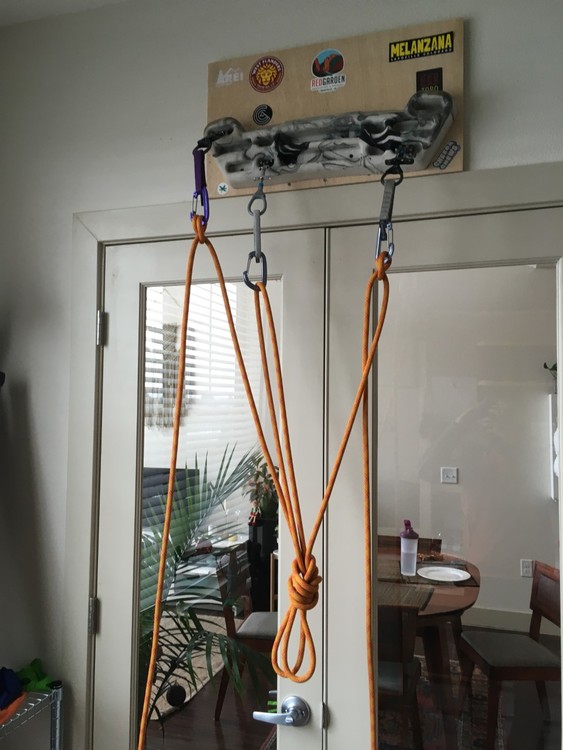 I've read some other posts and articles, but haven't seen this method exactly. Am I gonna die? -Doug |
|
|
It's fine. Practically textbook.
|


|
Looks plenty safe but imo unnecessary to use so much rope. You don't "need" a master point. Consider anchoring directly to the right piece and building a much shorter master point with the two pieces at left to use as the redirect for your second. Lots of ways of course. If course you can just daisy in series and weight the lowest piece yourself and redirect from the middle piece so the second still loads two pieces roughly sharing the load. That is what I normally do. Quick, safe, uses minimal rope. I don't carry a cordelette. |
|
|
Ditch the cordalette all together. I use the double or triple bunny ears eight 90% of the time when building my anchors and belay off the shelf. You are doing good and learning to improvise. Keep it up. |
|
|
Another thing that came to mind as I worked completely through this... Say I am clove hitched in on the rightmost piece. Once I have my 2nd up with me, how do I continue on? Taking my clove off of the right piece unequalized the master point and leaves me with 2/3 of my anchor pieces connected. The only thing I could think of would be to have the second clove in, then rebuild the anchor from the "bottom" of the rope where the second is connected. Basically, how do I escape it? |
|
|
Alec Baker wrote: I think the workaround during a block lead is to leave the cloves in, both you are your partner connect to the master point with slings, untie and swap ends of the rope. Then get on belay, come off the slings, and continue. Easiest would be to swing leads, I see that now for sure. I lead 95% of the time with my partner, so I missed that |
|
|
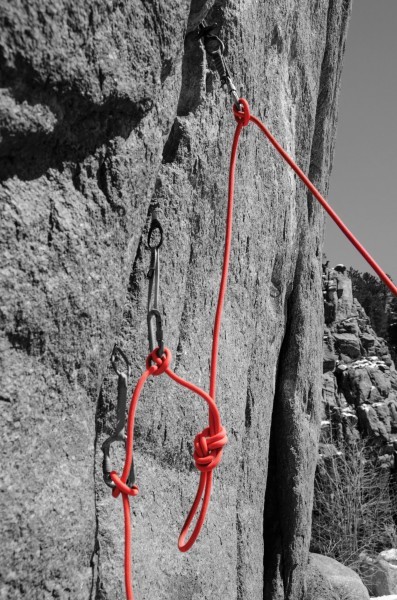
Doug Simpson wrote: A better way to block lead like this would be to add a carabiner to each piece (so all 3 pieces have 2 biners) and you clove into one biner on each piece, then when your second arrives take their end of the rope and run it under yours to clove into the other biners. Flip the rope, go on belay, remove the biners you’re attached to and climb. Typically when I do this, I clove into one piece (which one depends on where I’m standing and which side of the anchor is easiest for the leader to take off of) then create a master point between the other 2 pieces to belay the follower off of. The second could mirror this if you’re block leading so the master point could be used as a redirect for the leader. There other many other ways of doing it but this is generally how I do. |
|
|
 |
|
|
Posted many times going back a long way. The redirect.on point is strictly optional and not usually a feature of the anchor, Using a butterfly knot for the power point is a good idea if it is anticipated that the power point will get substantial and/or sustained loading, because the butterfly is relatively easy to untie afterwards. Most of the time, an overhand loop will be just fine. 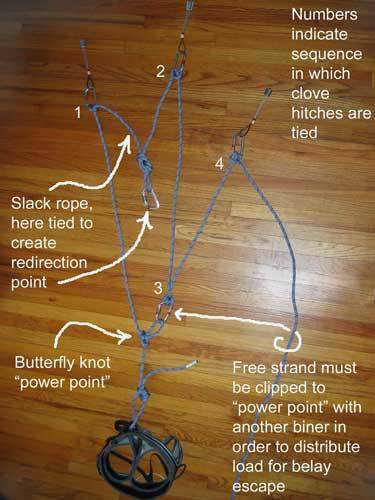 |
|
|
@rgold That's a clever little set up, like the use of the butterfly. I'm a 'double rope' user but can see how I could utilise some of the ideas. I tend to typically just do the usual Brit thing of using the rope and indirect belay, (unless block leading). Your set up does seem efficient and easier to escape, although in over 20 years I've never had to escape the system at a belay despite practicing every now and again to stay 'on it'. |
|
|
Neil B wrote: I'm with you on both the half ropes and the harness-level belay. Even with two ropes to play with, sometimes I only use one of the ropes for the anchor, leaving the other rope completely free. If you don't have any use for a power point, the value of having it here is that it makes it simple to escape the belay, If you put carabiner 3 on the tie-in loop rather than on a power point knot, then escaping the belay would be much more complicated. |
|
|
Poor rock quality. I would not trust this anchor - your primary placements are garbage and will sheer out in the event of a fall, lol j/k. In all seriousness though, this IS the biggest concern. How you rig it is secondary as long as you are attached to all the gear, you’ve minimized extension and everything is equally tensioned, and you have redundancy. What you have satisfies this and in fact may be a little too much. Efficiency becomes the next concern - you want something that can be built quickly and is flexible for different circumstances. What would you do if the gear were more spaced out, as is often the case? |
|
|
Doug Simpson wrote: Using this approach when block leading is a misapplication of the technique. If you’re block leading build your anchors another way. |
|
|
Anonymous Climber named Zay wrote: I also banshee belay anytime I come to a pair of bolts. To people saying to not use the rope when you're swapping leads, I find it to be pretty simple. You just reclove the follower into the anchor pieces and the unclove the leader. When I've done it, we've typically had the follower change over and flop the rope while leader reracks. Adds a minute or two at a belay at most. On something huge I'm sure that makes a difference, but adding 10-20 minutes for a ten pitch route is kind of nominal unless you're chasing daylight, and even then I think the fastest way to get up is to climb more efficiently. |
|
|
Doug Simpson wrote:  Edit: Doug you're on the right track asking good questions. If you climb long enough you're going to run into odd little situations. Keep adding Tools to your Toolbox ;-) |
|
|
Lot's of ways to do this. Some people use so-called "magic" carabiners to make transition easier.
Else, Both clip into rope anchor with slings and then swap rope ends. Else, leader carries one cordelette, second carries another. Leader takes second's cordelette at the belay station. Rinse and repeat. |
|
|
Doug Simpson wrote: this system is obviously safe and fine, but it uses up a fair bit of rope that then cannot be used by the leader on the next pitch. I've done plenty of pitches in the alpine where every bit of a 70m rope is needed. just keep this in mind.. |
|
|
If I was anchoring to those three pieces I would connect two with a runner, make a master point and tie the rope from the backside of my clove to the third. Simpler, faster to build and still economical on material use. You could use the girth hitch master point if you wanted to use only a single length runner. |
|
|
Of course one of the main advantages of using the rope to build the belay as opposed to cordalettes, slings etc is that it makes it easier to force your mate into leading the next pitch if it looks proper dodgy! |
|
|
Another reason to use the rope to build anchors is that it is BY FAR the strongest piece of gear you have on hand and is dynamic. There are efficient ways to built an anchor with the rope (many outlined here) that negate the need for carrying a cordelette or pre-rigged quad. Being safe and moving efficiently as a team requires understanding your gear and being able to use different pieces of gear for multiple things. Once I started tying anchors with the rope I've never looked back. And also been able to convince every partner I climb with (eventually, some don't want to let go of that cordelette) to do the same. |
|
|
James Frost wrote: I sure wish more people would figure out this is all you need. |


