Continue with onX Maps
 Sign in with Facebook






Direct belay off Anchor on multipitch routes - best device?


|
|
Matt Castelliwrote: Correct, or approx 1.7x the force due to friction.
Nope
Yes, physics (or at least people that understand physics) can figure it out.
Ummm. No!!!
That would be true if the belay device provided ZERO friction. Here's what you are missing. The equal and opposite force comes from the sum of the frictional forces at the device combined with the force generated by the belayer's hand. And a belayer's hand tends to max out around 2kN or so. A true redirect has very little frictional force. Thus, much more force is required by the belayer's strand in a true redirect such as a top rope (where the belay device assists). You are neglecting the friction in the belay device or friction hitch (munter) in a direct belay.
You are conflating many different issues. What you have posted is inaccurate, misleading and downright false in some cases. I suggest you delete your posts as you make a fairly simple discussion much more difficult to navigate. |
|
|
banshee and screw |
|
|
Joy likes tradwrote: Are you hitting on me? |
|
|
Noel Zwrote: If you actually put a load on the climber's strand you will see that the tube orient's itself properly. Probably a bad choice of carabiner (both too small and non locking). Have you actually read that it is the incorrect way according to the DAV? Maybe this configuration provides too much friction and doesn't allow for enough slippage as happens with a flipped Italian hitch. |


|
Great discussion everybody. There's quite a bit of confusion, too, so if this technique is new to you, I'd strongly recommend getting some expert instruction before you incorporate it to your toolbox. The OP's query was about "why do it this way?" and I skimmed responses, so apologies if I missed it, but, seems like nobody has simplified the answer...situations where a direct belay is probably far safer: --Belayer is significantly lighter (25%) than the leader --Inexperienced belayer who might/will probably drop the leader if s/he is moved/displaced by a very hard fall (see IG video/post below) --Any displacement/movement of the belayer would result in injury (think belaying in a cave or with icicles above belayer's head) --Real probability of a FF2 onto the anchor or high-force fall within the first 15m of a pitch (see IG video/post below) My son is 10 years old and super-stoked on climbing. After a couple single pitch routes, after a couple leads (his, not mine!), he of course looked up the cliff and said he wanted to do some multipitch climbing. He weighs maybe 70 lbs and I'm almost 170. A fall with him lead-belaying off his harness would almost definitely injure him, if he can travel upwards at all. OK, so anchor him down, but then: he's still going to get pulled violently upward and will still move somewhat, pulling him into the rock/etc---there's a good chance he will drop me if he's using an unassisted-braking device. Still a chance to pinch his hand or have a GriGri or assisted-braking device (ABD) get pulled into rock and fail...so 10 minutes of instruction, a pair of gloves, and he was capably direct-belaying me with a Munter. I kept the leading mellow so a) less chance of me blowing it and falling off and b) he could follow easily and still have fun. Over time he has become so comfortable belaying, I've taken a couple small test-falls (he ties an overhand on a bight on the brake strand, clips it to his harness as a backup) and he's done fine. He has belayed me on single ropes, as well as two 8.3mm half/twins (with both of them bunched into a fat Munter), too---zero drama. Manage the rope stack so it feeds smoothly and it's easy. After a few weeks of this, we incorporated a plaquette and he got that down pretty quickly, too. We used an Edelrid Gigajul in unassisted mode, per manufacturer's instructions. As somebody rightly pointed out above---the Edelrid instructions showing a MegaJul on a direct belay: the device is rigged backwards in unassisted mode! Instagram video of a professional climber catching her boyfriend on a fall early on the pitch---yikes. https://www.instagram.com/p/CB6N0Vyq3yo/ ENSA testing regarding direct belay: https://www.youtube.com/watch?v=eqZQnCGl24A Note on the ENSA testing: the softest catch (including belaying with a GriGri off the waist and jumping) was with a direct belay, using a Munter---BUT they intentionally let rope slip through the hitch during the fall. Gloves required and excellent technique! Derek and Ron F have probably done the most actual testing of direct belays in the lab. I route my technical questions about the technique thru Derek. In the field I've used it primarily when working with kids--they've all done really well with it! One or two pitches and futziness goes away, requires good positioning of the belayer and with a little creativity, easy enough to do with trad anchors. I'm all for "keeping it simple," but direct belaying is actually quite simple after a pitch or two of practice, especially if you consider the "complexity" of managing a violent fall and/or having to anchor an inexperienced belayer down. |
|
|
Anonymous Climber named Zay wrote: Like, bro, if you have to ask.... Ha! But regarding kids: I just have my kid belay me the whole pitch like that....given I'm almost 100 lbs heavier, a lead fall even 20m out could yank him into the wall...he seriously hasn't complained once about doing it. The little punk is now leading, so he top-belays me on an ATC-Guide....madness what these little suckers learn and how quickly! |
|
|
Single-point glue-in anchors and belaying the leader directly off a munter on the anchor is basically synonymous with climbing in much of the Dolomites. When I've done it, I've found a munter to be the easiest to manage – more so than a redirected brake strand + ATC combo. A good summary of the tests/methods here: alpinesavvy.com/blog/belayi… |
|
|
if you have an inexperienced belayer you have zero buisness falling. If your belayer is so inexperienced that you don't think they can catch you without a gri gri etc then you are guiding today which means you are not falling unless you are simply top roping single pitch. |
|
|
Sorry. Some of this is repeating myself, but my homemade photos may not be helping and I have found what my I was looking for in my original post - a method I can work with. So here are the guidelines and illustrations direct from the horse's mouth translated as best I could from German. The DAV state that it‘s only okay to belay off the harness:
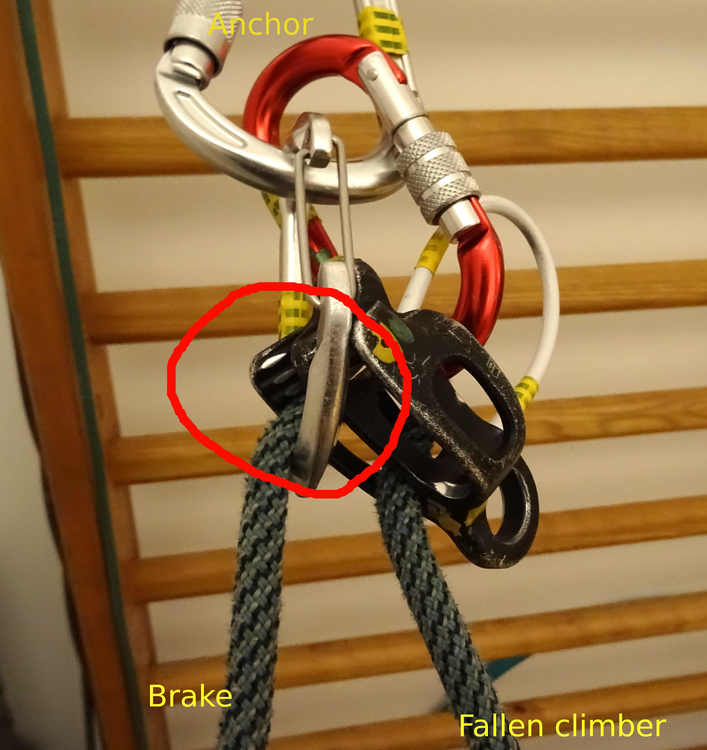
If any one of these requirements are not met, the DAV recommends belaying directly off the anchor. To do this use a munter or an ATC. Here are their illustrations on how to setup an ATC. ATC setup 1 - where there is no dummy runner 1) Where there is no re-direct bolt/dummy runner, then a redirect-biner must be clipped between braking hand and ATC to insure the correct routing during a fall for friction. Yes, there would still be a factor 2 fall, but the device will provide friction. Look closely, the DAV illustration shows the ATC setup in an unconventional way, brakeside up. They don’t provide a reason for this. I have used the setup, but never caught a fall this way. In my experience managing slack with the ATC setup as shown is best, but I can't say whether or not there is less or more friction. The redirect-biner can be removed once a reliable bolt has been clipped. A prudent belay might add an slip knot unted the ATC until the first bolt is clipped. 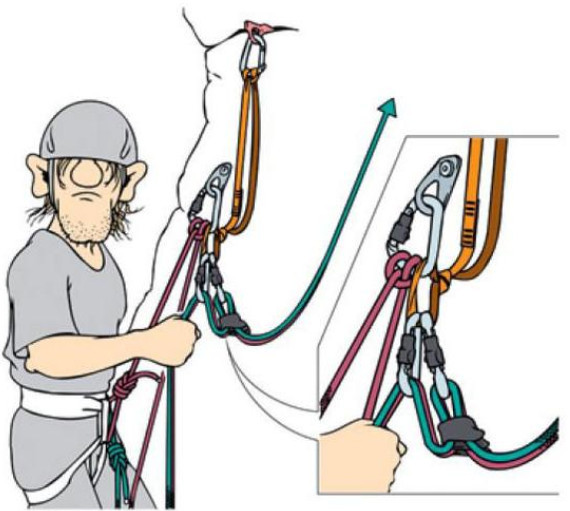 ATC 2 - Dummy runner available 2) Here the ATC is orientated in the expected way, brake side down, an there is a dummy runner. This is the more desirable ATC setup. 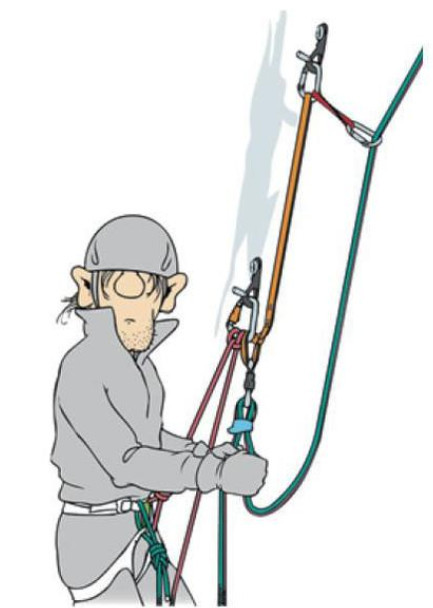 My most likely new goto method From the posts in this thread and the solid testing data presented in the document lined below, I think a hybrid method will be my goto choice. I always climb with a grigri and an ATC. I will begin by belaying direct off the anchor. Probably with an ATC but a munter is also fine. My grigri will already be attached to my harness and loaded with the brake strand. Between ATC (or munter) on the anchor and the grigri on my harness I gaude a cache loop of adequate length to get the leader passed several pieces of good gear/bolts. Under the grigri I will place a slip knot. Once the leader has good gear between me and him/her, I will remove the ATC or munter and belay off the harness with already insitu grigri. Removing the ATC or munter is easy and should be done while the leader looks comfortable. A munter will be easier to remove. The grigri with slip knot will always be providing redundancy during the changeover. I would also remove any dummy runner or redirect close to me so that I can provide a soft catch for the leader. An inexperience belayer using this setup will a least not drop me all the way if he/she is my belayer. Might be difficult to teach though. I climb with some very inexperienced climbers and they must belay me. Try convince even a very experienced climber, who is uninterested, about the danger of a factor 2 fall. I, as the leader, could setup the cache loop, grigri and knots before leading. At least I know they won't completely drop me. My hybrid dog's dinner of a setup 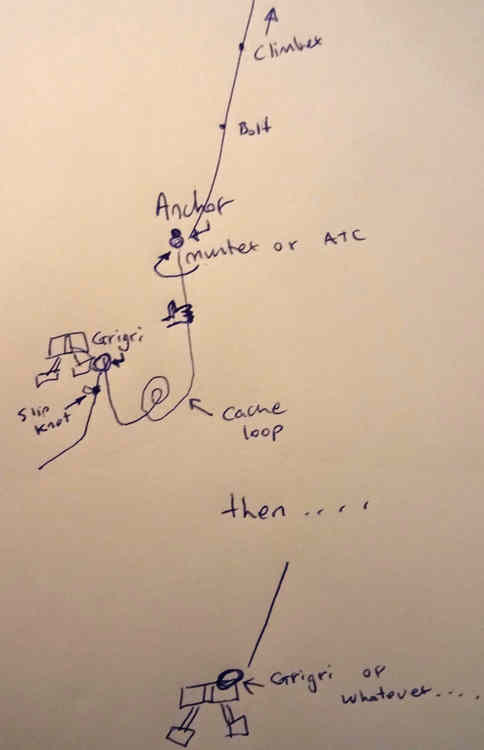 |
|
|
Thanks for the images...haven’t checked out « ATC Setup 1, » but at first glance I think it would be hard to feed smoothly....maybe I’m misreading it...I’ll give it a try! |
|
|
Here's my take. Factor 2 falls directly onto the anchor are extremely rare. In reality, the care taken by the leader not to fall without pro in is exceptionally effective. If using a tube, there is a way to manage the belay that does not disable braking in the Factor 2 situation, so the belayer does have a chance of stopping a factor 2 fall. I've had the pleasure twice in 63 years of climbing, once with a hip belay and once with an ABD {Alpine Up). The jolts are huge but we walked away from both and in one case went on with our day of climbing. Based on this personal experience, I don't envision going through the steps of setting up the hybrid system for every pitch; in fact for the majority of pitches I'm going to continue to count on the leader not falling, at least if it is someone I know well. That leaves a relatively small number of situations in which moves off the belay are a concern for us. My first thought in such cases is to see if the "plus clip" strategy is available and use that if it is. My experience with steep routes is that hanging the belayer well below the anchor is often impractical, uncomfortable, and time-consuming; I think the technique is best applied to relatively low-angle slab climbs. But there are situations where there is an alternate stance for the belayer removed from the anchor and it is fast and easy to set that up; then I'd go with that. If neither of these two options is available, I'd go with the hybrid direct off the anchor belay approach, using a Munter on the anchor and reverting to a harness-level belay after enough pro has been obtained. In the climbing I do, I expect this would turn out to be an extremely rare occasion, but I'm ready to do it if the circumstances arise. I'd add that this is probably not a viable solution for guides. |
|
|
Rgold, does your take assume similarly weighted climbers? Would you consider the direct belay if your climber out weighed you by 100lbs or visa versa? |
|
|
Live Perchedwrote: Yes I was assuming that because its been the case with almost all of my partners. A direct belay (if the anchor is up to it) seems like a really good idea with a 100 pound weight difference. |
|
|
rgoldwrote: Actually, a direct belay with Italian hitch is the configuration that puts the smallest load on the anchor. 1) Already in the 70s the CAI, and later the UIAA, concluded that a properly managed italian hitch would produce a maximum load of 3KN (even under a FF2 fall). 2) A recent study of the CAI (2014) on mobile protection (900 pulled samples of cams, pitons and nuts in granite and limestone) showed that: "for 9 out of 10 pieces to be able to hold a fall, the load needs to be below 2KN". 3) Another study (2013) showed that two loosely triangulated pieces resulted in a worst-case load distribution of 35 and 65% on each piece. From 1) and 3), the max load on a piece will be 3KN*65% = 1.95KN. Based on 2), there's a 90% chance that piece holds. Bomber belay with minimal gear and fuzz? The DAV says a tuber has a similar braking force to the Italian hitch. |
|
|
Fran, I knew about reference (1) (well, not specifically about the 3 kN figure) and results analogous to reference (3) have been repeated in the US. But I'm not familiar with reference (2) and wonder about the wording as you've reported it. I think it means that with a load of 2 kN they got 90% of the pieces holding. I don't think this says anything about the probability of failure for higher loads, is that right? I also wonder how their sample might have been affected by fixed pitons, which occur in Europe at a much higher rate than in the US. Can you provide a link for reference (2) (even if in Italian)? Here's a CAI video of folks catching falls (incuding FF2's) with the Italian Hitch. MP's link mechanism doesn't implement links that start at a time after the beginning, so click https://youtu.be/j0LlIImcnUg?t=1085 for immediate access to the good stuff. |
|
|
rgoldwrote: Then what do you mean "if the anchor is up to it"? I think it should be the other way round.
Right, nothing else but as stated.
Pitons faired slightly better. Can't paste a proper link. Google Ancoraggi di roccia - test de estrazione CAI. I think there was a presentation in english by Andrea Manes that can be found in youtube.
I mention the tuber to imply that all of the above could be applied to it as well. Personally, I've found that the tuber handles better for 8.3mm double ropes. It allows for double rope technique. Even then, I find myself using the Italian hitch most times. |
|
|
rgoldwrote: That CAI video is frightening. Never having caught a fall on a Munter/Italian hitch, the prospect of have my hand being dragged into the knot is unappealing. The tester all grimace as they take the rope and await their tests. They don’t look to be in pain after the results but clearly are not ambivalent before the tests. Is hand in the knot the normal result when catching a falling climber? |
|
|
when you guys say Italian hitch are you referring to the Munter? |
|
|
Nick Goldsmithwrote: Yes, Italian hitch is a common alternative name for the Munter hitch. |
|
|
Fran Mwrote: Some trad anchors are not able to withstand high upward loads. Moreover, I don't think the superior rating for the Italian Hitch on the anchor takes all the possibilities into account. As I've mentioned many times in other places, I use a modified harness belay in which the device is clipped not to the harness belay loop but to the rope tie-in loop. Combined with a snug tie-in to the anchor, this transmits the load directly to the anchor while still allowing body bracing to have some effect, so transmission is mediated by the length of dynamic rope connecting belayer to anchor as well as possibly some belayer resistance. Forgetting about belayer contribution, you could consider this a direct belay on the anchor with the device connected with a length of dynamic rope rather than being clipped straight to the anchor. I caught a Factor 2 fall with this set-up using an ABD (Alpine UP) and the jolt was big but not remarkable. I was well-braced and as the anchor tie-in stretched I absorbed a bit of the load with my legs. Of course the rope energy absorbtion depends how long the belayer tie-in is, but mine was not especially long in that case; perhaps three feet. A set-up like this might compete with the Italian Hitch directly on the anchor in some cases, and I feel better using such a system with an ABD, which isn't going to provide the advantageous slip of the Italian Hitch. I don't think this type of set-up was part of any tests. |