
 Continue with onX Maps
 Sign in with Facebook






Direct belay off Anchor on multipitch routes - best device?


|
|
Krimpit thee Frog here wrote: Just don't use a Munter or it will double the force on your waist. /S/ |


|
Matt Castelliwrote: You've got your fizziks wrong. In the no-slip situation, there is no "equal and opposite force on the brake hand side," because there in no pulley effect when the rope is effectively fixed to the carabiner. This means it is wrong to double the anchor load value for the no-slip case (which by the way was modeled with a Munter Mule, not a Grigri). In the rope-slip case, there is a 20 kg load on the brake side, which means that 0.2 kN should be added to the recorded falling climber load to estimate the anchor load. When this is done with the reported averages, the result is the rope-slip model reduced the estimated average anchor load by 28.5%, an amount very much in line with the Petzl results using a Grigri. |
|
|
I feel like this is only tangentially related but my partners think I am a weirdo and then they end up liking this. If I am on a multipitch with a high factor two fall risk, I back clip the first bolt of the next pitch and then I go back down to the anchor and essentially just top rope them up with the gri gri. That way they are on lead for the next pitch when they get to me and they are protected from a factor 2 fall. |
|
|
Princess Puppy Lovrwrote: are you really worried about a FF2 on a bolted multipitch? makes more sense when on gear... |
|
|
Princess Puppy Lovrwrote: i do this a lot as well. it makes the transitions quick as the other person doesn't need to clip into the anchor, etc. it also works great for those partners who like to go as high as possible off the belay before they get their first piece in ;) |
|
|
curt86irocwrote: For some reason yes. The last few I have been on have a crux through a traverse over hang that is reachy for my shorter partners. I would rather clip a bolt or place a piece when I am on lead rather than attached to anchor trying to help them reach the pro. Being a human stool a pitch up isnt fun for me. |
|
|
Noel Zwrote: We don't have a lot of multipitch climbing around here, so... ;) |
|
|
Princess Puppy Lovrwrote: This is basically what I was saying. Your suggestion to back-clip the first bolt of the next pitch is important because your partner will have that draw clipped correctly as she leads past it. Doing this enables belaying off of the harness. |
|
|
Fran Mwrote: @Live Perched I think the munter hitch is used so much in Europe because it handles better and more predictably than other devices in the role. @aikibujin is right that an ABD device (e.g. Megal Jul) would make things an even greater PITA. Still, an ATC could be used, but with mitigation tricks. Going back to the ATC trick for use where no dummy runner is immediately available and the question of which way to point the friction grooves. I setup the ATC again, this time the way not recommended by the German Alpine Club. The friction grooves now point to the brake hand and to the redirect biner. After playing around with this I can say that the feeding is just wrong. The friction grooves and the hole for releasing in guide mode interact in unpredictable ways with the redirect biner. With the groove point to climber, the recommended way, the flatter area sits nicely against the redirect biner. In my photo of the non-recommended way, even just pullying slack back in draws the ATCh back into the redirect biner. It may be may poor choice of biner, but on a route you take what you can get. So, the Alpine Club's setup seems correct, even if it looks wrong at first. My photo is of the wrong way, the German Alpine Club illustration is the right way. Incorrect way according to German Alpine Club 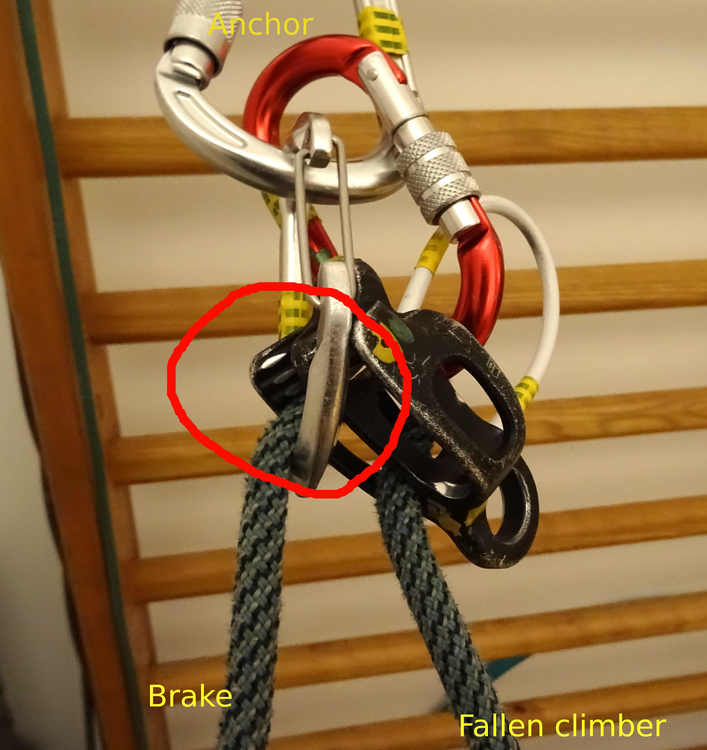 Correct way according to German Alpine Club 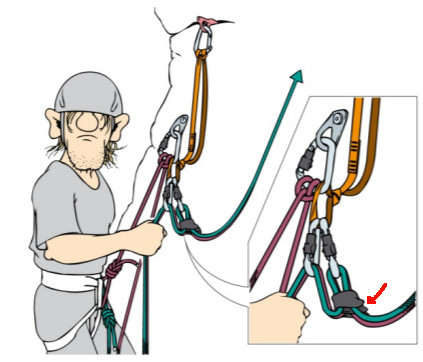 It just dawned on my how the correct setup, seen here after a climber would have fall, is the same principle as the LSD Lower technique. Right? 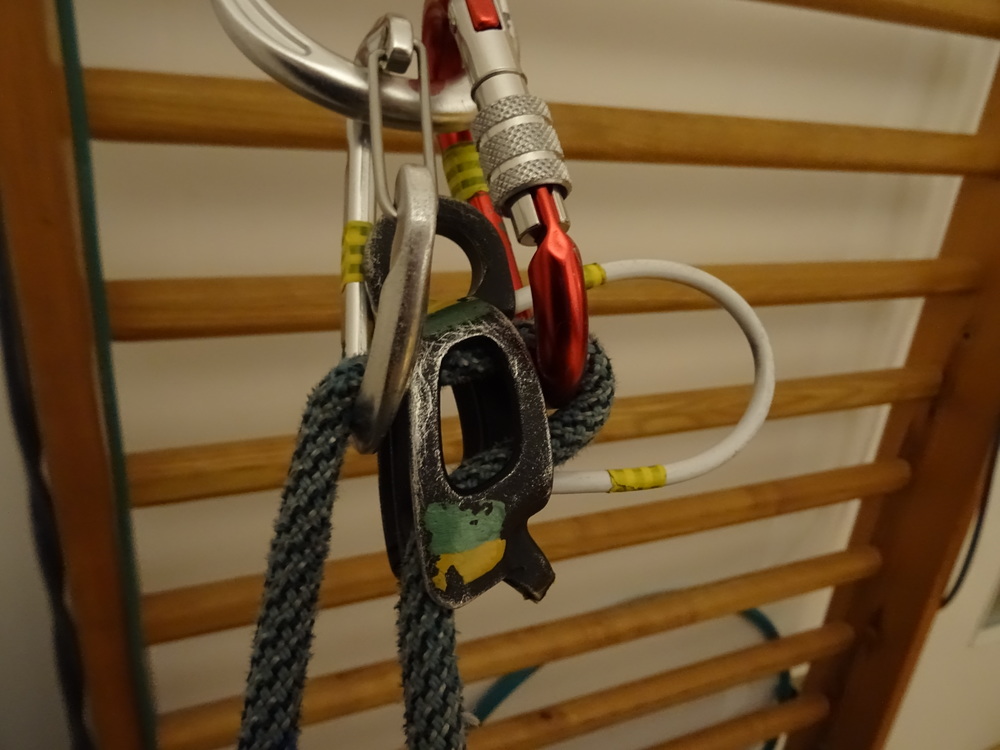 |
|
|
Do Germans really have to use such long words? |
|
|
Princess Puppy Lovrwrote: i guess i get it, but it seems like if the belay is bolted, just have the leader clip one of the anchor bolts and off they go. if there really is a crux before the next bolt, at least they're not falling directly on your device... but like you said, i can see very particular situations where the technique you described could be useful. |
|
|
Nick Goldsmithwrote: They only have 37 words total, so they have to string them together in different combinations to make new words. English, we just borrow everyone else words. |
|
|
Noel Zwrote: I thought that as well, but I don't believe it's a LSD. It looks like a LSD because we're loading the plate with the friction groves towards the load strand. In your photo, the load is on the right and the brake is on the left. For a LSD lower, this would be reversed and the climber would be on the left (or top, if you're belaying a follower on the anchor). What we're actually creating is a redirected plate, since we're redirecting the brake strand and the blocking carabiner is clipped to the anchor. |
|
|
Matt Castelliwrote: Thanks for sharing - this (1) restores our faith in the intuitive notion (questioned 2-3 years ago) that being belayed by a movable belayer can soften the catch for the climber and (2) provides a nice "table 4" summarizing the pros & cons of the 4 techniques available. |
|
|
Adam Flemingwrote: In his photo there's not a real load on the climber strand, so the brake strand is holding the device up higher than it would be in a realistic fall scenario. Under weight of a fall, the device would be lower and rotated and the rope bending angle would be sharper. I have to wonder if the extra carabiner shenanigans are really better than just holding the brake strand in the correct orientation. |
|
|
JaredGwrote: Thanks for pointing that out. I think you're absolutely correct about the device being lower with a real load. It would be extremely unnatural to hold the brake strand above the anchor. Failing to do so would be catastrophic. I would definitely keep the redirect until the climber got a couple good pieces of pro in the wall. It let's the belayer easily hold the fall with almost no thought or reaction. |
|
|
When i see those photos, the german word that calls out to me is "klusterfuck". |
|
|
slimwrote: The original German is “Komplikatenkonvolutenstandplatzklusterfucken.” Americans shortened it. |
|
|
Noel Zwrote: Yes, sounds like you understand it quite well. It's my preferred option. Limiting the amount of rope running through the munter during the pitch also helps minimize how much the munter twists the rope, especially if doing so for many pitches. |
|
|
Live Perchedwrote: In my opinion yes. Using an ATC or similar requires a redirect carabiner, which is a bit tedious. The redirect carabiner can be removed later once there is adequate protection in the pitch.
If using a hybrid system (such as grigri on the harness), then yes, it's quite easy to remove. And you're correct: if you wanted to use a hybrid system with the tube device, you'd need one on the anchor and one on the harness. I don't typically find myself carrying two belay devices unless I'm guiding, and even then it's situationally dependent.
A munter or tube device both keep the max forces on the climber "acceptably" low, so in that sense you could treat them as equivalent. An ABD (ex. grigri) does not. But note that "acceptable" is up to 6kN, so the falling leader is still probably not gonna have a great day if they end up taking a the factor 2 fall. |


