Continue with onX Maps
 Sign in with Facebook






Direct belay off Anchor on multipitch routes - best device?


|
|
When in Rome, do as the Romans do. As mentioned this forum is NA based so you won't get as much experience with this method. In NA for a lighter belayer typically an extra protection piece is placed near the belayer's feet with a sling from it to the belay device biner without any slack. All the advantages of belaying off your waist and you won't go flying if a heavier climber takes a lead fall. For bolted anchors where this isn't possible the method used in Germany sounds logical. |

|
@Noel Mo: I prefer a hybrid method: Place a grigri (or other preferred assisted braking device) on your harness. Pay out enough slack in front of the grigri for the leader to get a few pieces of protection. Build a fixed point belay with a munter hitch, per normal. Note that the grigri on your harness serves as a catastrophic backup for the munter in the event of belayer incapacitation. Once the leader has placed sufficient protection, remove the munter hitch and belay off your harness. @anyone else who's interested: Do not use an ABD for a fixed point belay unless explicitly stated in the manufacturer's technical notice. This includes a grigri. In the event of FF2, the minimal rope slip with an ABD increases peak forces, which can be particularly bad news for the falling leader. Also, gloves are strongly recommended for a fixed point belay. |

|
A major advantage of the fixed-point belay is that the belayer is in far better position to catch a factor 2 fall. Tube-style devices on the harness will just plain fail in this situation unless the belayer uses a palm-up hand position and brakes up rather than down. I have never seen anyone belaying properly with the leader in factor-2 territory (which of course is often very easy). Some people must know what to do, but they are a tiny minority from what I've observed. If the Factor 2 happens to a belayer with device on the harness and they don't lose control, which seems very likely with the conventional improper handling, the jolt can be tremendous. I've had the pleasure, and it ain't like catching other leader falls, believe me. The hybrid method seems like a good compromise for these situations, and since the munter is removed once the leader has pro, the need for the anchor to be super solid for upward loads is lessened, and this means the hybrid method can be used with trad gear in situations where it wouldn't seem wise to have a direct anchor belay that would impose upward loads. |
|
|
Joe Say'nwrote: If the leader finishes the pitch and continues up to the next bolt or good gear placement, clips her rope to it as a redirect, and descends back to the belay anchor, she can belay off of her harness as she brings up her partner. If her partner leads the next pitch, the lead rope is already clipped to the piece above the belay anchor. Assuming that the piece is bombproof and the rope can’t unclip itself, a factor-two fall is impossible. Therefore, the partner can continue to be safely belayed off of the first leader’s harness (without having to reconfigure the belay) as he begins his lead. If the first bolt or gear placement is a long way above the belay anchor, the belayer should stand or hang at least two meters below the anchor, using a long tether, and using the equalized anchor as the first clip on the next pitch. Also, an upward-pull anchor (any bolt or gear placement that can resist a strong upward pull), placed below the belay, can prevent the belayer from getting yanked upward when the leader falls. More complicated isn’t necessarily safer. |
|
|
slimwrote: On the anchor it will, because it doesn’t create the pulley effect a tube style device would. The force on the climber is a different issue. |
|
|
I've used the "plus clip" a few times to avoid having to make hard moves off the belay with no pro. If the second is going to be belayed via a redirect through the high piece, that piece better be bombproof! Out of an abundance of caution, I've sometimes placed two "plus clip" pieces and made a mini-anchor for the second's redirect. |
|
|
Marty Cwrote: It’s a different situation, as petzl tested forces when the belayer belayed off the belay loop. No dispute it will be a harder catch for the climber, but you’d eliminate the pulley effect belaying w a Grigri off the anchor. |
|
|
Matt Castelliwrote: You are comparing a Grigri on the anchor with a tube on the harness with redirect through an anchor point. This is a highly misleading comparison; you've condemned the tube to a worse performance by using it in a different system, but are reporting the discrepancy as simply a feature of Grigri vs. tube. Put the tube on the anchor too and the Grigri will produce a substantially higher load. |
|
|
@ Karl Henize I did ask the question in European forums, where off the anchor belaying is common, but climbing is cultural and not always objective so the responses are mostly... dunno mate.. that's why! The responses here are great, a different perspective. As a Brit living in Germany I was confronted with these contradictions of harness vs anchor? Now, when I climb at home in the UK I notice tension for the precarious first steps up from the anchor. In Germany nobody ever cares. Let's face it, if the first pro/bolt/dummy runner is only 1-2 feet above the belay device then you will be pulled in no matter what your weight. So the German logic holds water: 1) protect your belayer from injury and any resulting involuntary dropping of the dead rope (and you), and (2) protect the anchor by not adding your belayer's weight as well as yours in a fall. But the paying out and taking in is horrific. It is easier with a munter than any device I've used (ATC, Grigri). @Derek DeBruin I think your hybrid method sounds workable. The best of both and redundant. |
|
|
Derek, rgold and Noel, is the munter on a fixed point most convenient/easiest for paying out line and catching falls? is the munter preferred because it does not require carrying a second belay device and can be removed quickly when the belayer switches to the belay device on a harness?
@all, this is a very useful thread!!! |
|
|
If the leader takes a FF2 fall onto the anchor, with a munter hitch the belayers hands are in the position for maximum brake force, but with an ATC there will be almost no brake force at all in the same hand position. This is why I like a munter, it's simple and easy to use. ATC require additional mitigation for a possible FF2 fall, one mitigation is to re-direct the brake strand so the belayer has a chance to catch a FF2 fall. That's the configuration in this photo Noel posted. But managing slack in this configuration is a big pain. 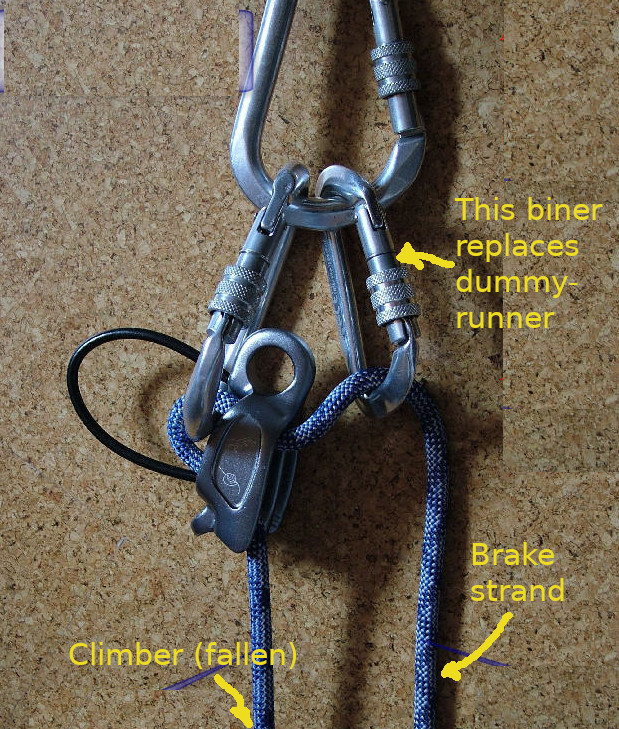 Another mitigation is to clip a jesus draw/piece (dummy runner), this mitigate the possibility of a FF2. That's this other photo Noel posted. In this case the second biner to re-direct the brake strand is no longer needed and can be removed. Managing slack become much easier. However, personally I like to have at least two or more protection points between the climber and me before I would remove brake strand re-direct, because one bolt can and have failed/unclipped, then you're looking at catching a FF2 with no mitigation. 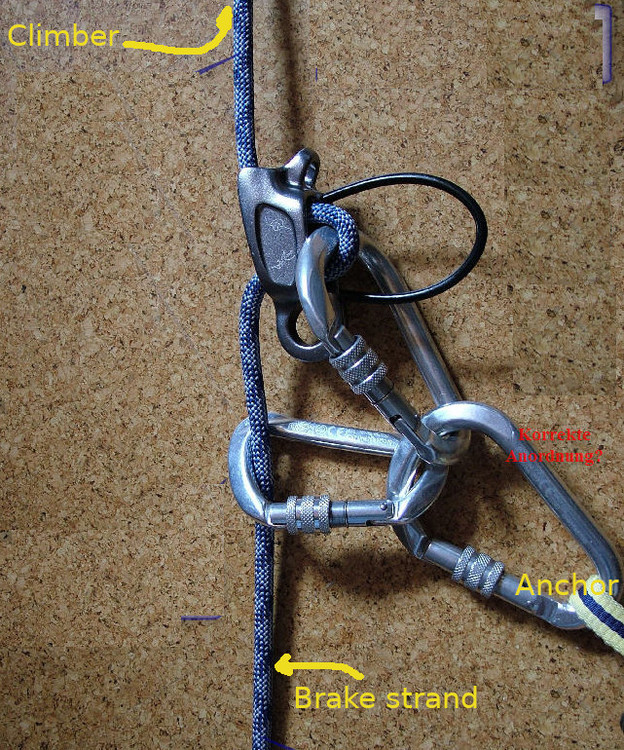 |
|
|
aikibujinwrote: Maybe I'm not looking at this right, But isn't that ATC rigged Backwards? Did I miss something in a post as to an advantage of it being in low friction mode for lead belaying? |
|
|
Joseph Raywrote: You're looking at it correctly. The ATC is not the conventional way around. This is how the German Alpine Club teaches it. When fully loaded, after a fall, the friction grooves are on top, the climber's side. A climbing buddy speculated that the climber's side has more force and that with the friction grooves on that side, the overall friction would be higher and not lower. I've never found any written information on whether this is true. It works though and it's only for when no dummy runner is available and additional biner can be removed after 1 bolt to 2 pro. have been clipped. With the ATC orientated this way, taking slack back in seems to be easier, as the grooves don't interfere with the jesus biner. |
|
|
rgoldwrote: I'm not, I'm comparing a grigri on the anchor to a tube or munter on the anchor. You example of a redirect is useful though, as it highlights how the pulley effect works: 2x force on the piece, one on the climber side, one on the belay side (the equal and opposite force). There is test data out there and it proves both our points. See below. Note that while the study didn't publish the load on the anchor with a munter belay of the anchor, physics can figure it out. It's the same concept above: equal and opposite force. The loads on the climber were between 4 and 7.75 kn. So that force is applied on the climber side, and an equal and opposite force is required on the brake hand side of a munter. Aka - double the climber's force to approximate the force on the anchor: 8 to 15.5kn. These values are more than the forces applied to the anchor when the no slip belay was tested (7-8.6kn). That said, I'll echo the findings of the paper: there are serious risks to all systems, and the forces to the climber are just too high in many of these scenarios, including a grigri off the anchor. The best solution seems to be the first leader clipping a piece or two above the first belay, then downclimbing. Then the second will be able to lead with a scenario that limits many of the peak forces and it largely doesn't matter what belay system is used. http://staff.weber.edu/derekdebruin/fixedpointbelay/Comparison%20of%20Fall%20Forces%20between%20Fixed-Point%20and%20Redirected%20Belays%20in%20Recreational%20Climbing%20Systems.pdf |
|
|
Has anyone used a Revo for a direct lead belay? My guess is someone will say it won't work because it would be a hard catch on a ff2. I would say it's a potentially promising device because it would catch a ff2 in basically any orientation, with or without redirects. Also, it is easier to feed rope than any other device, so I think it could make life better for the belayer. It's kinda a big chunk of metal to swing up into the rock during falls. Unlike a Gri Gri though, hitting the rock can't disengage the brake. |
|
|
Noel Zwrote: Makes Sense. I'm gonna play around with it a little bit so I can better understand it. |
|
|
aikibujinwrote: The Mega Jul's instructions carry no warning or additional requirement and assisted braking is included. But you're right, for the Giga Jul on the other hand there's no assisted braking (M mode) and this additional warning: "ATTENTION: This application may lead to reduced brake efficiency and increased passage of rope length. This application therefore should be reserved to very experienced users, who are capable of correctly estimating weight ratio, fall potential and friction occurring in the securing chain. Brake hand gloves must be used. The distance between the intermediate securing point and the fixed point at the station must be large enough to ensure that the device cannot be pulled up to the first intermediate securing point when it is loaded." That's turn off. |
|
|
Noel Zwrote: I've always wondered why they show the grooves towards the climber. I've used this setup many times and the grooves never seem to come into play in that configuration. In my experience, grooves towards brake strand increase braking force (for both a redirected brake strand and upwards pull). It does however, make taking slack in more tedious. In case you haven't tried,when using the redirect carabineer (no pro in yet), it is easier to feed slack whlie lifting brake strand so that the rope does not touch the redirect carabiner. |
|
|
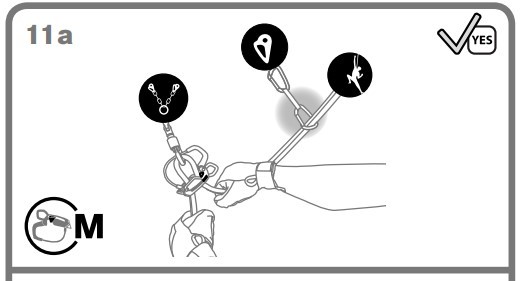
Despite the Mega Jul instructions, I would hesitate to use any assisted braking directly off the anchor, if a severe leader fall past the belay is possible. In severe falls, the forces on the climber, anchor, and top piece would be unnecessarily and perhaps dangerously high. There is also a possibility of damaging the rope. There is also the possibility of the rock restricting the movement of the device relative to the carabiner (potentially causing the assisted braking function to fail) to consider. The Giga Jul instructions seem contradictory to the Mega Jul instructions. The Giga Jul instructions tell you to use "guide" mode (what Americans might call unassisted braking mode), when belaying directly off an anchor. The Giga Jul instructions do not recommend using assisted braking mode for this application. 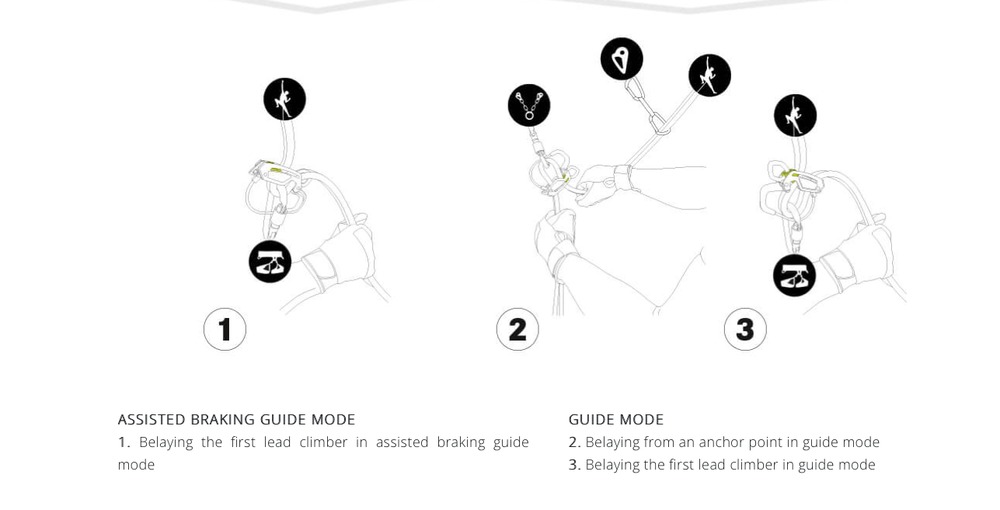
|
|
|
Matt Castelliwrote: So you think a Munter hitch doubles the force on the anchor like a re-direct? I had been taught long ago the Munter slips at about 2-4KN (about twice the amount as a hip belay). In your thinking just jerking an overhand on a bight and clipping that to the anchor will half the force compared to a Munter (which acts like a pulley). |