Continue with onX Maps
 Sign in with Facebook






Is trad climbing only crack climbing?



|
jt newgardwrote: Disagree! If we're at the point where people are calling Indian Creek "sport" and Whitehorse "trad", the lines have gotten blurry...if they were ever clear to begin with. Some of the original rap-bolted lines at Verdun, "the birthplace of sport climbing," are considered runout and scary by today's standards.
Can't argue with that!
Definitely, moderate slab is a joy. I'm just a practical person. I want to know if I need to bring quickdraws vs. trad gear and whether the climb is R or X. Looking at the recommended pro serves the same purpose but is less user-friendly from a database sorting perspective. If I want to know the history (and I often do), I'll read the guidebook. |
|
|
Great descriptions. If you're finding crack climbing uncomfortable, definitely look into some good crack shoes and tape/gloves. But some discomfort is expected. It is super rewarding to work through it and walk up a hand crack with ease. It's all in the technique. Look up the Wide Boyz tutorials on youtube. |
|
|
L Kapwrote: Actually we are in complete agreement :) I was being facetious with those first 2 sentences, although I’m realizing my chuckles didn’t make it across the keyboard and through the inter web! I also like that you mention the importance of PG/R/X etc. to the aspiring trad leader. A database of climber opinions could help scale these danger/severity ratings as a function of how hard a certain individual climbs. A climb could easily be PG for a 5.11 experienced climber but very much R for a 5.8 new climber. The moves are the same, the pro is the same, and the rating assigned (as things stand currently) is the same, yet the experience of the climber could not be more different! |
|
|
jt newgardwrote: Haha. Generally right after the crux |
|
|
Thomas Hoekwrote: Have you considered crack gloves? I found that they took away most of the hand-hurts and uncomfortable part of crack climbing, making me a lot more interested in doing it. (Foot jams may still hurt, though.) |
|
|
I always thought crack climbing wasn't for me. Same thing...always hurt, felt un-natural, and hard. Started placing gear last year and something clicked after a few months. Now I barely ever want to climb sport. What once felt awkward now feels secure and there's just something about a good jam that feels great. Being a sport climber first, you'll have an awesome base of strength and technique to work with. I think the funnest climbing areas have a mix of cracks and face climbing and feel relatively sporty (Eldo being the first that comes to mind). I say give it a go. Start with 5.6/7 and you may just soon find yourself as another crack addict. |
|
|
Tom Chingas wrote: The Gunk's is a trad mecca and the majority of routes don't require crack climbing technique (at least the classic moderates), they climb like steep jug hauls Don’t forget about horizontal hands jams..... |
|
|
jt newgardwrote: Completely disagree with you. The definition of the ratings refers to the likelihood of injury IF you fall. R is defined as, if you use the opportunity to place available gear, there is good chance of serious injury if you fall. X is defined as , even if you place the gear available, there is a serious likelihood of fatality if you fall. You may be more likely to fall if the climbing is harder for you, but you can be a 5.11climber on a 5.9 X route, which you would normally never fall on, and if a rock hits you and temporarily causes you to lose consciousness, you are still just as dead as the 5.8 climber who got on the wrong route. |
|
|
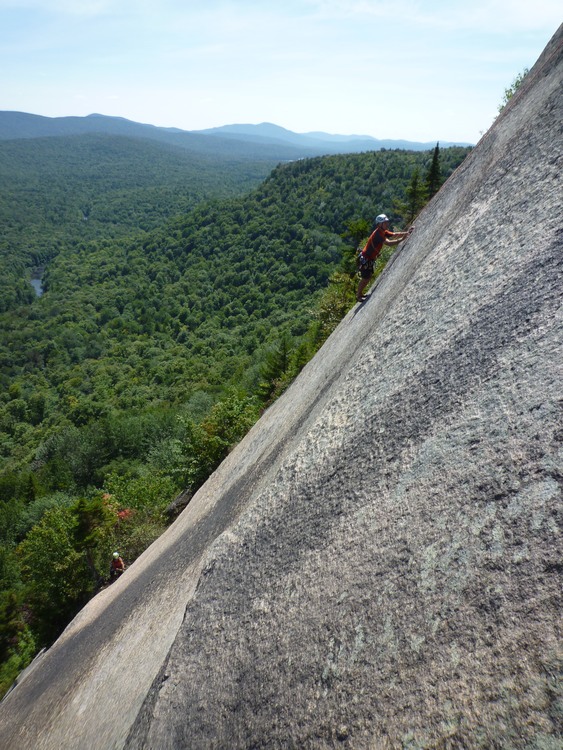
Gunkiemikewrote: Where is this? It looks like chapel pond slab |
|
|
phylp phylpwrote: Cool cool, I won't disagree with your definition, and I actually do see how that is very useful as a heads up for strong climbers on easier but R-rated routes. I'd just point to that oft-cited relationship where risk = likelihood x consequence. By your definition the PG/R/X ratings only consider consequence (how injured are you when you fall) and not likelihood that a fall occurs. Which seems like half the equation is just sort of left hanging in never never land. ********************************************* Edit for below, thanks L Kap again for clarifying! ...I am OK with that definition....I guess....haha... This is what happens when I can't climb, too much postin on the proj. But hey, word is that water is gonna fall from the sky soon....in California!! Back to your scheduled programming of what is trad and sport, or cracks and bolts and such ...I'm too old for this stuff anyway |
|
|
jt newgardwrote: No, that's exactly right. R and X ratings refer to the availability of gear placements and the objective consequences if you take a fall. R = if you fall near the end of the runout zone, you are likely to get seriously injured or possibly maybe die. X = if you fall near the end of the runout zone, there's strong chance you will die. It has nothing to do with the likelihood that any given climber will fall or how scared vs. confident you might feel. |
|
|
F Loydwrote: Solo with gear, perhaps? |
|
|
L Kapwrote: Agreed. The combination of climbing grade vs your climbing skill is how you should be able to estimate likelihood of a fall. You put that together with the fall consequence level (G/PG/R/X) and can decide on the total risk of the climb. So 5.9R is a lot more dangerous for someone who's red-point limit is around 5.10a than for someone who's red-point limit is around 5.12a. But that doesn't change the gear quality/consequences part of the grade. |
|
|
Levi Xwrote: Sugarloaf outside of Indian Lake NY. Much steeper than CP slab. Not much easier than 5.7, and several 10s. |
|
|
David Gibbswrote: Nice. I hope this tangent I accidentally brought up has been insightful to the OP. I certainly learned something new myself. At the risk of belaboring things, I’d submit for consideration the 5.9R climb where the hardest move is 5.9 and the runout, unprotected section is 5.6. Maybe that doesn’t make any difference, should not be reflected in this concept I had for a more holistic rating, and we all move on in peace...ha .... |
|
|
Like L Kap explained it’s been my impression that “trad” and “sport” just tells you about the style in which the route was established, and is not a designation intended to tell you about the protection, or the moves on the climb. The “traditional” way to establish a climb is to walk up to the base and climb it, placing removable protection or drilling bolts as needed on the way up. “Sport” climbing is a method to manufacture routes on otherwise unclimbable features, by rappelling down, cleaning the route and installing protection, and then attempting to send it. Because you’re not standing on a tiny edge or hanging on a sky hook hammering away at the drill bit, the sport climbing approach lends itself to more easily establishing G rated routes, but again I don’t think that safety is inherent just because a route was established this way.
|
|
|
The other big blurry line I'd advise newer climbers to watch for? Or anyone, at an area new to them? Routes in the lower grades put up in earlier times. No matter how they were put up BITD, if there are bolts guides often say "sport". No R or X, just an assumption it's easy and you won't fall. "Sport" climbers expecting "safe" are in for a surprise. "Trad" peeps who own gear may discover next to nothing for placements. If there are places gear could have been placed? Bolts may not be there, yet it gets tagged as "sport". Wahoo! To the OP? Learn to place at least a little gear, and recognize even "sport" might be more pleasant if you have more on your harness than just draws. You will also have a bunch more places to play! And second the opinions on jams. My go to has always been stuff the biggest body part that will fit, wherever it will go. Besides, some big guy's rattly something? May be perfect jams for my smaller self. Yay!! I do feel pretty helpless, as a belayer, watching my climber essentially soloing some big stretch with nothing at all. At that point, my main job is having a charged up phone to call it in, eh? ;-) 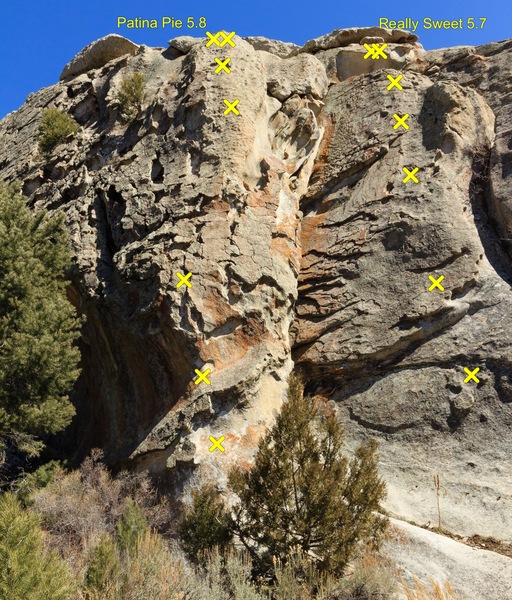 Literally almost half the route on Patina Pie. "Sport"....but not if you are leading at that grade, and expect to only clip draws. Both of these routes, bolts won't keep you from decking, until you clip number 4!  Then there's Conceptual Reality, a super easy, fun crack on the bottom....and fully bolted up top. Two entirely different climbs.  And? A favorite at City! Suncup slab. Two pitches of almost nothing whatsoever! Best, Helen |
|
|
Michael Vaillwrote: Who you callin crusty, guy? I'm aged, dang it !! Also in a better mood since my nice morning bike ride. It's been an honor postin with y'all, here we have a legitimately informative thread on nuanced topics. Like a streetside cafe conversation ... Helen, great post. The pics illustrate some of these points perfectly. Happy climbin! |
|
|
jt newgardwrote: It definitely does make a difference. I’ve done plenty of stuff with no scary safety ratings that contain substantial runouts in sections below the overall route’s grade...Red rock is a great example. You’ll frequently have large sections of unprotected climbing that is basically jug hauls on slab (so prob. 5.4 or so) but as long as the crux moves are protected the overall route is considered PG. If something is 5.9R/X I would be ready to climb near that level unprotected. Maybe not always, but it’s definitely on the table. |
|
|
Tom Chingas wrote: Sure is! sometimes |