
 Continue with onX Maps
 Sign in with Facebook






Is trad climbing only crack climbing?


|
|
I am looking to get into some trad climbing after having done quite a bit of sport climbing. Or maybe will I enjoy crack climbing more if I do it more? :p |

|
It 100% depends where you are climbing. But no, not all trad climbing is crack climbing. The protective gear needs to go IN cracks (or other irregular features), so trad routes by nature climb more featured rock and less blank face climbing than sport, but it’s not all hand jamming and Indian Creek splitters in trad-land. |
|
|
A wise old trad dad once told me: "Next to every crack climb is an even better face climb." He did not like crack climbing very much. |
|
|
To add to what others have said, it's easiest to find gear placements in cracks. So a lot of the easier trad routes are crack climbs. Where I am located, 5.6 and under you can probably cheat and avoid jamming. I think the more you do it, the more you'll like it. Learning to jam opens up a lot of possibilities...join us... |

|
There are tons of trad climbs which are bolted - some of them have zero pro except for bolts. They tend to be runout. Sport climbing is just a subset of climbs which are fully bolted AND relatively tightly bolted. Depending on the area, you can find lots of trad protected climbs which have no jamming at all, or almost none. |
|
|
Depends. If you live in Moab, you should probably learn to jam. Plenty of trad face climbs in the southeast. I actually wish there were more cracks here. |
|
|
Bolts were here long be for sport climbing came along. |
|
|
Thanks for all the answers and insights! |
|
|
Ask a British climber what trad is. |
|
|
Thomas, as people have already described, in many areas, there are trad climbs, protected exclusively by gear in cracks, but which which require very little crack technique. One of my favorite places to climb is Red Rock in NV, and a huge number of the routes there protect with gear but don't require crack technique - they are essentially face climbs that follow crack features. You mention cracks as hurting and being uncomfortable. That is typically only true on steeper cracks, where the torque on your hands and feet is what keeps you from falling. On low angle cracks (the often derided and scorned slab routes), you often can use those exact techniques with no pain whatsoever, even as a beginner in the style. Also, as you get more experienced, the pain goes away to varying degrees. Have fun! |
|
|
Greg Barneswrote: Wait... what? How is it a "trad" climb if the only pro available is bolts? Do you mean one pitch on a multi that only protects with bolts? Or a bolt ladder pitch on an otherwise traditionally protected route? Please explain. |
|
|
Chris Fedorczakwrote: Have you never climbed friction slab? |
|
|
So a lot of people have danced around the issue but the important thing to remember is that most trad climbs (at least: safe ones) follow a crack; depending on the rock, you may get some face features (as mentioned certain areas like the Gunks and Red Rock are more likely), but the crack is ALWAYS there, which is why learning to use it is beneficial. You don’t always have to fully commit to the crack like with IC or Granite splitters, but you’ll often make the climbs much harder (turn a 5.8 handcrack into a 5.12 layback). |
|
|
PWZwrote: A very little up in the North Cascades. As I said, if we are talking about one pitch of unprotectable climbing on an otherwise trad climb, then I understand what he is talking about. It was just confusing to hear "a trad climb that only protects with bolts." |
|
|
Ted Pinsonwrote: SOME face features? In the Gunks?? The vast majority of routes here permit exactly ZERO crack (jamming) movements. It's (often subtle) horizontals in otherwise thin-to-blank faces. I had to chuckle a while ago when I read some newbie (apparently) post something along the lines of, "I love trad; you can plug a cam overhear pretty much the entire way". And someone mentioned friction climbing. Something like this (pic) with bolts every 20-25 feet. NOT sport climbing. 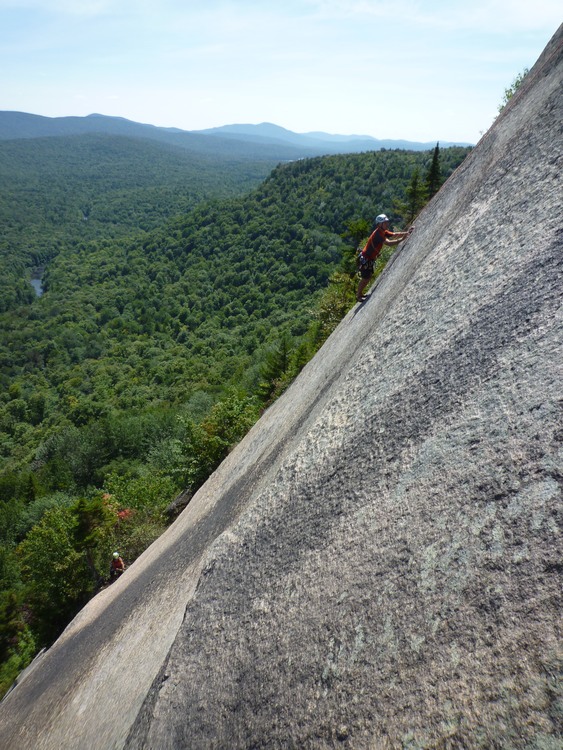 |
|
|
Chris Fedorczakwrote: Go climb in Darrington, WA. Friction slab, 20-60' run-outs (or greater), 2 ropes needed for descent, 2+ mile approaches (sometimes off "trail"), up to 25 pitches, little to no gear opportunities, routes that were put up ground up on sight, rapping off trees, etc Nothing you could reasonably call sport climbing. |
|
|
Chris Fedorczakwrote: This is why I don't like the terms sport and trad. The history here is that climbs that were protected ground-up in a bold style, putting in bolts sparingly where there is no natural pro, are considered to be traditional climbs even if the only pro available is bolts. So you get a lot of really run out climbs that are totally bolt protected but considered to be trad. Not just one pitch among many, but whole multi-pitch slab climbs that are otherwise unprotectable. |
|
|
L Kapwrote: Thanks. That makes sense. |
|
|
Chris Fedorczakwrote: Very common in Tuolumne Meadows and Yosemite Valley. |
|
|
L Kapwrote: That was a great description, L Kap. However, as climbers I think we can all agree it is best to stick with the historical terms and leave things be. If things made sense we'd have nothing to argue about. P.S. The slab-style bolted trad climbs are some of my favorite out there. They have a great flow since you are typically clipping at a very natural stance. We have a lot of these climbs in SoCal thanks to the older generation. It is a real reward to pursue them, when you first look up at these climbs they look totally crazy. Come back after some practice and they may just seem possible....... it is at this time you can vision quest into the great unknown. |
|
|
Gunkiemikewrote: Yes, but again: the Gunks is atypical. |


