|
|
Josh Rappoport
·
Sep 25, 2020
·
Natick, MA
· Joined Sep 2017
· Points: 31
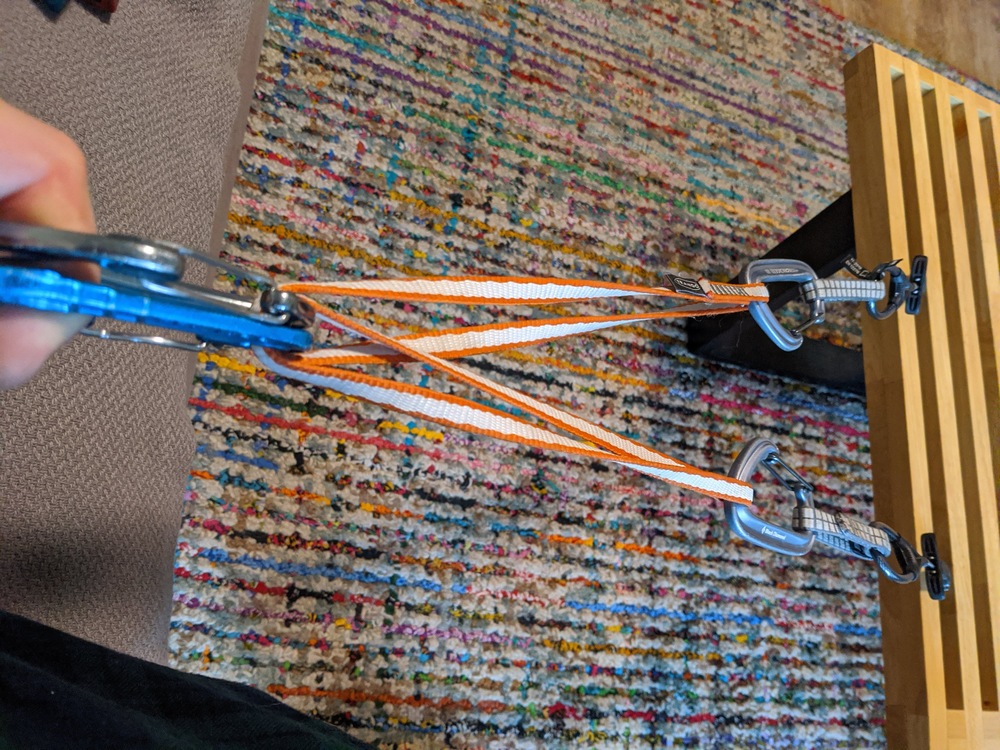
Would you want to do something to make sure the bar-tack stays out of the way?
|
|
|
Austin R
·
Sep 25, 2020
·
Las Vegas, NV
· Joined Aug 2018
· Points: 2
Clip it n rip it keep moving don't think too much etc. Also are u really gonna sit around at a Crux placing 2 cams and equalizing them on a sliding x? That sounds worse than just doing the move and moving on
|
|
|
Cosmic Charlie
·
Sep 25, 2020
·
Washington
· Joined Feb 2014
· Points: 0
Seems like overkill to me. Why wouldn't you use just one piece? The bartack could still shift around, right? If you want it out of the way, I would probably just clove hitch it to the cam biner. Personally, I wouldn't do anything like that on lead but I have clove hitched the anchor cord to the cam biner to keep the knot out of the way. (rare).
|
|
|
Josh Rappoport
·
Sep 25, 2020
·
Natick, MA
· Joined Sep 2017
· Points: 31
It was the clove hitch the bar-tack step that got me thinking this was probably overkill Thanks for the confirmation (and love the profile picture CC!)
|
|
|
Cosmic Charlie
·
Sep 25, 2020
·
Washington
· Joined Feb 2014
· Points: 0
Josh Rappoportwrote:(and love the profile picture CC!) Forever Grateful, Forever Dead baby!
|
|
|
John Clark
·
Sep 25, 2020
·
BLC
· Joined Mar 2016
· Points: 1,408
It is reasonable, but keep in mind you are lowering the effective height of both those pieces by equalizing, making your fall and fall forces larger than just clipping those two individually. If ledging out isn't a concern though and the gear is less than inspiring, equalizing a couple pieces is fine and the bartack shouldn't be a worry. A quicker way to get a similar result though (assuming a little flexibility on the placement) would be to clip a short draw to that top piece, bringing your clip in point on both pieces closer together. I agree with Austin in that the less pfaff you pfaff with, the more sending energy you'll have.
|
|
|
Bryan K
·
Sep 25, 2020
·
Chattanooga
· Joined Jul 2016
· Points: 699
If you feel the need to place two pieces at the crux like this, place the second cam in a little closer and just clip the second piece in to the same sling that you extended the first piece with. Still gives you a 2nd piece as a backup if the first one blows and is much quicker to deal with. No need to dick around with equalizing the pieces. Better yet, if the gear is bomber then just place one and go for it.
|
|
|
J C
·
Sep 25, 2020
·
Unknown Hometown
· Joined May 2015
· Points: 467
It's only reasonable to consider that kind of thing if all of the following conditions are met: A. hands free/really good rest stance at location of gear B. the gear is tiny C. forgot your screamers D. the best gear placements are within half a meter of each other All of these happen sometimes, but they rarely line up to convince me to mess around with anything but clipping individually. The one exception is that I sometimes place two pieces and clip them together in some fashion; this is mostly to conserve runners if I am placing two small pieces close together, not an effort to equalize them.
|
|
|
christoph benells
·
Sep 25, 2020
·
tahoma
· Joined Nov 2014
· Points: 306
I do this sometimes if there is a good stance. More often i will place 2 pieces and just clip them normally. 2 pieces can give some peace of mind!
|
|
|
Eric D
·
Sep 25, 2020
·
Gnarnia
· Joined Nov 2006
· Points: 235
This is a good idea and something I do sometimes with small gear, impeding run-outs, questionable rock, etc. Ignore the nay-sayers here. Though no need to worry about the bar tack.
|
|
|
Franck Vee
·
Sep 25, 2020
·
Unknown Hometown
· Joined Apr 2017
· Points: 260
It seems like too much work to me. Depending on the exact context of the route, but generally speaking.
I'm guessing you want to be able to commit to the crux with confidence. However in that case, it could be achieved simply by putting the same 2 pieces of pro & clipping them independently on 2 quickdraws. If whichever P1 gets loaded first and pops, then P2 would catch nearly immediately. Ironically (or perhaps not so if we think about it for a while), your setup would likely result in MORE force being applied on P2, should P1 one fail. If you clip them independently, then the load exerced on P2 would only be whatever different in length resulting from their relative position/lenght of draw. If you want, you could also use slightly different quickdraws to account of the relative position of those 2 placements.
There are 2 reasons I see why you would use this setup, instead of just clipping each separately, which would be : - Both are somewhat shitty you're not so confident in either but you think that both working together stand a better chance of holding a fall
- They need to work opposite to account for different likely directions of pull. It would make more sense if at least one of those is a stopper, as cams should generally be decently good at managing that. Though perhaps some weird topology may still make that relevant for 2 cams in rare cases.
If you are concerned about this/these pieces blowing in case you can't stick the crux, perhaps you may also be able to place other pieces shortly below, to also act as backup/confidence building. One last thought - if this is a tricky/project of yours, you may consider pre-rigging those pieces. Presumably you would know what gear you'll place & where, so nothing would prevent you from pre-rigging this double placement, already clipping on your draw etc. If that's the plan, I would suggest replacing the sliding X for a kind of mini quad-anchor. The reason being that, if properly rigged, the quad still gives you load balancing, but it also greatly limits the load placed on the remaining piece should one pop. In the case of 2 unsatisfying pieces of gear, this may be an important factor to consider.
EDIT: I'm not sure I agree with some of the comments above, about placing just a single piece vs 2 if that piece is good. Trad climbing, especially as the lower grades (which, no disrespect, you seem to be climbing, e.g. below some arbitrary limit we could place at 10+ or 11-), often is about your mental game just as much as it is about the physical/technical climbing aspects. With this in mind, if committing to a crux some distance above your gear isn't something you're fully comfortable with, building a mini-anchor below the crux is perfectly fine, IMO. Of course when we get to leading 5.11 & up on gear, that will have to change, as the weight factor may really tip the scale. But no need to optimize for minimal gear placements if that's not hindering your climbing at this moment. If those placements are indeed more about your mental game than about dubious quality of the placement, I would also suggest to take on those piece, perhaps even take smaller falls on them if the setup for that is safe enough.
|
|
|
David Deville
·
Sep 25, 2020
·
Fayetteville, AR
· Joined Oct 2013
· Points: 90
What is up with all of the talk about sliding x's lately? This is not a new concept, however, it's unnecessary and relatively ineffective. Research conducted and compiled by Thomas Evans shows that with static loads, LD anchors (LD= load distributing, AKA “self-equalizing” anchors) don’t distribute the load equally between legs. This is often due to friction in the system, particularly with the Sliding-X, and is dependent on the lengths of each leg. https://expeditiontraining.org/climbing-anchors-evidence-based-practices-myths-and-assessment-tools/
|
|
|
Josh Rappoport
·
Sep 25, 2020
·
Natick, MA
· Joined Sep 2017
· Points: 31
Franck Veewrote:It seems like too much work to me. Depending on the exact context of the route, but generally speaking.
I'm guessing you want to be able to commit to the crux with confidence. However in that case, it could be achieved simply by putting the same 2 pieces of pro & clipping them independently on 2 quickdraws. If whichever P1 gets loaded first and pops, then P2 would catch nearly immediately. Ironically (or perhaps not so if we think about it for a while), your setup would likely result in MORE force being applied on P2, should P1 one fail. If you clip them independently, then the load exerced on P2 would only be whatever different in length resulting from their relative position/lenght of draw. If you want, you could also use slightly different quickdraws to account of the relative position of those 2 placements.
There are 2 reasons I see why you would use this setup, instead of just clipping each separately, which would be : - Both are somewhat shitty you're not so confident in either but you think that both working together stand a better chance of holding a fall
- They need to work opposite to account for different likely directions of pull. It would make more sense if at least one of those is a stopper, as cams should generally be decently good at managing that. Though perhaps some weird topology may still make that relevant for 2 cams in rare cases.
If you are concerned about this/these pieces blowing in case you can't stick the crux, perhaps you may also be able to place other pieces shortly below, to also act as backup/confidence building. One last thought - if this is a tricky/project of yours, you may consider pre-rigging those pieces. Presumably you would know what gear you'll place & where, so nothing would prevent you from pre-rigging this double placement, already clipping on your draw etc. If that's the plan, I would suggest replacing the sliding X for a kind of mini quad-anchor. The reason being that, if properly rigged, the quad still gives you load balancing, but it also greatly limits the load placed on the remaining piece should one pop. In the case of 2 unsatisfying pieces of gear, this may be an important factor to consider.
EDIT: I'm not sure I agree with some of the comments above, about placing just a single piece vs 2 if that piece is good. Trad climbing, especially as the lower grades (which, no disrespect, you seem to be climbing, e.g. below some arbitrary limit we could place at 10+ or 11-), often is about your mental game just as much as it is about the physical/technical climbing aspects. With this in mind, if committing to a crux some distance above your gear isn't something you're fully comfortable with, building a mini-anchor below the crux is perfectly fine, IMO. Of course when we get to leading 5.11 & up on gear, that will have to change, as the weight factor may really tip the scale. But no need to optimize for minimal gear placements if that's not hindering your climbing at this moment. If those placements are indeed more about your mental game than about dubious quality of the placement, I would also suggest to take on those piece, perhaps even take smaller falls on them if the setup for that is safe enough. Thanks!
That all makes a lot of sense I totally get that the mini-quad would lead to less extension. Setting up the sliding X on the go already seems a bit much, I wouldn't even think about adding limiter knots...
|
|
|
Franck Vee
·
Sep 25, 2020
·
Unknown Hometown
· Joined Apr 2017
· Points: 260
David Devillewrote:What is up with all of the talk about sliding x's lately? This is not a new concept, however, it's unnecessary and relatively ineffective. Research conducted and compiled by Thomas Evans shows that with static loads, LD anchors (LD= load distributing, AKA “self-equalizing” anchors) don’t distribute the load equally between legs. This is often due to friction in the system, particularly with the Sliding-X, and is dependent on the lengths of each leg. https://expeditiontraining.org/climbing-anchors-evidence-based-practices-myths-and-assessment-tools/ I am not sure you have taken really taken to read the conclusions with attention. Another quote from the same paper: These data suggest that LD anchors, on average, do a better job of preventing an anchor point failure by more evenly distributing the load between anchor pointsduringdynamic events.
The point is NOT that load-balancing anchor (aka sliding-x, quad) do not load balance. They do, it's just not a perfect/magic solution. Again, from the conclusion of the paper, they themselves do not rule out LD anchors as irrelevent, as your comment seem to imply:
These generalizations are meant more as a rough guide, rather than a prescription for what kind of anchor should be used when. It is incumbent upon each rigger to identify the geometry, expected load, expected loading mechanism (static vs dynamic), and to choose what anchor to build given these constraints.
|
|
|
Bryan K
·
Sep 25, 2020
·
Chattanooga
· Joined Jul 2016
· Points: 699
Franck Veewrote:
EDIT: I'm not sure I agree with some of the comments above, about placing just a single piece vs 2 if that piece is good. Trad climbing, especially as the lower grades (which, no disrespect, you seem to be climbing, e.g. below some arbitrary limit we could place at 10+ or 11-), often is about your mental game just as much as it is about the physical/technical climbing aspects. With this in mind, if committing to a crux some distance above your gear isn't something you're fully comfortable with, building a mini-anchor below the crux is perfectly fine, IMO. Of course when we get to leading 5.11 & up on gear, that will have to change, as the weight factor may really tip the scale. But no need to optimize for minimal gear placements if that's not hindering your climbing at this moment. If those placements are indeed more about your mental game than about dubious quality of the placement, I would also suggest to take on those piece, perhaps even take smaller falls on them if the setup for that is safe enough. Being able to trust your pro when you know its good is very valuable in and of itself, especially for onsights. You might get on a climb where you have to commit to a crux move and there is only one piece of protection available and you don't have the option of placing more pieces. This is also not only applicable to harder climbs at 5.11 and up. There's a 9+ in Icebox Canyon here in Red Rock I hopped on earlier this year with the crux moves right off the bat protected by single 0 C3 in a very small pod in a seam. There was no other available gear at this point but the C3 was bomber so I trusted it and onsighted the route.
|
|
|
Franck Vee
·
Sep 25, 2020
·
Unknown Hometown
· Joined Apr 2017
· Points: 260
Bryan Kwrote: Being able to trust your pro when you know its good is very valuable in and of itself, especially for onsights. You might get on a climb where you have to commit to a crux move and there is only one piece of protection available and you don't have the option of placing more pieces. This is also not only applicable to harder climbs at 5.11 and up. There's a 9+ in Icebox Canyon here in Red Rock I hopped on earlier this year with the crux moves right off the bat protected by single 0 C3 in a very small pod in a seam. There was no other available gear at this point but the C3 was bomber so I trusted it and onsighted the route. Of course. But that is a process that is very climber-dependent, on personal risk tolerance, experience, climbing ability at the grade (e.g. a 12+ sport climbing on a 11- trad route may not feel the same as a climber who never pushed 11+, even on sport climbs), etc. There's often this kind of disconnect between the user profile that ask on question on this forum and the user profile who responds to is. Goes something like this:
Trad climber ask a question. Check tick profiles: lots of 5.7/5.8, maybe the odd 5.9 every once in a while, with 5.10 sport climbing.
Trad climber answer something related to how he climbs. Check tick profiles: onsights multipitchs 5.11 on gear, regular 5.12 sport climber.
The strategies one has to use on hard trad climbs have often little to do with what a relatively new trad climbers should do in his process to eventually get there. Or not - not every trad climber has as an ultimate objective of climber 11+ on gear.
|
|
|
Bryan K
·
Sep 25, 2020
·
Chattanooga
· Joined Jul 2016
· Points: 699
Franck Veewrote: Of course. But that is a process that is very climber-dependent, on personal risk tolerance, experience, climbing ability at the grade (e.g. a 12+ sport climbing on a 11- trad route may not feel the same as a climber who never pushed 11+, even on sport climbs), etc. There's often this kind of disconnect between the user profile that ass on question on this forum and the user profile who responds to is. Goes something like this:
Trad climber ask a question. Check tick profiles: lots of 5.7/5.8, maybe the odd 5.9 every once in a while, with 5.10 sport climbing.
Trad climber answer something related to how he climbs. Check tick profiles: onsights multipitchs 5.11 on gear, regular 5.12 sport climber.
The strategies one has to use on hard trad climbs have often little to do with what a relatively new trad climbers should do in his process to eventually get there. Or not - not every trad climber has as an ultimate objective of climber 11+ on gear.
Hard is relative to the person who is climbing the route and what their limit is. You can encounter similar situations in terms of placing gear and committing to moves being on a 5.8 just as you would on a 5.11 which was my point. I don't see how committing to moves when you have a bomber piece in has to do with climbing at any specific level. That is just an aspect of leading on gear that you have to be comfortable with at any level if you want step up your game, whether your limit is 5.11 or 5.8. If 5.8 is at your limit and you get in a bomber #3 in a deep horizontal in solid rock right before the 5.8 crux is it doing you any good to place another piece as a backup? That's what I'm getting at. EDIT: post limits reached. Responding to the post below, if the leader equalized the pieces with a sliding x and clipped in to a single carabiner at the end that would still have the same risk of the rope magically unclipping itself in that scenario. What you be suggesting would be to clip the rope with two opposing carabiners or a locker each time and that's a complete waste of time apart from very specific scenarios where the carabiner might be loading weirdly and you can tell that ahead of time. That's not the same thing as placing a 2nd piece of gear as a backup piece.
|
|
|
Crotch Robbins
·
Sep 25, 2020
·
Unknown Hometown
· Joined Apr 2003
· Points: 307
If the pieces are spaced vertically you can clip the top piece with a screamer and the bottom piece with a regular draw and then the screamer will extend until both pieces are loaded.
|
|
|
Patrik
·
Sep 25, 2020
·
Third rock from Sun
· Joined Jun 2010
· Points: 30
Bryan Kwrote: If 5.8 is at your limit and you get in a bomber #3 in a deep horizontal in solid rock right before the crux is it doing you any good to place another piece as a backup? That's what I'm getting at. Redundancy is a great thing. Just ask all climbers who have had the rope magically unclip itself from solid pieces of gear during a fall.
|
|
|
Austin R
·
Sep 25, 2020
·
Las Vegas, NV
· Joined Aug 2018
· Points: 2
Patrikwrote: Redundancy is a great thing. Just ask all climbers who have had the rope magically unclip itself from solid pieces of gear during a fall. Ok where are they so I can ask them
|
|
|
Evan Kirk
·
Sep 25, 2020
·
Unknown Hometown
· Joined Aug 2014
· Points: 116
In an academic sense, yes. In a practical sense, no. Personal opinion here, but always choose the right tool for the job. Go climbing and you will see why this might not be the “right tool” for the given “job”. Then again, maybe you might encounter an instance where it is. Learn lots, keep your mind open, and always remember coming to a hard stop is bad news.
|

 Continue with onX Maps
 Sign in with Facebook