Mountain Project Logo

Coronavirus on a crag that is in the sun

Ted Pinson · · Chicago, IL · Joined Jul 2014 · Points: 252
Mark Wyss wrote:

90% of what you said was correct, however, the one-hour survival on a hard surface is a stretch.  Climbing gyms with sweaty handholds and people breathing hard all over them on the route is going to be a problem.  Not to mention door handles going in and out of yoga, weights or cardio rooms is dangerous.  It is most likely going to stick around on ropes, biners.  My guess is there aren't too many studies out there focusing on chalky, sweaty handholds.  Going to a gym now is a bad move.  They are going to become Petri dishes in due time. 

Totally agree.  Again, the key finding in that study is that *indoor* transmission is much more common.  I would extend what you said to now is probably not a great time for conga lines or sharing routes with strangers.  But if you show up to a wall and no one’s there, chances are pretty low that someone with COVID literally got off the wall and grabbed the exact holds you’re about to use.  If people are practicing safe social distancing (IE: not sharing a wall with other parties) they’ll probably be ok.

tom donnelly · · san diego · Joined Aug 2002 · Points: 405

Even on a sunny route, some holds are shady, or little sections of holds are shaded.  I would still avoid popular routes, all gatherings, and shared cars & equipment.
Also that study is just a preliminary draft.

"...chances are low that someone ... grabbed the exact holds you’re about to use "
Most people do use most of the same holds.

Aerili · · Los Alamos, NM · Joined Mar 2007 · Points: 1,875
Dana Bartlett wrote: I check UpToDate every day, I use it for work and my freelance work. The summaries of the expert opinion articles about COVID that discuss your questions, i.e., transmission, environmental contamination, virus survival outside a host are: "We don't know yet." "More research and data are needed before a conclusion can be made."  And so on.

Thank you, Dana. 

The research put out by the National Biodefense is preliminary at best. This research needs validation. It is neither peer reviewed nor published.

From what I've read via reliable sources, UVA and B aren't that effective at killing viruses when compared to UVC (which doesn't penetrate our atmosphere), at least not in any reliably short time frame in most cases. UVC is used to disinfect objects, including medical equipment and drinking water. 

This article from the BBC Future states:
"Though there hasn’t been any research looking at how UVC affects Covid-19 specifically, studies have shown that it can be used against other coronaviruses, such as Sars. The radiation warps the structure of their genetic material and prevents the viral particles from making more copies of themselves.

However, it's not quite as good as we might have hoped. In a recent study – which looked at whether UVC could be used to disinfect PPE – the authors found that, while it is possible to kill the virus this way, in one experiment it needed the highest exposure out of hundreds of viruses that have been looked at so far. The amount of ultraviolet required varied widely, depending on factors such as the shape and type of material the virus was on
."  

You can either read what you want to hear into the news presented by the U.S. government or you can wait for it be to validated and reviewed by other experts. Option 2 is the only smart tack to take on this issue.  

Ted Pinson · · Chicago, IL · Joined Jul 2014 · Points: 252
Dana Bartlett wrote: I check UpToDate every day, I use it for work and my freelance work. The summaries of the expert opinion articles about COVID that discuss your questions, i.e., transmission, environmental contamination, virus survival outside a host are: "We don't know yet." "More research and data are needed before a conclusion can be made."  And so on.

Thanks for sharing this!  Great source.  Of note for this thread:

Environmental contamination — Virus present on contaminated surfaces may be another source of infection if susceptible individuals touch these surfaces and then transfer infectious virus to mucous membranes in the mouth, eyes, or nose. The frequency and relative importance of this type of transmission remain unclear. It may be more likely to be a potential source of infection in settings where there is heavy viral contamination (eg, in an infected individual's household or in health care settings).


Extensive SARS-CoV-2 contamination of environmental surfaces in hospital rooms of patients with COVID-19 has been described [16,53]. In a study from Singapore, viral RNA was detected on nearly all surfaces tested (handles, light switches, bed and handrails, interior doors and windows, toilet bowl, sink basin) in the airborne infection isolation room of a patient with symptomatic mild COVID-19 prior to routine cleaning [16]. Viral RNA was not detected on similar surfaces in the rooms of two other symptomatic patients following routine cleaning (with sodium dichloroisocyanurate). Of note, viral RNA detection does not necessarily indicate the presence of infectious virus [32].

It is unknown how long SARS-CoV-2 can persist on surfaces [15,54,55]; other coronaviruses have been tested and may survive on inanimate surfaces for up to six to nine days without disinfection. In a study evaluating the survival of viruses dried on a plastic surface at room temperature, a specimen containing SARS-CoV (a virus closely related to SARS-CoV-2) had detectable infectivity at six but not nine days [55]. However, in a systematic review of similar studies, various disinfectants (including ethanol at concentrations between 62 and 71%) inactivated a number of coronaviruses related to SARS-CoV-2 within one minute [54]. Based on data concerning other coronaviruses, duration of viral persistence on surfaces also likely depends on the ambient temperature, relative humidity, and the size of the initial inoculum [56].”

One thing I saw mentioned in a climbing gym reopening theoretical model document was the encouragement of replacing dry chalk with liquid chalk due to its alcohol content.  It seems this would also be prudent for those choosing to climb outside at this time.

Ted Pinson · · Chicago, IL · Joined Jul 2014 · Points: 252

https://www.youtube.com/watch?v=E2EiyUDRNaI

Worth a watch.  Kim does a good job of keeping an open mind when reporting.

Robert Kolmos · · Seattle · Joined Aug 2018 · Points: 0

Maybe this is good news, gotta wait for the study to get reviewed so we are sure climbing in the sun is safe. Personally I'm more hopefully about the prospect of antibody tests. If we determine that immunity is actually a thing I don't see a strong reason why people who have already had the virus shouldn't be allowed to go outside and climb.

Mitch Monty · · Raleigh, NC · Joined Oct 2019 · Points: 0
tom donnelly wrote: 
"...chances are low that someone ... grabbed the exact holds you’re about to use "
Most people do use most of the same holds.

So propensity for getting off route is now admirable, I knew my time would come!

John Byrnes · · Fort Collins, CO · Joined Dec 2007 · Points: 392
Dan Brockway wrote: So the Department of Homeland Security has done a study saying that the Coronavirus can live in the sun for only two minutes. 

Isn't it absurd that things that were known long ago are suddenly "New" and a new study must be done?   The fact that viruses, any virus, can't survive in direct sunlight has been known for at least 70 years.  Hell, I posted the same thing a month ago and was shouted down by a bunch of uninformed paranoids who listen to the all the Media hype.  

Similarly, injecting the blood or blood serum from people who have recovered into sick people in order to use the specific anti-bodies has been understood since the 19th Century, yet NBC reported it as a "new treatment" a week and a half ago.  The fact that recovered people are immune (that's what "recovered" means, duh) and are not gonna get Covid-19 in the Fall, just like every other virus.  That Corona virus causes toilet paper shortages...  it just goes on and on.

 Of course to a climber this gets us thinking that a crag that has been in the sun for a few minutes might be safe to climb on.  

"might be"?   IS safe to climb on.    There could have been people on ventilators climbing all over it, and by the time you got roped-up, it'd be fine.  

Joe Prescott · · Berlin Germany · Joined Apr 2013 · Points: 6

Not sure if I was one of the 'uninformed paranoids' but I have a fair amount of experience with virus stability testing and review a lot of these papers, etc. A lot of my testing has been done to develop protocols to remove viruses from high-containment labs to work with them (killed) safely at lower containment (mostly unpublished), but some experiments to assess potential risk (published).

Long story short-ish - when assessing stability in real-world situations as it applies to virus killing or transmission potential, I would put sunlight (or any visible-UV radiation) near the bottom of the list of important factors. The problem is that the radiation has to be very direct and without obstruction. These experiments are typically done with high titer virus dried or in a thin layer of medium on a flat surface perpendicular to the source. Any obstruction, even small particles (dust), basically renders the effects of the radiation null. This would be almost every real-world climbing situation.

Far more important would be the time at a specific humidity and temperature, etc.

Even more important still is that it is very hard to experimentally determine the other aspects of fomite transmission (dose, route, etc). No one can tell you the risk and it will vary. My semi-expert opinion would be that by a fairly large margin, the social interactions would outweigh the chance of infection from the rock surface. If the surface is contaminated, there is or was an infected person nearby. Second might be gear acting as a fomite if someone in your group might be infected. That said, there is certainly a risk of transmission and that wouldn't be much different from a door handle (if it had the same number of infected/naive contacts).

These types of experiments are important, but the most difficult ones to assess are the light/UV ones, and how they might translate to risk.

TLDR: Take-home message - don't use sunlight as a factor for determining real-world risk of infection.

Joe

Lena chita · · OH · Joined Mar 2011 · Points: 1,842

The paranoia level with this epidemic is unprecedented.

I am NOT, by any means, the denier who says that we should open casinos and concerts and go back to life-as-usual, because this is no worse than a flu. This is a much more serious public health concern than a flu, clearly.

BUT... direct virus transfer from dry contaminated surface to person (without direct person-to-person transmission) is still very much a hypothetical, even for heavily-contaminated surfaces. And in case of a rock climb, we are not talking about heavily-contaminated surfaces, even if they aren't in direct sun.

There is a lot we don't know, and so erring on the side of caution is understandable. But it really isn't the act of climbing on a route that someone potentially-infectious had just touched 15 minutes ago that you should be worried about. It's the extended time spent next to other people that is most likely cause of infection transmission -- hanging out next to that person at the base of the crag, going into gas station bathrooms next to possibly-infected person on your way to and from the crags, etc. etc.

Dales DeadBug · · Unknown Hometown · Joined Jun 2019 · Points: 1,643
John Byrnes wrote:
Isn't it absurd that things that were known long ago are suddenly "New" and a new study must be done?   The fact that viruses, any virus, can't survive in direct sunlight has been known for at least 70 years.  Hell, I posted the same thing a month ago and was shouted down by a bunch of uninformed paranoids who listen to the all the Media hype.  

Similarly, injecting the blood or blood serum from people who have recovered into sick people in order to use the specific anti-bodies has been understood since the 19th Century, yet NBC reported it as a "new treatment" a week and a half ago.  The fact that recovered people are immune (that's what "recovered" means, duh) and are not gonna get Covid-19 in the Fall, just like every other virus.  That Corona virus causes toilet paper shortages...  it just goes on and on.

"might be"?   IS safe to climb on.    There could have been people on ventilators climbing all over it, and by the time you got roped-up, it'd be fine.  

Much longer than 70 years - give Nikola Tesla some credit!

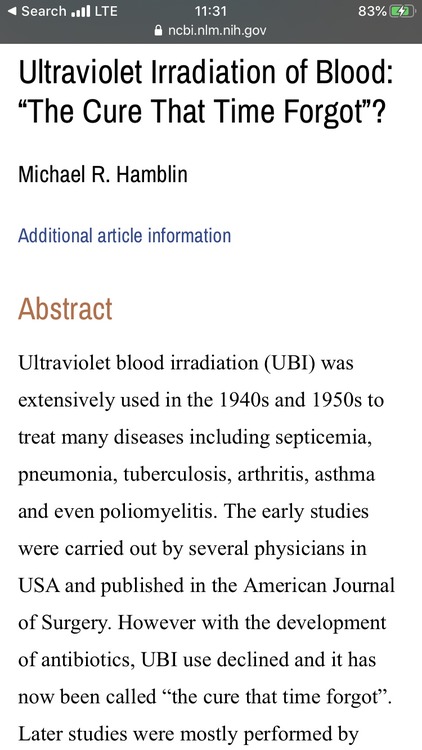
“1903, Niels Ryberg Finsen was awarded the Nobel Prize for his invention of UV light therapy for skin tuberculosis (lupus vulgaris)“
https://vitalitymagazine.com/article/the-vital-light-of-nikola-tesla-healing-power-of-ultraviolet-light/amp/
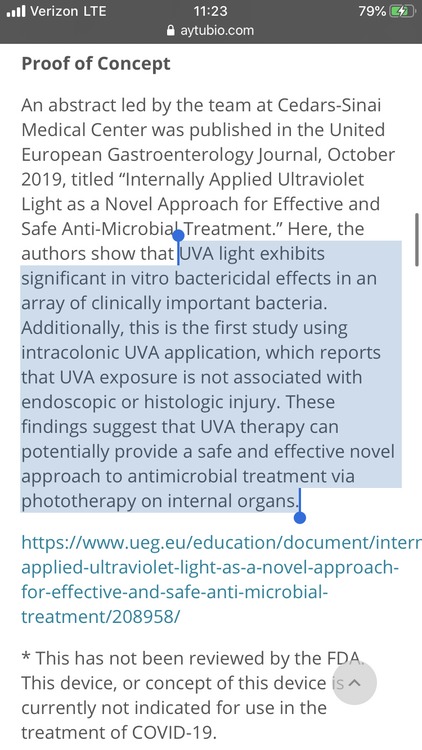
There are some fascinating new developments regarding catheters that direct UV light to internal organs:
https://m.washingtontimes.com/news/2020/apr/26/pharmaceutical-firm-aytu-bioscience-testing-uv-lig/ 

https://www.ncbi.nlm.nih.gov/pmc/articles/PMC6122858/ 
Alejandro T · · Portland · Joined May 2017 · Points: 0
John Byrnes wrote: Isn't it absurd that things that were known long ago are suddenly "New" and a new study must be done?   The fact that viruses, any virus, can't survive in direct sunlight has been known for at least 70 years.  Hell, I posted the same thing a month ago and was shouted down by a bunch of uninformed paranoids who listen to the all the Media hype.  

Similarly, injecting the blood or blood serum from people who have recovered into sick people in order to use the specific anti-bodies has been understood since the 19th Century, yet NBC reported it as a "new treatment" a week and a half ago.  The fact that recovered people are immune (that's what "recovered" means, duh) and are not gonna get Covid-19 in the Fall, just like every other virus.  That Corona virus causes toilet paper shortages...  it just goes on and on.

"might be"?   IS safe to climb on.    There could have been people on ventilators climbing all over it, and by the time you got roped-up, it'd be fine.  

It's not absurd at all because not all viruses are the same, and not all immune responses are the same. That's the essence of science, you don't just assume you know things, you test them. See Joe Prescott's post above giving a much more informed take than yours.

x15x15 · · Use Ignore Button · Joined Mar 2009 · Points: 280

you know, drump was hilarious.  Injecting disinfectant into the lungs. BWAHAHAHA...

Although, I am sure many of the smart people understand that doctors may call it medicine, while a drump may call it a disinfectant... still, Darwin will handout as many awards needed to those who inject Lysol into their lungs...

John Byrnes · · Fort Collins, CO · Joined Dec 2007 · Points: 392
Joe Prescott wrote: Not sure if I was one of the 'uninformed paranoids' but I have a fair amount of experience with virus stability testing and review a lot of these papers, etc. A lot of my testing has been done to develop protocols to remove viruses from high-containment labs to work with them (killed) safely at lower containment (mostly unpublished), but some experiments to assess potential risk (published).

Got any OUTDOOR, Open Air high-containment labs?   Applying indoor parameters and results to an outdoor environment is disingenuous.   Very similar to gym-gumbies going outside and expecting they can climb the same grade.

Long story short-ish - when assessing stability in real-world situations as it applies to virus killing or transmission potential, I would put sunlight (or any visible-UV radiation) near the bottom of the list of important factors. The problem is that the radiation has to be very direct and without obstruction. 

DUH!  Which words do you not understand in the phrase "direct sunlight"?  

These experiments are typically done with high titer virus dried or in a thin layer of medium on a flat surface perpendicular to the source. 

Yup. Controlled environment with an artificial source.   Why doncha just have someone infected with Corona cough onto a granite wall?  In direct sunlight with a 10mph wind at 70F?  

Any obstruction, even small particles (dust), basically renders the effects of the radiation null. This would be almost every real-world climbing situation.

Nonsense.  The sun MOVES so the angle of incidence changes and get into just about every crevice.   Wind MOVES dust particles and dries out aerosols and the virus covering.  Rain washes dust and other contaminants off the rock.

Far more important would be the time at a specific humidity and temperature, etc.

Fine.   Here in Colorado and throughout the West, many of the climbing areas are at altitude where you need to be more concerned about skin cancer than viruses.    Today will be 80F, about 25% humidity and the UV at 6000ft will be enough, without protection, to sunburn you beyond recognition.   So what's your analysis?


Even more important still is that it is very hard to experimentally determine the other aspects of fomite transmission (dose, route, etc). No one can tell you the risk and it will vary. My semi-expert opinion would be that by a fairly large margin, the social interactions would outweigh the chance of infection from the rock surface. If the surface is contaminated, there is or was an infected person nearby. Second might be gear acting as a fomite if someone in your group might be infected. That said, there is certainly a risk of transmission and that wouldn't be much different from a door handle (if it had the same number of infected/naive contacts).

I agree with this: catching it from a person is a risk.  Catching it from the rock is probably as likely as being hit by a meteorite.

TLDR: Take-home message - don't use sunlight as a factor for determining real-world risk of infection.

Hysteria.  I forgot how uncommon common sense is.  Novel Corona Virus 2019 is a member of a common virus family, including the common cold.   It's not any different from any other virus.  It's not Super-Virus with a stylized "S" on its chest.   It's susceptible to the same things that kill/deactivate other viruses: Soap, detergents, alchohol, UV, air (dry-out) and the immune system.   Healthy people should use caution and not get their first exposure to a large amount of the virus at one time (eg. in a hospital, someone coughing on you) but I haven't seen any Covid wards at the crag.   It's also highly unlikely that a sick person is gonna be out there climbing.

The fact that the world population is the most unhealthy it has ever been is the root problem.   With 70% of the U.S. population being over weight, 40% being obese, 20% being smokers*, and all the co-morbidity factors that go with that (heart disease, COPD, diabetes, malnutrition, etc.), they are killing themselves a little bit every day anyway.   Any added stress puts them in the hospital and many die. If you are surprised by this, well, you haven't been paying attention.

* cdc.gov/nchs/fastats/obesit…

John Byrnes · · Fort Collins, CO · Joined Dec 2007 · Points: 392
Lena chita wrote: The paranoia level with this epidemic is unprecedented.

I am NOT, by any means, the denier who says that we should open casinos and concerts and go back to life-as-usual, because this is no worse than a flu. This is a much more serious public health concern than a flu, clearly.

BUT... direct virus transfer from dry contaminated surface to person (without direct person-to-person transmission) is still very much a hypothetical, even for heavily-contaminated surfaces. And in case of a rock climb, we are not talking about heavily-contaminated surfaces, even if they aren't in direct sun.

There is a lot we don't know, and so erring on the side of caution is understandable. But it really isn't the act of climbing on a route that someone potentially-infectious had just touched 15 minutes ago that you should be worried about. It's the extended time spent next to other people that is most likely cause of infection transmission -- hanging out next to that person at the base of the crag, going into gas station bathrooms next to possibly-infected person on your way to and from the crags, etc. etc.

Yes, yes, yes, yes....... YES!

John Byrnes · · Fort Collins, CO · Joined Dec 2007 · Points: 392
Alejandro T wrote:

It's not absurd at all because not all viruses are the same, and not all immune responses are the same. That's the essence of science, you don't just assume you know things, you test them. 

Some things ARE the same.  If a shotgun kills a Western Bluebird, I'm pretty damned sure a shotgun will kill an Eastern Bluebird.   I don't need to test it.  

Charlie B · · SLC, UT · Joined Aug 2008 · Points: 0

Maybe we could hit the crag with very bright light. Like inside the crag... Or disinfectant. Inject the crag with a strong disinfectant... like a cleaning almost.
IDK, cofefe. 

Salamanizer Ski · · Off the Grid… · Joined Sep 2005 · Points: 20,944

My feeling is that everyone from the govt down has done a decent job of getting the basic info out there everyone can use to best protect themselves from the virus. If you go out somewhere and get it, that’s on you. If you then go around spreading it and someone else comes in contact with you, because there out there running around exposing themselves to potential risky areas just like you and they get it, that’s on them.

The notion that it’s somehow the governments duty, scientists/doctors duty, or your personal mission and duty to protect people from themselves is asinine. Everyone knows smoking is bad, but many people start and continue to smoke anyway despite the excessive regulations placed upon it. Everyone knows going around licking doorknobs is risky behavior, but here we are... but the amount of people so willing and eager to surrender their rights and freedoms for even the slightest gesture of perceived security is unprecedented in this country. An entire generation of Mockingbirds so easily herded by Wolves. 

Not Not MP Admin · · The OASIS · Joined Nov 2018 · Points: 17

How's the corona getting in the holds unless dumbasses (who were presumably asymptomatic)  were climbing on these routes during "lockdown"....?

Mark Pilate · · MN · Joined Jun 2013 · Points: 25
Salamanizer suchoski wrote:......If you go out somewhere and get it, that’s on you. If you then go around spreading it ....and they get it, that’s on them.

....people so willing and eager to surrender their rights and freedoms for even the slightest gesture of perceived security is unprecedented in this country. An entire generation of Mockingbirds so easily herded by Wolves. 

Seems to be a curious dichotomy in your views.

So if I stay home, or generally follow guidelines to avoid “it being on me” ,  then I’m a mockingbird easily herded by wolves? 
Yet apparently you think the “wolves” have been putting out good info though.   So what type of bird are you?

I’ve noticed one thing that has increased in correlation with Covid19 — the amount of stupid shit that people come up with
Guideline #1: Don't be a jerk.

General Climbing
Post a Reply to "Coronavirus on a crag that is in the sun"

Log In to Reply
Welcome

Join the Community! It's FREE

Already have an account? Login to close this notice.