|
|
Max R
·
Jan 20, 2020
·
Bend
· Joined Jul 2014
· Points: 302
Sheldon Deeny wrote: I'm thinking of investing in the setup shown above with a Vergo on top backed up with Micro Traxion. Intended use is working hard sections on a project, so lots of stop and go: falling, lowering, and climbing back up in short sections, with a stopper knot below the section I'm on.
My question is, will a 10mm rope will feed through the Vergo smoothly? I need to buy a static line and want to go durable but not so much that it hinders the rope running through both devices. I mean obviously there's a trade-off since I'm sure an 8.5 will slide right through but I'd like the rope to last awhile, just want to see if anyone has experience with the rope being too fat. A 10mm should feed, with lots of weight on the bottom of the rope.
|
|
|
Bruno Schull
·
Jan 21, 2020
·
Unknown Hometown
· Joined Dec 2009
· Points: 0
spaceman laflare wrote: watsup gangsters
OP, maybe extra clarification that you are seeking info on TOP-rope soloing...or the snark will keep coming.
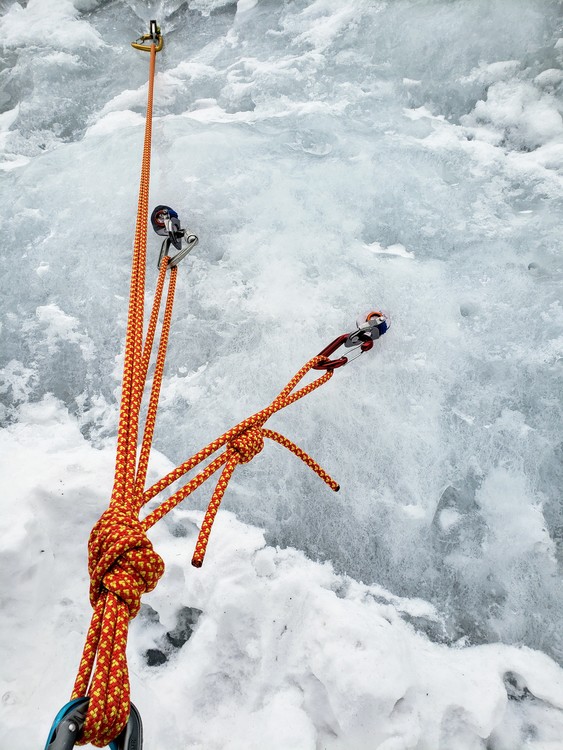
build your bomber anchor up top, find the midpoint of your rope, tie a figure 8 on a bight and clip to anchor, now you have two separate strands. Chime in if there’s a better knot for this application.I like having the redundancy of two strands when on ice as I recently blasted a tool right through one.
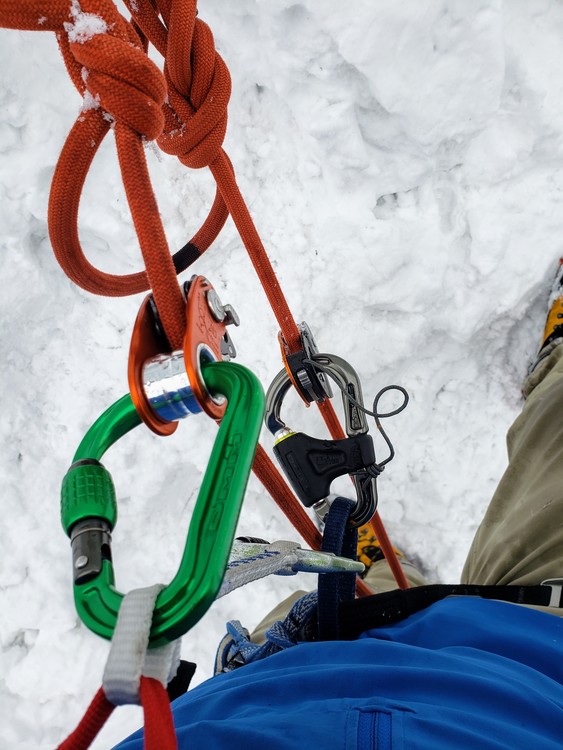
I use a micro trax on one strand and a wild country rope-man2 on the other. One is clipped to the belay loop the other to a very short sling girthed through the hard points.
Both are toothed devices so another good reason to be on two strands.
I’ve seen the micro trax slip on an icy rope but not the rope-man2, prolly cuz it’s teeth are cammed into the rope when loaded.
now you need to somehow weight or fix the bottom of the rope so the devices feed properly.A water bottle or a backpack full of snow work to weight the bottom of the ropes. sometimes I’ll instead slap a screw in way at the bottom and fix the ropes to that, leaving just enough slack so that it’s still possible to rap back down, this takes some adjusting to figure out.
whatever you do just make sure it’s stupid redundant because you’re by yourself.
once you have it dialed you’ll be able to crank out some laps! This is good advice. There are various devices that will work for this application. Something Ive been experimenting with this is the Petzl ASAP. It's a rope access device with a great deal of cross-over to climbing. The great advantage of the ASAP (and the related ASAP lock) is that it runs freely both up and down the rope, and locks in any position with a sudden acceleration. I've tested it in snowy/ice conditions and it runs and locks well. What that gives you is a "set and forget" device on the back up strand--you place it on the rope at the beginning of the day, or climbing workout, and take it off at the end. There's no fiddling about to switch devices to rappel, which I see as a big safety problem with other systems (the constant switching of devices could easily lead to a mistake and a fall). On the other strand, you can switch between devices to ascend/descend, or you can use something like a Gri Gri, but on the back up strand you always have one secure device, up and down.
|
|
|
Mtn Ape XL
·
Jan 21, 2020
·
Utah
· Joined Apr 2010
· Points: 131
https://www.facebook.com/groups/RopeSolo/3359155784156932/?comment_id=3359494024123108¬if_id=1579587118393961¬if_t=group_comment
|
|
|
Mtn Ape XL
·
Jan 21, 2020
·
Utah
· Joined Apr 2010
· Points: 131
|
|
|
Max R
·
Jan 21, 2020
·
Bend
· Joined Jul 2014
· Points: 302
revans90 wrote: you could use just a gri gri and tie back up knots in the second strand. cheaper. Have you ever actually done this? It’s terrible. I don’t recommend anyone use a grigri for TR solo unless they’re climbing like 5.6.
|
|
|
Andy Wiesner
·
Jan 21, 2020
·
New Paltz, NY
· Joined Sep 2016
· Points: 35
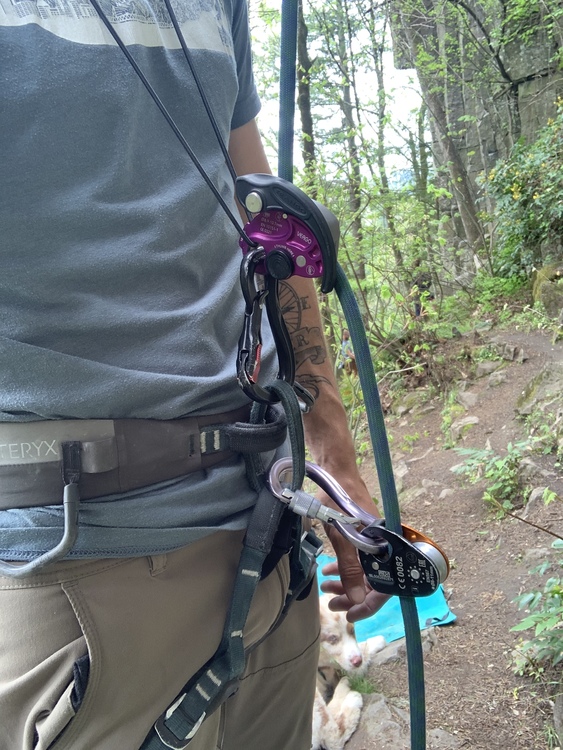
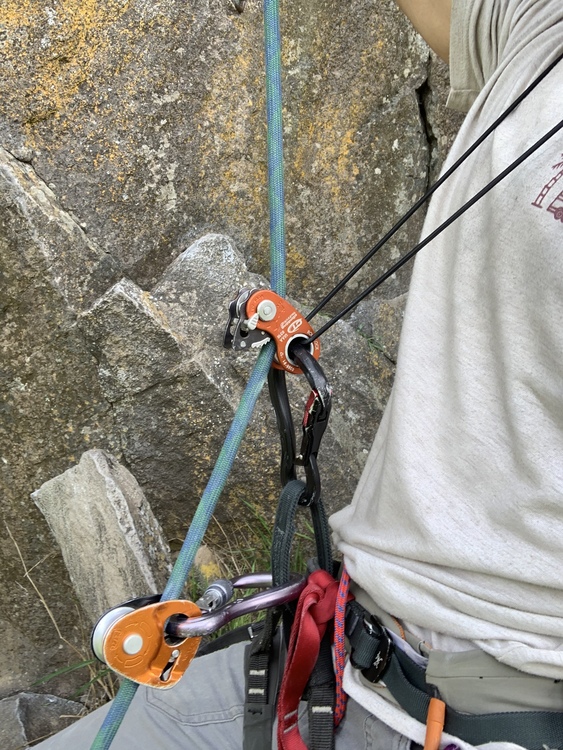
Max R wrote: What i do. For working a hard route. I use the Roll n Lock setup when i’m moving fast, (Rope solo’ing an easy multipitch after leading it solo) Max R or JCM, Why the Vergo for this application as opposed to other options such as Gri, Eddy, etc.? Curious b/c I use the Roll n Lock / Microtrax (bottom photo above) but want something where I can go up and down to work harder sections. Thanks in advance.
|
|
|
JCM
·
Jan 21, 2020
·
Unknown Hometown
· Joined Jun 2008
· Points: 115
Andy Wiesner wrote: Max R or JCM, Why the Vergo for this application as opposed to other options such as Gri, Eddy, etc.? Curious b/c I use the Roll n Lock / Microtrax (bottom photo above) but want something where I can go up and down to work harder sections. Thanks in advance. Simple: the Vergo slides up the rope much smoother, with much less resistance, than the GriGri or Eddy, but still allows you to easily go down to work harder sections. I find with the Vergo I only need to hang about 2-2.5 lbs on the end of the rope to get it to feed smoothly from the beginning. A liter of water, or my approach shoes and a few quickdraws, works well. The reason for this is that the rope path through the Vergo is pretty close to straight (thus less resistance), whereas the GriGri has a sharper bend and takes a lot more weight on the rope (or manually pulling rope through) for it to feed. The Eddy is particularly poorly suited for TR solo because the rope path through the device is backward from the GriGri and Vergo. This makes the Eddy feed well for lead solo, but poorly for TR solo. I use similar setups to what you are proposing, for similar applications. The RollnLock + Microtrax is nice for a super-smooth feeding setup for running laps on long pitches. The Vergo + Microtrax does not feed quite as smoothly, but has the major advantage of being able to easily lower down to re-try sections; I use this when working a harder route.
Whatever you use, don't use the Vergo without a backup. Too sketchy. I think the Vergo is a bit less reliable than something like the RollnLock, due to greater possibility that you can accidentally mechanically override the Vergo cam, snag the lowering handle, etc. But the Vergo + Microtrax combo, to me, feels totally bomber due to the high reliability of the Microtrax backup. With this system I feel confident enough to not use any backup knot most of the time. If I am hanging on the rope, working a crux and falling repeatedly, I will tie an overhand on a bight about 10 feet below as a backup. More for mental reassurance than actual safety need.
|
|
|
JCM
·
Jan 21, 2020
·
Unknown Hometown
· Joined Jun 2008
· Points: 115
Sheldon Deeny wrote: I'm thinking of investing in the setup shown above with a Vergo on top backed up with Micro Traxion. Intended use is working hard sections on a project, so lots of stop and go: falling, lowering, and climbing back up in short sections, with a stopper knot below the section I'm on.
My question is, will a 10mm rope will feed through the Vergo smoothly? I need to buy a static line and want to go durable but not so much that it hinders the rope running through both devices. I mean obviously there's a trade-off since I'm sure an 8.5 will slide right through but I'd like the rope to last awhile, just want to see if anyone has experience with the rope being too fat. My concern with that setup, regarding feeding smoothly through the Vergo, would be not the diameter (10 mm isn't too thick) but the combination of the diameter with the stiffness of the static rope. Since the Vergo puts a slight bend in the rope, stiffer ropes give you a lot more drag. So a supple 10 mm dynamic rope is still fine, but a stiff static 10 mm could be a bit of a drag. It'll still feed, but you'd need more weight on the end. Disclaimer: this is mostly speculation. I have not actually used a 10 mm static with the Vergo. I mostly used my Vergo with old ("well broken in") 9.5-9.8 mm dynamic ropes. I can say with certainty that a 10 mm static feeds quite well through a Microtrac and RollnLock setup, since I have done thing on many occasions.
|
|
|
Max R
·
Jan 21, 2020
·
Bend
· Joined Jul 2014
· Points: 302
JCM- Very well explained.
Do you use a neck bungee, or sling? Or nada?
|
|
|
JCM
·
Jan 21, 2020
·
Unknown Hometown
· Joined Jun 2008
· Points: 115
Max R wrote: JCM- Very well explained.
Do you use a neck bungee, or sling? Or nada? Nada. I've tried a couple of neck-loop setups (neck bungee, Petzl Torse-style chest harness), but in the end decided that elevating the device is more trouble than it is worth. The extra 8 inches of fall distance is fine by me (though I also understand why many people like to elevate the top device). So, my usual setup is the RollnLock or Vergo directly on the belay loop on a Gridlock biner. The Microtrax backup trails below (on the same rope strand) on a quickdraw. The quickdraw provides the separation between the devices. This is what works for me, at this point in time, but there are many other ways to do it. The nice thing about TR solo is that there are a number of different , equally good setups to choose from depending on your preferences.
|
|
|
JCM
·
Jan 22, 2020
·
Unknown Hometown
· Joined Jun 2008
· Points: 115
Sheldon Deeny wrote: There is something else I have a question about: in the photos upthread with Vergo at chest level and Micro Traxion at belay loop level, I can't figure out how the Vergo would engage before the MT. An auto-blocking device requires kinetic friction for the cam to engage, so some rope has to move through it first, whereas doesn't the MT engage almost as soon as the rope reverses direction? So wont the waist-level MT always be catching your fall? I have no hands-on experience with this, so it is just my own conjecturing. I'm considering the scenario where I've fallen and the MT is engaged but the Vergo is not, so I would have to somehow engage the Vergo before releasing the MT in order to lower myself, by using a jumar or something. Seems like it would be a hassle to do over and over. The piece you are missing here is that the microtrax is trailing at the bottom of the belay loop. So in other for it to become load bearing you need about 8-10 inches of travel, as the carabiner and device go from hanging down from bottom the belay loop, to pointed up at the top of the belay loop. Whereas the upright Vergo (held up by neck loop) in already pointed up, in position to become load bearing immediately with no travel needed. In my experience, the Vergo catches essentially immediately once weighted, with no perceptible rope slippage. It is possible that some rope moves through as the device engages, but it is probably on the scale of millimeters. So, in either configuration, when the system works correctly the Vergo will become load bearing first. In order to rap all you need to do is lock open the cam on the Microtrax, and then rap normally with the Vergo.
However, that is is the system works correctly. There are scenarios where the Vergo fails to catch, mostly involving some sort of mechanical interference with the cam or lever. Such as th elevel getting snagged on you leg loop. This type of issue has never happened to me - the Vergo has caught immediately and perfectly for me for hundreds of TR solo falls/takes so far, but is well within the realm of possibility. That is why you have the Microtrax backup.
If the Vergo were to fail to catch, it would crash down into the Microtrax underneath. You would then be supported by the Vergo sitting atop the Micro. So the Micro would be supporting you not through its carabiner attachment, but by direct loading of the device body from the Vergo above. For the Microtraxion, this is still fine and the device will catch the same. For other devices (such as the Microcender, etc) this type of loading would cause the device to not catch; those devices need to be loaded through the carabiner attachment, rather than through the body, to catch. This is why you should use the Microtraxion as your trailing backup, rather than a different type of device.
|
|
|
Gunkiemike
·
Jan 22, 2020
·
Unknown Hometown
· Joined Jul 2009
· Points: 3,777
JCM wrote: If the Vergo were to fail to catch, it would crash down into the Microtrax underneath. You would then be supported by the Vergo sitting atop the Micro. So the Micro would be supporting you not through its carabiner attachment, but by direct loading of the device body from the Vergo above. For the Microtraxion, this is still fine and the device will catch the same. For other devices (such as the Microcender, etc) this type of loading would cause the device to not catch; those devices need to be loaded through the carabiner attachment, rather than through the body, to catch. This is why you should use the Microtraxion as your trailing backup, rather than a different type of device. You are describing the difference between a cam-loaded device (Micro/Rescucender, Gibbs) and a frame-loaded device (Traxions, handled ascenders and handle-less based on them like Petzl Basic). Cam-loaded devices should NEVER be run on the line below another device. A Grigri should also never be the lower device for the same reason.
|
|
|
JCM
·
Jan 22, 2020
·
Unknown Hometown
· Joined Jun 2008
· Points: 115
Personal anecdote: I have, twice, had the experience of the primary device failing to catch, and been caught by the backup device trailg below. In both cases, the primary device was an old-style Rescuecender, and the backup was a Microtraxion. Both on one rope. In both cases, the Rescuecend did not catch within the first couple of inches of rope movement, so it slide down into the top of the Microtraxion. The Microtraxion was loaded through the device body, and the fall was stopped with the two devices mashed together. The extra fall distance was just a few inches, barely noticeable, and no damage to either device or the rope. So the Microtrax backup performed exactly as intended.
Still, this is not a situation you want to occur. Since once the primary fails, you are then relying on a single backup device to catch you. Ideally you want both of your devices to be relaible and not fail. After the second time this happened I concluded that the old-style Rescuecender is not a reliable TR solo device, and stopped using it. That's when I got a Vergo and a RollnLock. No issues with either of those - both have performed very well.
In the event that the Vergo (or any other primary device) were to fail to catch, I would expect the Microtrax backup to perform similarly well.
|
|
|
JCM
·
Jan 22, 2020
·
Unknown Hometown
· Joined Jun 2008
· Points: 115
Gunkiemike wrote: You are describing the difference between a cam-loaded device (Micro/Rescucender, Gibbs) and a frame-loaded device (Traxions, handled ascenders and handle-less based on them like Petzl Basic). Cam-loaded devices should NEVER be run on the line below another device. A Grigri should also never be the lower device for the same reason. Yes, agreed - and you have detailed the difference better than I did. This is a VERY important distinction to make, and it is work repeating. This is a common mistake that people new (and not-so-new) to TR solo make, and it is potentially quite hazardous since they, unwittingly, do not have an effective backup.
|
|
|
Glen Prior
·
Jan 26, 2020
·
Truckee, Ca
· Joined Jul 2015
· Points: 0
If you're going to the bother of using two strands, (I don't), then tie an eight on a bite for each strand. Otherwise there is no redundancy at the anchor.
|

 Continue with onX Maps
 Sign in with Facebook