Continue with onX Maps
 Sign in with Facebook






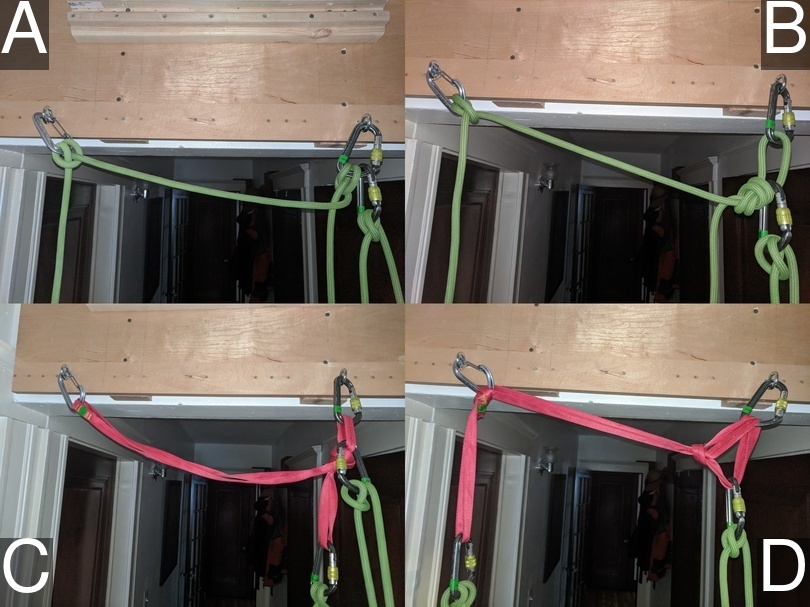
Direct belay off of series anchor variations



|
Here's one using the rope . . . IRL the blue carabiners would be lockers. The belayer is cloved to the bolt on the left, leader headed up and away from the munter on right. Pls critique. 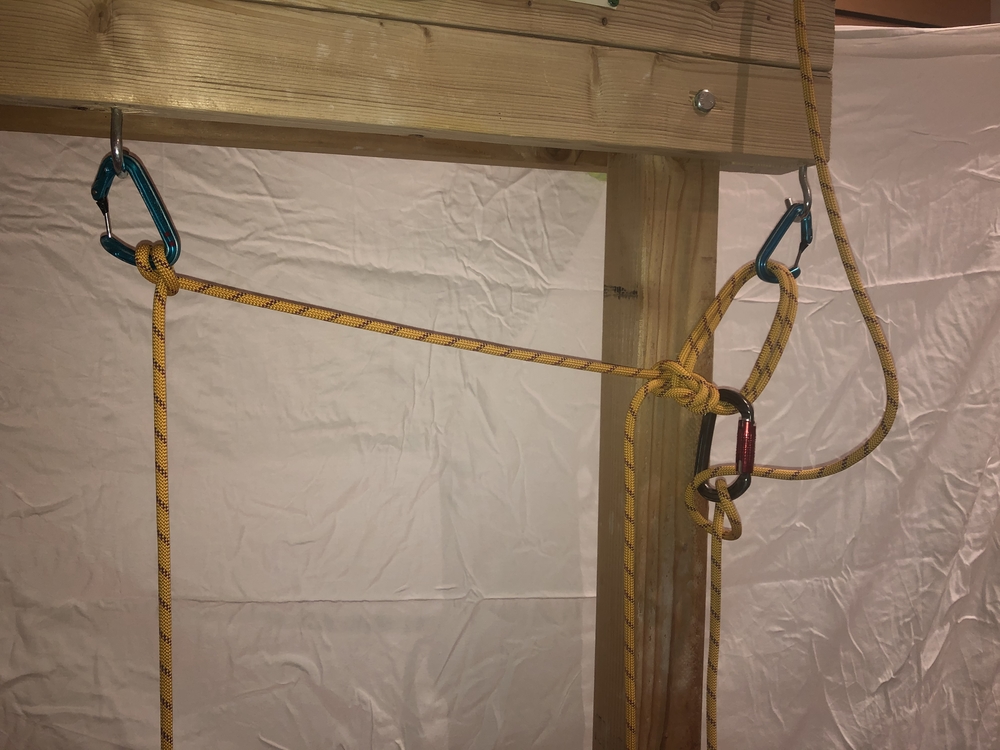 [Edit: Following version incorporates Fran's critique] 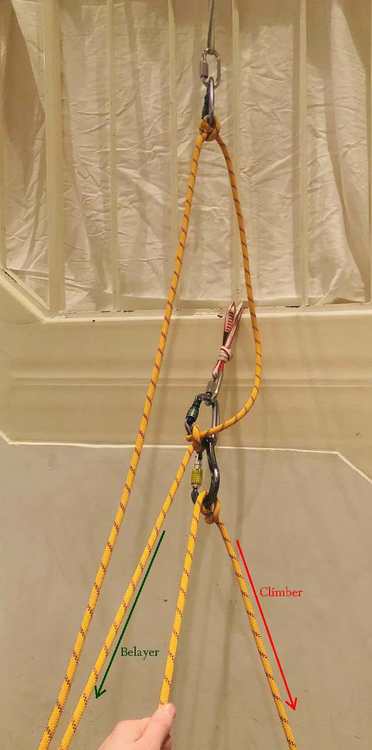 |
|
|
Eli 0 wrote: I have seen a few different series anchor variations for belaying a leader directly off an anchor on two bolts in a horizontal configuration, but there are a few aspects of these variations that I have been wondering about: The issue I have with A is that if a call occurs after pro is placed, the munter biner swings up and can easily crossroad during the transition. You have metal on metal on metal and that can get kinked up during that split second reorientation upward. |
|
|
Kees van der Heiden wrote: The reason Europeans place the bolts vertically is to avoid extension and shockload as much as possible in this series connection with one loaded and one backup bolt. I don’t know why the Americans favor horizontal placement. It seems like this is only true in some cases. If you place MP on the lower bolt and fall after pro is placed, the potential for extension exists if the lower bolt fails. If you place the MP on the upper bolt and fall before pro is put in, the same potential extension exists if the upper bolt fails. If the argument is the setup should be so as to protect the worst case fall onto the anchor (no pro in yet), it follows that the MP should always be on the lower bolt so no extension occurs if the lower bolt fails. Thoughts? |
|
|
Christian Mason wrote: I'd be interested to read that. I'm reasonably new to trad climbing and have been taught to use the rope for the belay and belay off my harness. Last trip for the first time I caught a falling follower. I was well braced and everything was OK, and feel if everything is set up properly there's not a huge chance that both the climber who fell and the belayer will stress the anchor. I understand, though, that where one belay's off the anchor that ONLY the falling climber stresses the anchor. So, I guess the thing is, would the belayer reduce the stress on the anchor, or would the belayer ADD to the stress on the anchor IF they were pulled over the edge IF the anchor was not taught? If you or someone else could point me to some studies on this I'd be appreciative.... |
|
|
MyFeetHurt wrote: I had a similar thought and question. On the margin, I try to maximally protect the worst case. So I'd opt for the vertical bolt placements, w/ the master point on the lower bolt, no extension if it fails. Unless no risk of F2 (solid first piece or lead bolt), in which I'd put the MP on the top. So many choices. |
|
|
If people just used a PAS all of this could be avoided |
|
|
Eli 0 wrote:Fran, I would like clarification on one of your points: Yes, that is what I meant. If it is, the load on the MP is actually magnified because of the extreme angle. So, slightly slack is good. With regard to ring-loading of the master point (mentioned by a few), does it really matter if I use a knot that can capsize such as an overhand or figure-8? Even if it does capsize, it will not roll itself apart. The loop will enlarge a bit is all. Depending on the sling material, overhand and Fo8 can fail at much lower loads, critical ones if only one strand is loaded. They don't capsize much if at all when loaded dinamically since they tighten too fast. All that said, still probably ok. I'd still favor the bowline to keep it simple: Only one (double strand) loop for everything. |
|
|
Andy Wiesner wrote: Here's one using the rope . . . IRL the blue carabiners would be lockers. The belayer is cloved to the bolt on the left, leader headed up and away from the munter on right. Pls critique. The left bolt shouldn't get loaded at all, so the rope should be s bit more loose. If it's taut then what you get is an extremely poor parallel connection because of the angle >100° between the "legs": loop and clove. The bowline is overkill when using the rope, an overhand will do. Also, if the belayer is on the non-cloved strand of the bowline, the knot would get loaded in a weird way if the right bolt failed (loop-clove strand loaded by climber and clove- non-cloved strand loaded by belayer). This wouldn't be a concern with the overhand. |
|
|
MyFeetHurt wrote: Yes, the MP should always be at the lowest point to avoid extension in case of a fall directly onto the anchor. Upwards pulls are not nearly as strong because of the friction at the top piece, the longer length of rope involved, and drag if there is any. If there is only one solid point and happens to be above (i.e. bolt on top, pin below), then the MP should still be at the bottom but the load should go to the bolt (clove is loaded, not the loop). And the loop connected to the pin loosely. |
|
|
curt86iroc wrote: In the photo, the sling connecting the bolt to the pin has obvious slack in it and is dyneema. I would have less of a problem if the slack was removed AND a rope was used as in the OPs images A and B. The old version series-connection anchor of the CAI was to thread a cord through both points making several loops and tie it off as tight as possible. Then connect brake and belayer on each. Nowadays they also abide by a loose connection with static material or the rope. https://images.app.goo.gl/HeMctiZrhLSbdkLt6 |
|
|
trailridge wrote: If people just used a PAS all of this could be avoided I have avoided this without a PAS. Also, If someone might whip onto the belay I would want them to belay off their harness clipping something the anchor as their first piece. That will soften the catch up a little. Most of this seems like overly complicated Mazama whatever. |
|
|
Darrell Cornick wrote: True. Though they'll need the perfect stance to not get slammed into the rock. Or a good upward pull piece without a lot of allowed motion - both of which seem unlikely in the context I would consider using it (i.e., bolted anchors and long run outs). The alternative to the rig of this thread (for me) is a catch directly off the harness. It is the primary driver of why I decided to habitually wear good gloves while belaying. |
|
|
Hi |
|
|
Darrell Cornick wrote: The direct belay off the anchor is far better in the factor 2 situation than a harness belay combined with clipping the anchor, and the idea that the catch will be "softened a little" is misguided. First of all, clipping the anchor is going to come close to doubling the anchor load compared to the direct belay. With the high forces involved in a factor 2 catch, doubling the anchor load potentially puts you in dangerous territory. Second of all, most anchors aren't very high above the belayer, which means, with the belay redirected through the anchor, that the belayer, the non-brake hand, and the device are all going to get slammed into the redirecting carabiner, with injuries to the belayer likely and significant potential for loss of control present. Any softening you get from those events is overshadowed by their downsides. With a Munter on the anchor, rope will run through the knot, about 1/3 the length of the fall according to studies quoted by Fran. Approximately the same amount of rope will run through a tuber on the harness, probably a bit more unless the tuber is an ATC-XP. These effects constitute the available softening, but the belayer using a direct anchor belay is in a far better position to manage the slip since their body isn't being slammed into the anchor. If a Grigri is used in this situation, rope won't run but the anchor loads and impact to the faller will be significantly higher with the dangers that come with that. |
|
|
Is the DAV PDF available in English? |
|
|
I have often used Variant A, but know of many people that use setups like that posted by Malcolm Daly on the first page or David Coley above. I prefer using the rope most of the time. A modification of Variant A that I really like is to use the top carabiner of a quickdraw, turned upside down, as the second point for the series connection. This system is safe enough on two bolts, and fast, especially when swinging leads. The follower can just clip the quickdraw and move on. 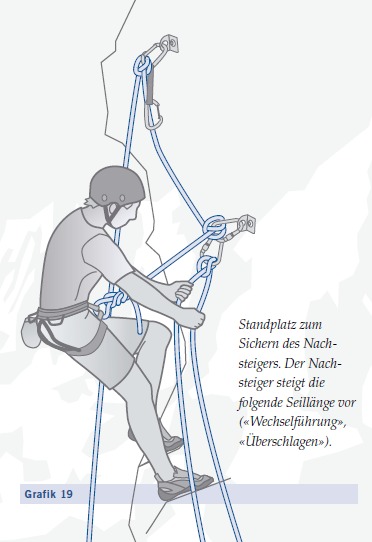 |
|
|
rgold wrote: not always... data below from the AMGA suggests the loads on the anchor can be similar depending on how the belay is managed. Also, the rope damage experienced due to the rope running through the munter is interesting and should be considered.. http://staff.weber.edu/derekdebruin/fixedpointbelay/Comparison%20of%20Fall%20Forces%20between%20Fixed-Point%20and%20Redirected%20Belays%20in%20Recreational%20Climbing%20Systems.pdfas i've thought about this more and more over the past few days, i should't have been so quick to dismiss this belaying method. However, it's also not the shining light at the end of the tunnel. it's a tool to be used in certain situations, but should not be considered the "new" way to always build anchors and belay... |
|
|
curt86iroc wrote: Oops! That link didn’t work. Try again? |
|
|
Malcolm Daly wrote: yea odd, i can't get it to work as a link either. if you copy and paste it into your browser it should work.... |
|
|
Fran M wrote: Thanks Fran! I updated my prior post w/ better version based on this critique. |