Mountain Project Logo

When did the soft catch become a thing?

Kyle Elliott · · Granite falls · Joined Jul 2015 · Points: 1,798

A good belayer can decide whether its needed or not IMO. but sometimes its not required, and seems to be extra dangerous.

at the gym yesterday some dude fell at the last clip on a 50' wall and his belayer gave him a soft catch (loop of slack, plus a small hop) and he was about 3 feet from cratering.

That scenario is not my thing. 

Marc801 C · · Sandy, Utah · Joined Feb 2014 · Points: 65
Abram Herman wrote:

This is almost the exact opposite of how it works.

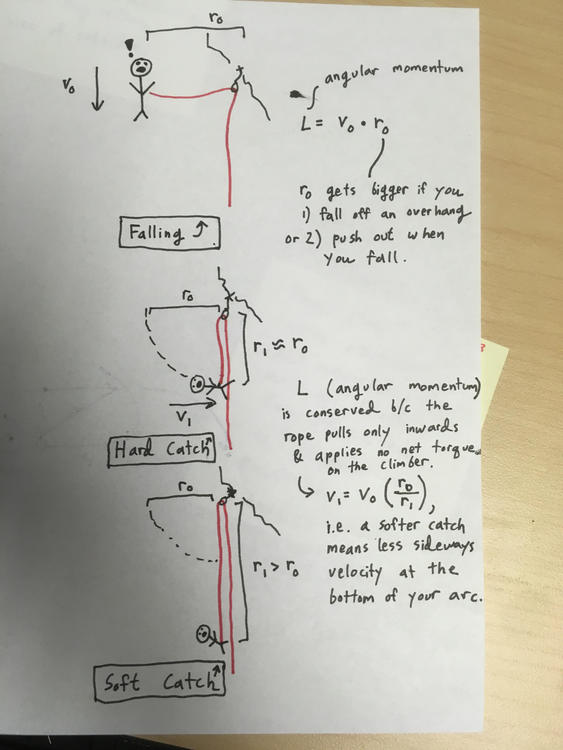
A soft catch doesn't matter much if it's overhanging since you're not gonna hit the wall. If it's less than vertical and you're gonna hit the wall, it's nice to hit it softly, rather than getting spiked into it by a hard catch. Gym doesn't make any difference, same rules apply regarding the angle of the terrain.

Um.......

You might want to think about that a bit more.  
Mike · · Unknown Hometown · Joined Dec 2013 · Points: 30
Abram Herman wrote
If you do this on vertical or slightly less than vertical terrain, it translates the force that would be smacking the climber into the wall into a downward force, so they fall a little farther, but they don't hit the wall as hard.

Edit: I guess I type slow.

You need to think about this more if you think soft catches are more important on vertical and less than vertical. Assuming the climber is in line with the bolt and not traversing there is virtually zero horizontal component of the fall to be minimized. The classic situation where a soft catch helps the climber is on slightly overhanging terrain or at the start of a steep roof where you are climbing and moving in a direction that is not purely vertical.

Soft Catch · · Unknown Hometown · Joined Oct 2018 · Points: 0
Marc801 C wrote:

Um.......

You might want to think about that a bit more.  

Unfortunately it's not a lack of thinking that is the problem here.

It's a fundamental lack of understanding compounded by way too much thinking.

Rock Monkey · · Bonita · Joined Jun 2019 · Points: 15
Soft Catch · · Unknown Hometown · Joined Oct 2018 · Points: 0
Rock Monkey wrote: There are some videos here where they attempt to measure the differences with some of the variables... 

Those videos have been posted here many times. They present a bunch of data, none of which is surprising, and end with no actionable conclusion. They don't even discuss, attempt to illustrate, or measure potential cause of injuries, which is the whole reason for attempting these belay gymnastics.

The video of the gym climber on the first page clearly shows what is important. It illustrates the problem that the "soft catch" is trying to solve, it shows where the problem can exist (steep, more than vertical terrain) and it shows how to actually solve the problem without being overly complicated.

That's all there is to it. Endless ramblings about different categories of catches and hypothetical descriptions of scenarios just muddy the waters. Those who make belaying ridiculously complex are not making belaying safer.

Kip Kasper · · Bozeman, MT · Joined Feb 2010 · Points: 200

If you are requiring catches on less than vertical, broken terrain in the mountains you might want to go back to the gym and get a bit stronger, falling on stuff like that is the way to hurt yourself and have a bad time, no matter the type of catch. 

I’ve seen so many (generally older) climbers spiking the living shit out of each other, seemingly unphased or oblivious to the risks they’re exposing themselves to.

Stephen L · · South + Van · Joined Aug 2013 · Points: 166

In Denny’s Valley book he tells a story of climbing with Royal Robbins. Royal was leading up but fell when some pins ripped or something, the rope slid through Denny’s panicked hands until he finally caught it. Royal went for a long ride. And then he simply complimented Denny on a perfect, textbook soft catch. Or something like that. This anecdote would suggest a long established technique of some type of soft catch, predating the 80s/90s.

Either way, ropes are pretty darn comfy these days. I’ve never felt too jacked around on even the hardest if catches. 

Richard Randall · · Santa Cruz · Joined Jun 2016 · Points: 0

This helped me think a little bit about what's going on when someone gets "spiked". Even though it ignores some stuff it might be useful. I guess from the picture it could be "a ton of extra rope out" or a legit soft catch, but I meant it more as a legit soft catch. So not only does the amount of rope out matter, but also how far away (in space) from the wall you are when you pass the gear that's catching you. One thing this makes me realize (that I've observed but never thought about) is that spiking often is worst when you transition from vertical to a gentle overhang and fall from the overhang onto the lower wall. Agree that you figure this all out intuitively from belaying a lot, and teaching "always soft catches" without clarifying its limitations is a bad idea.

Ned Plimpton · · Salt Lake City · Joined Jul 2008 · Points: 116

“Soft catch” really = dynamic belay.  A dynamic belay reduces impact forces on pro, the rope, and your carcass.  

Certainly, there are times when not hitting the ground/ledge/feature/etc. is paramount, but by in large, I think most prefer reduced forces on their pro, rope, and carcass.
Probably amplified by the prevalence of ‘modern’ sport climbing ethic, where multiple falls are okay versus the older trad ethic of the leader must not fall.
And the amount of slack rope a belayer gives out is only *part* of giving a dynamic belay.
Rock Monkey · · Bonita · Joined Jun 2019 · Points: 15
Attentive Follower wrote:

Those videos have been posted here many times. They present a bunch of data, none of which is surprising, and end with no actionable conclusion. They don't even discuss, attempt to illustrate, or measure potential cause of injuries, which is the whole reason for attempting these belay gymnastics.

The video of the gym climber on the first page clearly shows what is important. It illustrates the problem that the "soft catch" is trying to solve, it shows where the problem can exist (steep, more than vertical terrain) and it shows how to actually solve the problem without being overly complicated.

That's all there is to it. Endless ramblings about different categories of catches and hypothetical descriptions of scenarios just muddy the waters. Those who make belaying ridiculously complex are not making belaying safer.

You find nothing of value in those videos? Ok, you're weird but so am I in my own special way.
All that data I see is a good basis for potentially quantifying some of the conclusions you say are missing from those videos. But alas, this thread wasn't about that was it?
It was "when did a soft catch become a thing" and those videos show, what I think, are interesting details of that "thing" that has become a "thing". Did you really not find any of that interesting? I did but perhaps I'm the only one. Oh wait, they've been posted here many times. YES, I AM NOT ALONE. Btw, I am a fan your trolling. I'm not saying you're trolling on this one. I think someone else did earlier but what do they know. 

Malcolm Daly · · Hailey, ID · Joined Jan 2001 · Points: 380

To the point the OP was trying to make. The “soft catch” started from a convergence of three things.
     - The Grigri was invented and was thought to give a non-dynamic catch, resulting in more force on the protection points. For a while, and perhaps still, Petzl’s instructions did not reccommend the use of a Grigri for belaying a trad climb. 
     - More and more people were climbing single pitch routes where the belayer is standing on the ground.
     - The routes were getting steeper, shorter and more people were falling.

Stir those into the same pot and you get soft catches.

But good ideas often turn into dogma which is always bad. There are plenty of examples: SERNe, cordalettes, 10 Essentials etc. Help me think of more.

Climb safe,
Mal

Not Not MP Admin · · The OASIS · Joined Nov 2018 · Points: 17
Kevin Mokracek wrote: I get it in the gym or overhanging sport routes but anything less than vertical I don’t want a soft catch, seems like a invitation for a busted ankle.  

Wrong

Andrew Rice · · Los Angeles, CA · Joined Jan 2016 · Points: 11

Kevin, I think it came about, really, with the need of gym lead climbing classes to make something simple seem more complicated, dangerous and mysterious.

As you correctly note, a "soft catch" is a good thing when you're run out laterally from your last bolt on overhanging terrain. Helps you not pendulum past the bolt and back into the wall. Also helpful if you're above a roof and the belayer wants to be sure you don't face-plant into the roof edge. On less-than-vertical terrain it just makes you fall farther before hitting the wall. 

Paul Deger · · Colorado · Joined Sep 2015 · Points: 36

Getting some popcorn - this is gonna be good!

Billcoe · · Pacific Northwet · Joined Mar 2006 · Points: 936

https://www.ukclimbing.com/articles/skills/dynamic_belaying_for_sport_climbs-1844

"The dynamic belay


First of all, just to clear-up a few myths, the following is not dynamic belaying:
1) Dynamic belaying involves giving lots of slack - FALSE!
The more slack there is in the system, the further the climber will fall before the rope can start to do its job and the more force will need to be absorbed. Unless there is an obvious hazard that you need to steer the falling climber away from, give only enough slack to allow freedom of movement.

2) Dynamic belaying is about letting the rope slide through the belay device a bit - FALSE!
Arresting a fall requires an almost instinctive response, there isn't enough time for the fine motor skill required to allow for controlled rope slippage, the risk is you will drop them altogether (note: this can be done but requires gloves, a figure of eight as a belay device, and preferably a back-up belayer.)

Kevin Mokracek · · Burbank · Joined Apr 2012 · Points: 378
Malcolm Daly wrote: To the point the OP was trying to make. The “soft catch” started from a convergence of three things.
     - The Grigri was invented and was thought to give a non-dynamic catch, resulting in more force on the protection points. For a while, and perhaps still, Petzl’s instructions did not reccommend the use of a Grigri for belaying a trad climb.
     - More and more people were climbing single pitch routes where the belayer is standing on the ground.
     - The routes were getting steeper, shorter and more people were falling.

Stir those into the same pot and you get soft catches.

But good ideas often turn into dogma which is always bad. There are plenty of examples: SERNe, cordalettes, 10 Essentials etc. Help me think of more.

Climb safe,
Mal

This is great stuff and exactly what I was looking for.   

Corey Flynn · · Beattyvillain · Joined Aug 2008 · Points: 170

"back in my day the only thing you had to worry about catching was a bad case of crabs"

Soft Catch · · Unknown Hometown · Joined Oct 2018 · Points: 0
J T wrote:

Wrong

It's crazy how many people believe that a belayer jumping up can reduce the force of gravity pulling down on the climber.

The force from gravity never changes, no matter what their belayer does.

Abram Herman · · Grand Junction, CO · Joined May 2009 · Points: 20
Attentive Follower wrote:

It's crazy how many people believe that a belayer jumping up can reduce the force of gravity pulling down on the climber.

The force from gravity never changes, no matter what their belayer does.

*facepalm*

Are being intentionally obtuse, or are you just completely missing the point?

Guideline #1: Don't be a jerk.

General Climbing
Post a Reply to "When did the soft catch become a thing?"

Log In to Reply
Welcome

Join the Community! It's FREE

Already have an account? Login to close this notice.