
 Continue with onX Maps
 Sign in with Facebook






Half-hitch back up to flat bends


|
|
In a recent issue of the Alpine Club of Canada's Gazette, this article describes a method to back-up flat 8 and overhand bends with a half-hitch. The article itself provides scant description of testing this method, and I can't find any other sources supporting this as an effective method to keep either bend from rolling and failing. While understanding that a flat overhand with sufficient tail doesn't need a back-up has anyone tested this method or have experience with it? 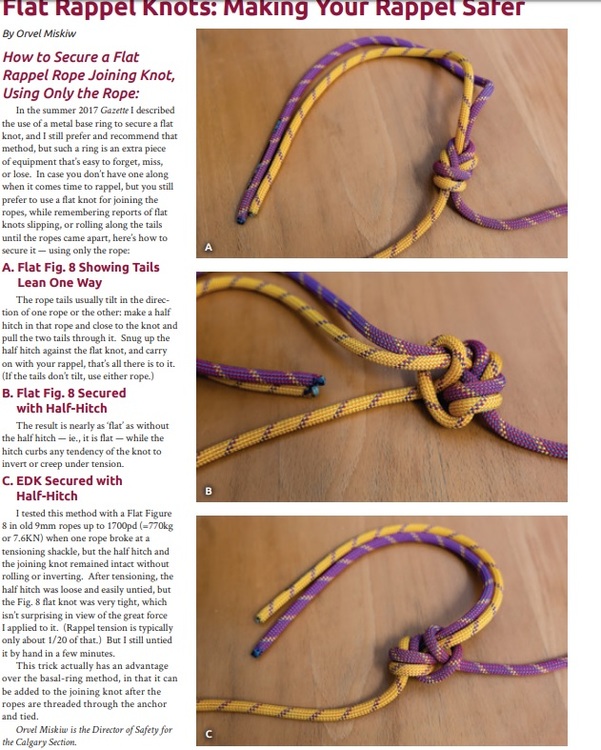 |

|
Why? |
|
|
Mark Hudon wrote: Why? As described in the article, the half-hitch is proposed as a back-up to the flat overhand. The article shows both flat overhand and flat 8 version. I have no use for a flat 8, but I do have a general interest in the article as well as potential solutions to backing up a knot if they are less bulky then the traditional method. |
|
|
Ditch the flat 8 altogether. It is another death waiting to happen. Plenty of tests and real life have proven this. |

|
I wouldn't consider the source reliable if they are in any way recommending a flat 8 for joining ropes for a rappel. |
|
|
Greg D wrote: [...] Thanks, I already noted this my post. Adding a half hitch adds another layer of complexity and diminishes one of the benefits of it. Namely, a flat side that doesn’t get hung up easily when pulling. This doesn't appear to eliminate the flat side. |
|
|
Michael Parker wrote: I wouldn't consider the source reliable if they are in any way recommending a flat 8 for joining ropes for a rappel. While I would concur - as there a number of sources indicated significant failures at low loads - Petzl included a Flat 8 bend as an option for their RAD line system petzl.com/US/en/Sport/RAD-L…; |
|
|
If I'm reading correctly, the Petzl RAD Line page shows the flat figure 8 taking more force to capsize and generally being stronger in that particular cord versus the EDK. Interesting. They do point out the advantages of the EDK in getting stuck less, being less sensitive to proper dressing, and being easier to untie after load. And, that their results are only valid for that cord, of course, not other ropes and cords. |
|
|
Sorry, I’m at fault for typing before fully reading! |
|
|
Does a properly dressed EDK with 18" tails really need a backup knot? I'm a big dude, and have simul-rappelled with another big guy and the EDK didn't even cinch up that bad much less roll. I think this is a solution in search of a problem... |
|
|
FosterK wrote: That article specifically states the flat 8 is NOT recommended indicated by the giant warning symbol next to it. It shows the pull tests for both flat overhand and flat 8 as a comparison but in both instances they recommended the flat overhand. |
|
|
Michael Parker wrote: That interpretation is not consistent with either the actual wording of the warning, or Petzl's use of their warning symbols. Nor is it consistent with the results of their testing. All of which is off-thread, since the proposed back-up could be used with a flat overhand bend. |
|
|
Here’s another option that has the advantages of the overhand (simplicity, compactness, offset from the rope axis), but doesn’t capsize. Tie it by tieing an overhand, then pass the ends through the loop a second time. It’s been tested on a slow pull machine, and does not capsize. I learned this at a rope rescue course last year in Ouray, Colorado. 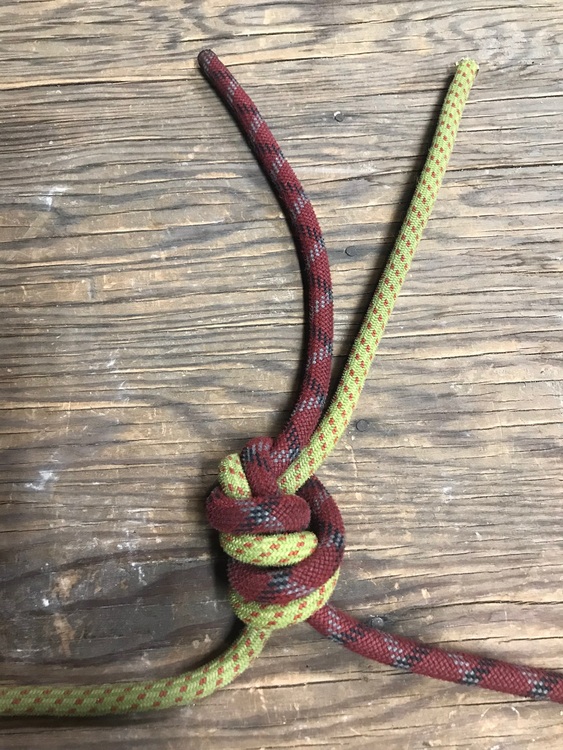 |
|
|
Bob Harrington wrote: I've been using this method for a few years now and it works really well, glad to see it's catching on! Here's more discussion of the knot. |
|
|
Yes, thanks. I think the knots are the same, but loaded on opposite sides. In the photo I posted, imagine the strands at the top are the rap lines and the tag ends are at the bottom. That would be your new knot. In photo in the R&I article, you can’t tell which he tested, because the photo doesn’t show where the ends are, but from his description of how to tie it, it sounds like he’s talking about the version I showed. Interesting that that he found that it capsized. Nonetheless, failure was by the rope breaking, so it’s plenty strong. 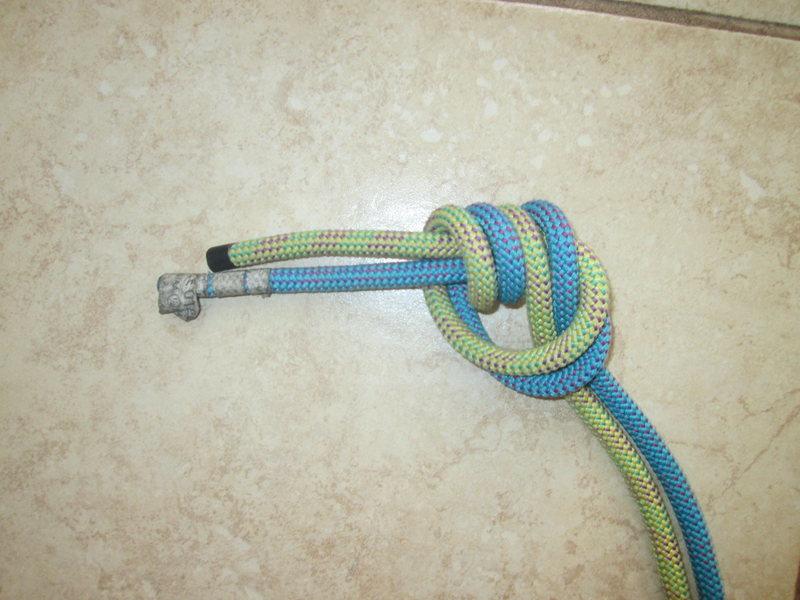 |
|
|
Has anybody really had a problem with a EDK? I'm not talking about a sloppy no tail EDK, but one you see guides everywhere use? I really don't see the point of making a functioning SAFE knot almost twice as big so it can get stuck. |
|
|
The only reference to a flat overhand failure I’ve seen is in the introduction to Tom Moyer’s paper on pull tests of the flat overhand and flat figure-eight. If your point is that flat overhands are safe, I agree. |
|
|
Bob Harrington wrote: Yes, thanks. I think the knots are the same, but loaded on opposite sides. In the photo I posted, imagine the strands at the top are the rap lines and the tag ends are at the bottom. That would be your new knot. In photo in the R&I article, you can’t tell which he tested, because the photo doesn’t show where the ends are, but from his description of how to tie it, it sounds like he’s talking about the version I showed. Interesting that that he found that it capsized. Nonetheless, failure was by the rope breaking, so it’s plenty strong. I see what you're saying, I'm just not sure if it matters which side you load it. If you leave the knot loose and manipulate it by flipping the loop around, you can get it to go from the tail strands wrapping around the loop twice, to loaded strands wrapping around the loop twice. Seems to work either way you tie it, but maybe one way is stronger than the other. We need a pull test machine. |
|
|
Bob Harrington wrote: Here’s another option that has the advantages of the overhand (simplicity, compactness, offset from the rope axis), but doesn’t capsize. Tie it by tieing an overhand, then pass the ends through the loop a second time. It’s been tested on a slow pull machine, and does not capsize. I learned this at a rope rescue course last year in Ouray, Colorado. It’s called the barrel knot with two ropes. Same effect as flat overhand except with a 2nd pass through. Superior to the flat overhand for loads rappel or situations where loads could rise above 5 kN. At this load the flat overhand wants to roll or worse snap. For an obvious example, we never use the flat overhand to join ropes for a double rope slingshot toprope or for simul rappel. More info here: http://topherdonahue.com/blog/2016/12/7/barrel-knot-for-tying-rappel-ropes-together |
|
|
Also please never use a flat figure 8. That thing will capsize faster than a sailboat in strong winds and tall whitecaps. |
|
|
Thanks! |


