|
|
Mark Pilate
·
Jul 22, 2019
·
MN
· Joined Jun 2013
· Points: 25
rockklimber wrote: ..... Isnt just as easy to tie off the brake and tie the klemheist w 2 hands. I’ not sure why you would do it with “one hand” when you dont need to. In what scenario would you be belaying and then suddenly have to tie a klemheist one handed while braking with the other .......But getting hands free is pretty simple and requires only two simple knots and about 10 seconds. Let’s just say we agree OK? My only bone with you is that you haven’t tried it or you wouldn’t be asking those questions.... I hesitated to promote something that I have a total of 4 days experience with, and I hesitate to continue to defend it, but it seems the only people who care are the handful still tuning in to this thread and they are all savvy and experienced....and prone to criticize or point out BS when they see it so I figured it was reasonably safe.... To answer your questions: It’s almost equally as easy to tie with one hand and with mouth holding stationary part as you wrap it around the rope, as it is with two hands -one hand holding as other hand wraps. In fact, it is almost an insult to your hand and a waste of its talents to do what your lazy mouth can do just as easily. It’s better suited to maintaining the belay The scenarios are the same regardless. One minute all is fine and dandy, and you’re spacin out on belay as the dang leader takes twice as long to lead a pitch as it would take you....then BAM. Shit happens....rockfall, dropped gear, leadfall, lightning, whatever. After assessing the situation, you still have a climber on belay. I’m saying you can whip a sling off your shoulder and have the load transferred almost instantly. It just skips the belay tie off, then undoing it to transfer load. Eliminates two steps by doing it directly and faster. Achieves load transfer in one step rather than three. It is unquestionably faster. I’ve been timing both ways. And I’m pretty good at knots. Safer is a debate, but whenever you add steps and tying and untying knots, and physically letting go of the belay, it does allow more points for screw up. In my suggestion they never go off active belay until load is safely transferred. In the “standard procedure” Someone could forget the mule details, think they have to do this step, and go with a knot below the device and get jammed up. I’m merely suggesting the technique to try for yourself. It sounds contrived, but it worked pretty slick in practice. It requires an easily accessible sling or cord, and an anchor within reach. Not too rare. If you have to rummage around for gear or move significantly to get near the anchor, then by all means tie off. PS. I noticed your own times for knots getting much shorter as posts went on (2 mins at first to 10 secs now). Lol. Just bustin yer balls. I agree that a few secs either way means nothing.
|
|
|
Stan Hampton
·
Jul 22, 2019
·
St. Charles, MO
· Joined Feb 2008
· Points: 0
Mark Pilate wrote: Let’s just say we agree OK? My only bone with you is that you haven’t tried it or you wouldn’t be asking those questions.... I hesitated to promote something that I have a total of 4 days experience with, and I hesitate to continue to defend it, but it seems the only people who care are the handful still tuning in to this thread and they are all savvy and experienced....and prone to criticize or point out BS when they see it so I figured it was reasonably safe.... To answer your questions: It’s almost equally as easy to tie with one hand and with mouth holding stationary part as you wrap it around the rope, as it is with two hands -one hand holding as other hand wraps. In fact, it is almost an insult to your hand and a waste of its talents to do what your lazy mouth can do just as easily. It’s better suited to maintaining the belay
The scenarios are the same regardless. One minute all is fine and dandy, and you’re spacin out on belay as the dang leader takes twice as long to lead a pitch as it would take you....then BAM. Shit happens....rockfall, dropped gear, leadfall, lightning, whatever. After assessing the situation, you still have a climber on belay. I’m saying you can whip a sling off your shoulder and have the load transferred almost instantly. It just skips the belay tie off, then undoing it to transfer load. Eliminates two steps by doing it directly and faster. Achieves load transfer in one step rather than three. It is unquestionably faster. I’ve been timing both ways. And I’m pretty good at knots.
Safer is a debate, but whenever you add steps and tying and untying knots, and physically letting go of the belay, it does allow more points for screw up. In my suggestion they never go off active belay until load is safely transferred. In the “standard procedure” Someone could forget the mule details, think they have to do this step, and go with a knot below the device and get jammed up.
I’m merely suggesting the technique to try for yourself. It sounds contrived, but it worked pretty slick in practice. It requires an easily accessible sling or cord, and an anchor within reach. Not too rare. If you have to rummage around for gear or move significantly to get near the anchor, then by all means tie off.
PS. I noticed your own times for knots getting much shorter as posts went on (2 mins at first to 10 secs now). Lol. Just bustin yer balls. I agree that a few secs either way means nothing. I “tried it” in my head. Here is a problem with your setup: Once you tie the klemheist one handed(agreed that its simple enough to do) and you clip it to your anchor which should be orientated for an upward pull,, then you transfer the load to the friction hitch. How do you then transfer the load off the weighted friction hitch and then onto the rope? There is no load releasable knot in the system? Do you just leave the injured climber on this friction hitch?And if you do, then how do you lower them off this setup later after you have ascended to them to address their injuries? When you tried this one-handed klemheist did you just stop there or did you actually work through the next steps needed?My times never changed. I said less than 1 minute to tie and the same to untie which combined is still less than 2 minutes. The video shows 10 seconds which is more accurate than my estimate off the top of my head which is still a trivial amount of time compared to the long times some people on this thread claim it takes. The point is the same. It takes a trivial amount of time to go hands free and tie two simple knots. And I knew you were bustin my balls. Now I’m bustin yours. :)
|
|
|
rgold
·
Jul 22, 2019
·
Poughkeepsie, NY
· Joined Feb 2008
· Points: 526
rockklimber wrote: I “tried it” in my head. Here is a problem with your setup: Once you tie the klemheist one handed(agreed that its simple enough to do) and you clip it to your anchor which should be orientated for an upward pull,, then you transfer the load to the friction hitch. How do you then transfer the load off the weighted friction hitch and then onto the rope? There is no load releasable knot in the system? I can't speak for Mark, but in general I think the secret is to use an autoblock and not a Kleimheist. With the load held by the autoblock and sling to the anchor, you connect the rope from the belay device to the anchor with a Munter, remove the rope from the belay device, snug the Munter up tight, mule it off, and then just pull back on the autoblock and the load transfers to a Munter Mule on the anchor. That's the advantage of the autoblock, you can release it under tension.
|
|
|
Mark Pilate
·
Jul 22, 2019
·
MN
· Joined Jun 2013
· Points: 25
Rockklimber - Good questions. Shows that you are noodling on it pretty good. But I have answers cuz “yes” I did work it all the way through.
Basically have 3 options depending on METT-T analysis — milspeak for what you’re gonna do next based on available gear, time, injuries, available help, position on climb,
etc...
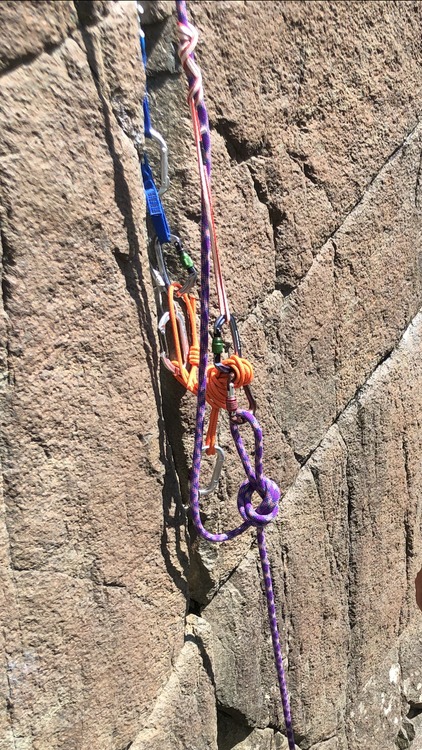
1. Quickest and simplest way: Leave climber on weighted Klemheist and back up with clipped overhand to Anchor (see pic) To release it there are two options... A). Worked yesterday easy: re-establish your belay, take up all slack and use your own counter weight to relieve tension on Klemheist and remove. Surprising how fast and simple this is. I actually worry that if people start using this, they will actually be tempted to scoot out for a snack, drink, or a smoke and jump back into the belay without the leader ever knowing...lol. B). If you are too lightweight to do (A), then use one of those knives everyone is carrying on the other thread to carefully cut the sling (once back on belay of course) the sling Can be re-tied and re-used if needed. 2. Best way: as I posted earlier, it takes me an extra 45 secs on avg to girth hitch an additional sling onto the Klemheist and tie a one handed mariner knot onto the anchor biner to provide full release. I found it’s too putzy to tie a Munter/mule or Munter/mariner one handed this way, but a pure basic mariner worked well and held the load (my GF) Can always add extra wraps if needed for heavier loads. Don’t just try it in your head, try it for real! (under controlled conditions of course) Climbing esoterica for sure.
|
|
|
Mark Pilate
·
Jul 22, 2019
·
MN
· Joined Jun 2013
· Points: 25
Rgold - I considered the autoblock as well, but chose the Klemheist (not Kleimheist- common mistake) simply due to the need for an extra component (biner or sling) to complete the hitch.
My goal was trying out the least steps with least equipment in fastest time to complete the mission (load transfer)Of all the friction hitches, the Klemheist is easiest to tie one handed. Your method works and has advantages as well.
|
|
|
Stan Hampton
·
Jul 22, 2019
·
St. Charles, MO
· Joined Feb 2008
· Points: 0
rgold wrote: I can't speak for Mark, but in general I think the secret is to use an autoblock and not a Kleimheist. With the load held by the autoblock and sling to the anchor, you connect the rope from the belay device to the anchor with a Munter, remove the rope from the belay device, snug the Munter up tight, mule it off, and then just pull back on the autoblock and the load transfers to a Munter Mule on the anchor. That's the advantage of the autoblock, you can release it under tension.
I like the klemheist iver an autoblock but will be interesting to try to rejease it under tension Just remember when you snug up the munter it has to be in lowering mode before you tie it off .
|
|
|
Stan Hampton
·
Jul 22, 2019
·
St. Charles, MO
· Joined Feb 2008
· Points: 0
Mark Pilate wrote: Rockklimber - Good questions. Shows that you are noodling on it pretty good. But I have answers cuz “yes” I did work it all the way through.
Basically have 3 options depending on METT-T analysis — milspeak for what you’re gonna do next based on available gear, time, injuries, available help, position on climb,
etc...
1. Quickest and simplest way: Leave climber on weighted Klemheist and back up with clipped overhand to Anchor (see pic)To release it there are two options...
A). Worked yesterday easy: re-establish your belay, take up all slack and use your own counter weight to relieve tension on Klemheist and remove. Surprising how fast and simple this is.
I actually worry that if people start using this, they will actually be tempted to scoot out for a snack, drink, or a smoke and jump back into the belay without the leader ever knowing...lol.
B). If you are too lightweight to do (A), then use one of those knives everyone is carrying on the other thread to carefully cut the sling (once back on belay of course) the sling Can be re-tied and re-used if needed.
2. Best way: as I posted earlier, it takes me an extra 45 secs on avg to girth hitch an additional sling onto the Klemheist and tie a one handed mariner knot onto the anchor biner to provide full release. I found it’s too putzy to tie a Munter/mule or Munter/mariner one handed this way, but a pure basic mariner worked well and held the load (my GF) Can always add extra wraps if needed for heavier loads.
Don’t just try it in your head, try it for real! (under controlled conditions of course)
Climbing esoterica for sure. I’m an engineer and have been teaching for 15+ years so I’m used to noodling complex systems. It’s not too complicated to do in my head. You just never I explained these other steps before. A. Is simple enough. Have had to do it many times with a heavy haul bag which are harder. B. I prefer not to put sharp knives next to weighted rope. Not a good combo if there was a slip. And there are other wats that dont require cutting anything. A mariner knot for rescue. No thanksI understand all your scenarios. Sorry, but you havent sold me. I still dont see any of them superior to using simple munters mules and overhands. 16years ago I did a lot of studying and practicing of the autoblock, bachmann, klemheist and prusik and various self rescue scenarios. 16years ago and after years of teaching I still find the sane techniques the safest and simplest.If you cant tie the basic knots then you shouldnt use it. If you dont have the right gear then you shouldn't use it. If you arent adept and practiced and exoerienced in the skills then you shouldnt use it and should wait for someone else who is more experienced to come rescue you.But if my partner is injured and needs immediate attention, I will use these methods to solve the problem now instead of having to wait for help that may take too long or may not ever come.If it works for you and your partner without error, then great for you. i hope you never have to use it though.
|
|
|
M Mobley
·
Jul 22, 2019
·
Bar Harbor, ME
· Joined Mar 2006
· Points: 911
rockklimber wrote: . .
If it works for you and your partner without error, then great for you. i hope you never have to use it though. and the thread ends?
|
|
|
Stan Hampton
·
Jul 22, 2019
·
St. Charles, MO
· Joined Feb 2008
· Points: 0
rockklimber wrote: I’m an engineer and have been teaching for 15+ years so I’m used to noodling complex systems. It’s not too complicated to do in my head. You just never I explained these other steps before. A. Is simple enough. Have had to do it many times with a heavy haul bag which are harder. B. I prefer not to put sharp knives next to weighted rope. Not a good combo if there was a slip. And there are other wats that dont require cutting anything.
A mariner knot for rescue. No thanks
I understand all your scenarios. Sorry, but you havent sold me. I still dont see any of them superior to using simple munters mules and overhands.
16years ago I did a lot of studying and practicing of the autoblock, bachmann, klemheist and prusik and various self rescue scenarios.
16years ago and after years of teaching I still find the sane techniques the safest and simplest.
If you cant tie the basic knots then you shouldnt use it. If you dont have the right gear then you shouldn't use it. If you arent adept and practiced and exoerienced in the skills then you shouldnt use it and should wait for someone else who is more experienced to come rescue you.
But if my partner is injured and needs immediate attention, I will use these methods to solve the problem now instead of having to wait for help that may take too long or may not ever come.
If it works for you and your partner without error, then great for you. i hope you never have to use it though. I just realized I forgot to go back and look at your picture and noticed you tied off your partner to a single piece of pro and the backup has a lot of slack. Not an ideal setup. If that one piece failed it would be a bad situation.
|
|
|
L Kap
·
Jul 22, 2019
·
Boulder, CO
· Joined Apr 2014
· Points: 224
m Mobes wrote: and the thread ends? hope springs eternal
|
|
|
F r i t z
·
Jul 23, 2019
·
North Mitten
· Joined Mar 2012
· Points: 1,190
This mountain project profile has been taken over by the SGP Social Media Content Curator, Amanda Eller. She a str8balla.
Much love,
Marco Kylie Stone
|
|
|
chris magness
·
Jul 23, 2019
·
Unknown Hometown
· Joined Oct 2010
· Points: 590
Mark Pilate wrote: Ok not saying this works in all cases, but have had success last couple days testing out tying one handed Klemheist and skipping the mule/overhand tie off to get hands free. Can actually do it faster.
While holding/locking off the belay with one hand, pull sling off shoulder, Hold tip of sling in mouth, whip it quickly around rope, thread end through and clip into anchor, release load onto Klemheist ....easy peasy.
Skips tying “hands free” knots and then releasing them.
Try it. I can tie a MMO on the load strand or spine in less than 5 seconds. While I agree that there isn't a standard set of rules, this thread is a pointless conversation. As I said upthread: increased knowledge = increased safety. We're seeing an increase in the number of accidents with under prepared gym climbers hitting the crags. Why advocate for a lower level of preparedness and thus ignorance or complacency? While there is a learning curve, newer climbers usually have access to mentors, myriad print resources, and now websites like this one. Speaking of that, MP could benefit from having a Resource Page as it has become a common tool for a wider range of climbers.
|
|
|
Mark Pilate
·
Jul 23, 2019
·
MN
· Joined Jun 2013
· Points: 25
Chris - you are arguing amongst yourself
|
|
|
Tradiban
·
Jul 23, 2019
·
Unknown Hometown
· Joined Apr 2004
· Points: 11,610
chris magness wrote: I can tie a MMO on the load strand or spine in less than 5 seconds. While I agree that there isn't a standard set of rules, this thread is a pointless conversation. As I said upthread: increased knowledge = increased safety. We're seeing an increase in the number of accidents with under prepared gym climbers hitting the crags. Why advocate for a lower level of preparedness and thus ignorance or complacency? While there is a learning curve, newer climbers usually have access to mentors, myriad print resources, and now websites like this one. Speaking of that, MP could benefit from having a Resource Page as it has become a common tool for a wider range of climbers. As I said upthread, increased knowledge is not increased safety. Noobs are coming out with all their book smarts and getting spanked because they can only regurgitate their knowledge, not apply it. The solution is, and my advice for noobs, is to learn the basics (prussik, etc) and then run through scenarios irl with a backup (TR or whatever). Use those opportunities to make mistakes and figure out what works for them and what doesn't.
This approach changes the noob's mindset and teaches adaption and innovation which is what actually keeps us "safe".
|
|
|
Stan Hampton
·
Jul 23, 2019
·
St. Charles, MO
· Joined Feb 2008
· Points: 0
chris magness wrote: I can tie a MMO on the load strand or spine in less than 5 seconds. While I agree that there isn't a standard set of rules, this thread is a pointless conversation. As I said upthread: increased knowledge = increased safety. We're seeing an increase in the number of accidents with under prepared gym climbers hitting the crags. Why advocate for a lower level of preparedness and thus ignorance or complacency? While there is a learning curve, newer climbers usually have access to mentors, myriad print resources, and now websites like this one. Speaking of that, MP could benefit from having a Resource Page as it has become a common tool for a wider range of climbers. Newbies have cell phones. Why do they need to go through the laborious, time-consuming, difficult and so complicated process of learning rescue skills when somebody else can come bail them out after they get in trouble because they are inexperienced. unprepared, ignorant, arrogant, complacent, haughty.....
|
|
|
Buck Rio
·
Jul 23, 2019
·
MN
· Joined Jul 2015
· Points: 16
chris magness wrote: I can tie a MMO on the load strand or spine in less than 5 seconds. While I agree that there isn't a standard set of rules, this thread is a pointless conversation. As I said upthread: increased knowledge = increased safety. We're seeing an increase in the number of accidents with under prepared gym climbers hitting the crags. Why advocate for a lower level of preparedness and thus ignorance or complacency? While there is a learning curve, newer climbers usually have access to mentors, myriad print resources, and now websites like this one. Speaking of that, MP could benefit from having a Resource Page as it has become a common tool for a wider range of climbers. i don't think most new gym climbers think they need a mentor...not all, but a great many. I put a posting up in my local gym for someone to climb with (and mentor if that was needed) I had exactly 0 responses. One older guy wanted to know if I would take his pre-teen daughter climbing, but I'm not a guide.
I posted on MP and did find one guy that wanted to get outside and actually learn about trad. He already knew the basics by reading and taking classes, and was a strong face climber, and is putting in the time to learn different styles of climbing.
|
|
|
Mark Pilate
·
Jul 23, 2019
·
MN
· Joined Jun 2013
· Points: 25
Ok I pulled the tombstone. We’re going 20 pages lol
To Chris And Rockklimber — you guys are disappointing. not sure why you guys are having such a knee jerk reactionary defense that the MMO must be used or there’s something wrong. You guys are now sounding like the dogmatic AMGA acolytes that HB was grumbling about. I tossed out an idea for legit feedback as I am not totally sold yet myself as I’ve been just playing with it for a few days. But you guys have yet to formulate a legit criticism.
Back to basics: the ONLY reason for the MMO is so that you can rig a transfer to a friction hitch. It’s a step that you do and then undo only because it is assumed you need two hands to do the hitch. It’s based on assumptions. I like to overcome assumptions and dogma and cut to the chase if I can. I described an option that is available that eliminates the need. Try it or don’t try it, it may or may not work for you in all situations, but then few things do.
But arguing how fast you can do potentially needless steps is not a sound argument to keep doing them. Or just Because “that’s the procedure”. As Tradiban says, “don’t just regurgitate your knowledge, apply it”. To clarify, I like the MMO myself and find it potentially useful. (And I can tie it in 2.5 secs, so there). I am not advocating FOR my suggestion, I’m arguing AGAINST dogmatic and false arguments that keep popping up. As soon as someone shows it’s not suitable from a legit standpoint I’ll be the first to acknowledge it. How fast you can tie an MMO is a false argument. “I tried it, but I can’t tie a Klemheist without two hands” is a legit argument. Or, “I never have slings or cords on my shoulder or harness, they’re always buried” Oh, and as long as this thread is back on, Rockklimber your criticism of the pic is off base. And Mariner knots are used by many in rescue.
|
|
|
Fran M
·
Jul 23, 2019
·
Germany
· Joined Feb 2019
· Points: 0
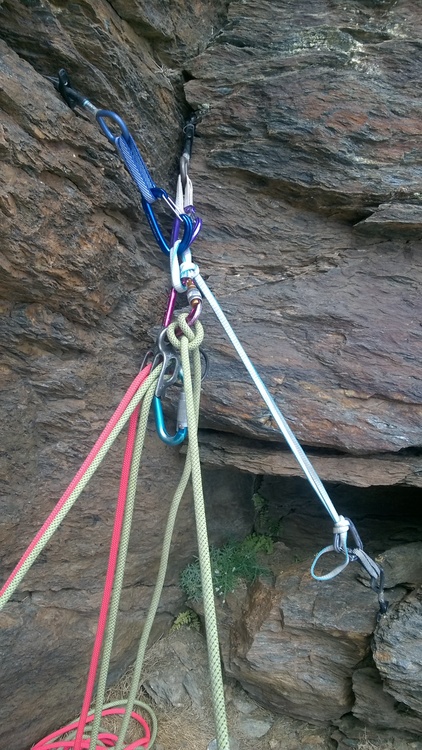
Better 3-piece-anchor configuration for upward or sideways pull. the sling is tied into a bowline on a bight, and cloved tight to the lower piece
|
|
|
curt86iroc
·
Jul 23, 2019
·
Lakewood, CO
· Joined Dec 2014
· Points: 274
Fran M wrote: Better 3-piece-anchor configuration for upward or sideways pull. the sling is tied into a bowline on a bight, and cloved tight to the lower piece if your twin ropes are indeed the fall line, this is a poor anchor configuration for a downward load. your blue cam is sharing a very small portion of the overall load, and since your 3rd piece is configured for an upward pull, your purple cam is left to take the majority...
|
|
|
Fran M
·
Jul 23, 2019
·
Germany
· Joined Feb 2019
· Points: 0
curt86iroc wrote: if your twin ropes are indeed the fall line, this is a poor anchor configuration for a downward load. your blue cam is sharing a very small portion of the overall load, and since your 3rd piece is configured for an upward pull, your purple cam is left to take the majority... downward is in the direction of my green, cloved rope, which happens to be the same as the fall line (last piece) so both blue and purple should get some load. id argue that if the fall line and downward direction dont coincide, still build the anchor for a downward pull in case the last piece (responsible of the fall line) pops out. And back up the anchor piece that opposes said fall line (purple xam in this case)
|

 Continue with onX Maps
 Sign in with Facebook