|
|
Robert Hall
 ·
Jun 11, 2019
·
North Conway, NH
· Joined Aug 2013
· Points: 28,846
·
Jun 11, 2019
·
North Conway, NH
· Joined Aug 2013
· Points: 28,846
1st Question: Rope lengths don't seem to add up. " (80m) Top Rope set up"...."...tied into a Fig-8-bite...confirmed enough rope on the ground....then lowered [off the shared anchor] about 75 ft...then fell 25 ft to ground" ...."rope still in the device when climber hit ground".
The 75 + 25 = 100 ft. A top rope on this implies 200 ft is in use. To lower the 100 ft with a fig-8 requires another 100 ft be on the ground by the lowering-belayer; yet 80m is only 262 ft. OK maybe cut a bit long, and maybe not a 100 ft climb (although these days most single-pitch-sport climbs are that, since 60m = 196 ft, with ropes usually cut to at least 200 ft)
2nd Question: Why couldn't the climber just be lowered on his/her OWN rope?...after putting in his/her own gear and biners in the shared anchor. (or even, with permission, just 2 biners through the already-in-place gear)
|
|
|
Russ Keane
·
Jun 11, 2019
·
Salt Lake
· Joined Feb 2013
· Points: 437
I can't grasp how the loose rope beneath the tied-in climber at the top, being lowered, would cause the fall. Or also how a tail (like when you clean a sport anchor and thread a bight through and re-tie, then untie your original) would cause this.
|
|
|
Robert Hall
·
Jun 11, 2019
·
North Conway, NH
· Joined Aug 2013
· Points: 28,846
|
|
|
Andrew P
·
Jun 11, 2019
·
North Bend, WA
· Joined Mar 2015
· Points: 848
I also don't really get it. From what I am understanding, people are saying the loose strand could have gotten stuck on some feature above the climber. And as the climber was lowered, the climbers entire weight would be on this loose strand. The loose strand then released from the feature, and the climber fell??
In order for the climber to fall 30 feet, the belayer would have had to be paying out slack and it seems to me would surely have noticed that the weight of the climber was no longer on them. Maybe I'm just missing something though.
|
|
|
Mark A
·
Jun 11, 2019
·
Golden, CO
· Joined Jun 2016
· Points: 96
Russ Keane wrote: I can't grasp how the loose rope beneath the tied-in climber at the top, being lowered, would cause the fall. Or also how a tail (like when you clean a sport anchor and thread a bight through and re-tie, then untie your original) would cause this. For the second part, no one is saying that (now). For the first part one theory is that the hanging rope got caught or tangled in something and held up the climber, there was enough rope out to pull out additional slack as it was fed out by the belayer, and then the tangled end released dropping the climber. It does seem unlikely I'm just reiterating the theory.
The idea that weighted end was actually running over something which it then popped off of seems more interesting but getting 25 feet of drop out of that seems very hard to accomplish.
|
|
|
Andrew Rice
·
Jun 11, 2019
·
Los Angeles, CA
· Joined Jan 2016
· Points: 11
The flaw to the "tail" theory is it doesn't explain how the rope was taught while lowering and then, when the tail got stuck, 30 feet of slack just magically got through the GriGri without any weight pulling it up. What's the mechanism for that? I can't imagine a belayer actively PULLING rope through a GriGri when just seconds before they were braking and making sure rope didn't run away too fast. Makes no sense. And if they did, well, there's your human error.
My vote is on a panic response from the belayer and/or improper use of the GriGri to begin with. I recently had a newbie GriGri user who had just fed slack properly (by pinching the GriGri) attempt to use that same technique to lower me. Luckily I was looking down and caught that before weighting the rope.
|
|
|
Robert Hall
·
Jun 11, 2019
·
North Conway, NH
· Joined Aug 2013
· Points: 28,846
Barring any further info, my vote is also for " a panic response from the belayer and/or improper use of the GriGri to begin with ".
|
|
|
Grant Kleeves
·
Jun 11, 2019
·
Ridgway, CO
· Joined Jan 2011
· Points: 60
This whole thread makes my head hurt with the lack of reading comprehension and common sense and also terrible math... OP almost certainly has the correct answer, tag end snags, the belayer would probably feel it slack off but not much before the climber completely unweights the rope, and the snag pops loose, not very hard to hit the ground from 25' with almost 200' of rope in the system, just stretch would get you really close, belayer getting pulled a bit would make it certain... a whole lot of hate for the grigri that probably helped in this case...I am curious why the rope that was going to be rapped on couldn't be used for lowering though?
|
|
|
Big B
·
Jun 11, 2019
·
Reno, NV
· Joined Mar 2015
· Points: 1
Grant Kleeves wrote: This whole thread makes my head hurt with the lack of reading comprehension and common sense and also terrible math... OP almost certainly has the correct answer, tag end snags, the belayer would probably feel it slack off but not much before the climber completely unweights the rope, and the snag pops loose, not very hard to hit the ground from 25' with almost 200' of rope in the system, just stretch would get you really close, belayer getting pulled a bit would make it certain... a whole lot of hate for the grigri that probably helped in this case...I am curious why the rope that was going to be rapped on couldn't be used for lowering though? ....don't forget grammer...oh wait, you already did ;)
|
|
|
Mark A
·
Jun 11, 2019
·
Golden, CO
· Joined Jun 2016
· Points: 96
Grant Kleeves wrote: This whole thread makes my head hurt with the lack of reading comprehension and common sense and also terrible math... OP almost certainly has the correct answer, tag end snags, the belayer would probably feel it slack off but not much before the climber completely unweights the rope, and the snag pops loose, not very hard to hit the ground from 25' with almost 200' of rope in the system, just stretch would get you really close, belayer getting pulled a bit would make it certain... a whole lot of hate for the grigri that probably helped in this case...I am curious why the rope that was going to be rapped on couldn't be used for lowering though? I can see that, if you have 10% rope stretch and a lot of rope out, releasing that while hung up and then going back on could make for a good fall and might also explain the relatively light injuries and the rope was still slowing the fall as it re-stretched.
|
|
|
Russ Keane
·
Jun 11, 2019
·
Salt Lake
· Joined Feb 2013
· Points: 437
"tag end snags,"
Between the climber and the anchor? Or between the belayer and the anchor. Honestly I am trying here.
|
|
|
Suburban Roadside
·
Jun 11, 2019
·
Abovetraffic on Hudson
· Joined Apr 2014
· Points: 2,419
YES CAPS_LOCK FAIL BUT ONCE I GOT STARTED . . . I went with it
.
IS ANYONE MISSING THAT a LONG ROPE WAS IN USE ?
The end of this rope was not on the ground, it was dangling, unsecured
(THIS ALLOWED FOR) A VERY LONG "TRAILING-END" OF THE ROPE TO MAKE A TRIANGLE
RUNNING FROM STUCK SPOT ABOVE, BACK DOWN TO CLIMBER, AT THE POINT WHERE THIS TOOK WEIGHT, IT CAME LOOSE
THIS ROPE WAS RUNNING UP THROUGH GEAR, ON AN ADJACENT ROUTE, TO A GUNKS ANCHOR (AS MANY AS 3 ROUTES SHARE)
THEN THE 8 ON A BITE LOOP WAS TIED, A 'BIENER USED TO CLIP INTO THE BELAY LOOP OF THE LOWERING CLIMBER.
UN-LIKE A STRAIGHT UP & DOWN SLING-SHOT SYSTEM,WHERE THE WEIGHT OF THE CLIMBER IS A CONSTANT ON THE DEVICE & BELAYER...
IN THIS CASE, THE ABILITY TO FEEL A LIGHT-WEIGHT CLIMBER WILL BE DRASTICALLY REDUCED
depending on the severity, A broken heel, (Calcaneus,w/ ankle compromise )is extremely painful & can be a life-changing injury. Likewise getting dropped can cause re-occurring trust/panic issues & PTSD .
|
|
|
Andrew Rice
·
Jun 11, 2019
·
Los Angeles, CA
· Joined Jan 2016
· Points: 11
Grant Kleeves wrote: This whole thread makes my head hurt with the lack of reading comprehension and common sense and also terrible math... OP almost certainly has the correct answer, tag end snags, the belayer would probably feel it slack off but not much before the climber completely unweights the rope, and the snag pops loose, not very hard to hit the ground from 25' with almost 200' of rope in the system, just stretch would get you really close, belayer getting pulled a bit would make it certain... a whole lot of hate for the grigri that probably helped in this case...I am curious why the rope that was going to be rapped on couldn't be used for lowering though? IMO there's a problem with this explanation: You're lowering someone. The rope is fully weighted. Rope is suddenly unweighted as they stop on a ledge or as rope tail gets snagged in a crack. Rope instantly stops pulling up through belay device without the person's weight pulling down. So how does 30 feet of slack enter the equation, even if the descent was stopped by something? Watch your belay device next time the person you are lowering touches ground. The rope doesn't just keep going through it, as if by magic.
I LOVE the GriGri, BTW, and think this story would probably be worse if it'd been an ATC. But
|
|
|
Grant Kleeves
·
Jun 11, 2019
·
Ridgway, CO
· Joined Jan 2011
· Points: 60
Russ Keane wrote: "tag end snags,"
Between the climber and the anchor? Or between the belayer and the anchor. Honestly I am trying here. the loose (unweighted) end of the 8 on a bight, between 5' long which is admittedly pretty unlikely to get snagged, and 60' long, which is pretty likely to get snagged, gets stuck in a crack or wrapped around a feature to the point it would hold weight, in my experience the end of the rope snags pretty easily in a crack where the factory end is stiffer than the rest of the rope, not hard to get that stuck to a point it will hold body weight, and usually a tiny bounce will pop off the factory tag and let it slip...
|
|
|
Grant Kleeves
·
Jun 11, 2019
·
Ridgway, CO
· Joined Jan 2011
· Points: 60
Señor Arroz wrote: IMO there's a problem with this explanation: You're lowering someone. The rope is fully weighted. Rope is suddenly unweighted as they stop on a ledge or as rope tail gets snagged in a crack. Rope instantly stops pulling up through belay device without the person's weight pulling down. So how does 30 feet of slack enter the equation, even if the descent was stopped by something? Watch your belay device next time the person you are lowering touches ground. The rope doesn't just keep going through it, as if by magic.
I LOVE the GriGri, BTW, and think this story would probably be worse if it'd been an ATC. But think how much slack you have to throw someone who just lowered from the anchor when they touch the ground, from a 100' route you are giving them a solid 10' to get all of their weight on the ground from the second their feet touch, you don't think about it, and that's kinda my point, it slips through the device without you pulling it, you feed one armload but on a long route quite a bit more ends up through your device, and that is a static load, not the dynamic load that would happen in the case of this accident...think of a TR fall onto a slack rope 25' up a 100' route, with average rope you are going to be uncomfortably close to the ground... I'm not saying errors were not made but in this case I think the main mistake was not realizing the climber was unweighting the rope.
|
|
|
Andrew Rice
·
Jun 11, 2019
·
Los Angeles, CA
· Joined Jan 2016
· Points: 11
Grant Kleeves wrote: think how much slack you have to throw someone who just lowered from the anchor when they touch the ground, from a 100' route you are giving them a solid 10' to get all of their weight on the ground from the second their feet touch, you don't think about it, and that's kinda my point, it slips through the device without you pulling it, you feed one armload but on a long route quite a bit more ends up through your device, and that is a static load, not the dynamic load that would happen in the case of this accident...think of a TR fall onto a slack rope 25' up a 100' route, with average rope you are going to be uncomfortably close to the ground... I'm not saying errors were not made but in this case I think the main mistake was not realizing the climber was unweighting the rope. Hmmmm. My experience differs. When I'm belaying with a GriGri and someone touches down I have to DELIBERATELY give them slack to get a comfortable amount for them to move around. There's no way it would happen accidentally. But I don't think someone accidentally threw slack into a system with a climber 25 feet up, still. I think they lost control of their belay device. It happens with relative frequency.
|
|
|
Robert Hall
·
Jun 11, 2019
·
North Conway, NH
· Joined Aug 2013
· Points: 28,846
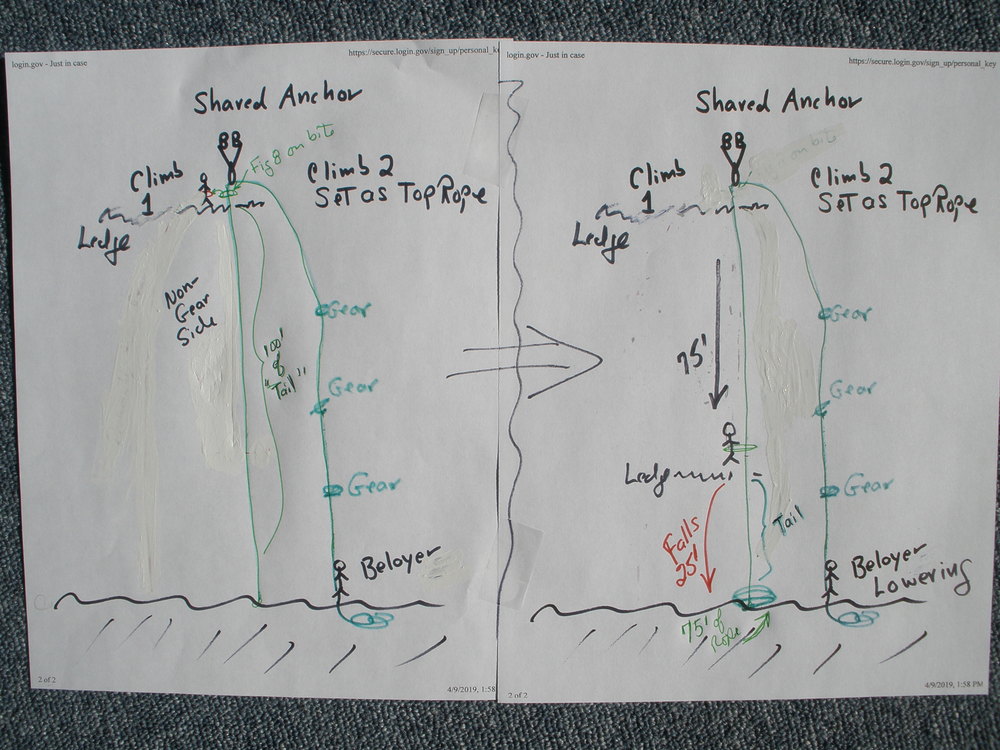
If, as the Thread's Originator stated, the rope was set as a Top Rope, and the climber tied in to it with a fig-8-on-a-bite, then the situation would be as shown in the photo. ["Set as a TR" implies to me that both ends are down on the ground; this is where I get the speculation that the climb is probably less than 100 ft if a 80m rope (262 ft) was used. If the tail end of the rope had been pulled UP to the climber before he/she tied in, then why use a Fig-8-on-a-bite + locking biner, why not just a fig-8-tie in? ]
(double click to enlarge) I (and I think Russ, too) don't see where a tail would be "caught" (only, perhaps a loop of that tail). Also, it isn't clear from the original post whether the climber got to the ledge by climbing up climb#1, or hiking around to the ledge. But, it really doesn't make any difference to the fall.
|
|
|
Andrew Rice
·
Jun 11, 2019
·
Los Angeles, CA
· Joined Jan 2016
· Points: 11
It dawned on my while thinking about this that some belayers lowering a climber with a GriGri often modulate the speed of lower by opening and closing the lever partially. I can see how someone lowering at 2/3 open Grigri might instinctively open it up MORE when their climber suddenly stops lowering (as in if a rope got snagged). And then, when it unsnagged, the device is wide open and prone to the rope suddenly yanking through.
I also had a situation recently where I was lowering with a Grigri and an odd loop from twist in the rope momentarily popped the rope free of my brake hand. My climber accelerated and, by pure reflex, my brake hand caught the rope again before it could get going fast. But that could have ended badly.
|
|
|
Tradiban
·
Jun 11, 2019
·
Unknown Hometown
· Joined Apr 2004
· Points: 11,610
Señor Arroz wrote: It dawned on my while thinking about this that some belayers lowering a climber with a GriGri often modulate the speed of lower by opening and closing the lever partially. I can see how someone lowering at 2/3 open Grigri might instinctively open it up MORE when their climber suddenly stops lowering (as in if a rope got snagged). And then, when it unsnagged, the device is wide open and prone to the rope suddenly yanking through.
I also had a situation recently where I was lowering with a Grigri and an odd loop from twist in the rope momentarily popped the rope free of my brake hand. My climber accelerated and, by pure reflex, my brake hand caught the rope again before it could get going fast. But that could have ended badly. I think you people need to start listening to me regarding the flaws of the Gri or you might be subject of the next "unexplained" accident.
|
|
|
Used 2climb
·
Jun 11, 2019
·
Far North
· Joined Mar 2013
· Points: 0
Señor Arroz wrote: It dawned on my while thinking about this that some belayers lowering a climber with a GriGri often modulate the speed of lower by opening and closing the lever partially. I can see how someone lowering at 2/3 open Grigri might instinctively open it up MORE when their climber suddenly stops lowering (as in if a rope got snagged). And then, when it unsnagged, the device is wide open and prone to the rope suddenly yanking through.
I also had a situation recently where I was lowering with a Grigri and an odd loop from twist in the rope momentarily popped the rope free of my brake hand. My climber accelerated and, by pure reflex, my brake hand caught the rope again before it could get going fast. But that could have ended badly. It's no wonder I hate it when ppl use gri gri's to belay me. I read these stupid stories all the time. I'll stick to ATC belay, people don't seem to screw that up as often.
|

 Continue with onX Maps
 Sign in with Facebook