
 Continue with onX Maps
 Sign in with Facebook






History and reasoning behind gear ratings



|
I'm trying to track down some documentation about where gear ratings come from. For example, the UIAA specifies that the maximum impact force for a climbing rope not exceed 12 kN upon the first drop in the standard UIAA drop test. I'm interested to know if anyone has come across some climbing-specific documentation that talks more about where that number comes from in detail. |
|
|
The 12kN comes from military tests on parachute harnesses and the rest follows on from there but then modified in the light of experience and practicability/material developments etc. Basically there is a fundamental safety chain which is altered in light of experience. |
|
|
This is what you need..
Edit: Google "survivable impact forces on human body constrained by full body harness" and the pdf should be the first link. |
|
|
Thanks for the link! |
|
|
F loyd wrote: This is what you need.. "An extraordinary fact is that no kernmantle rope construction of 9, 10, or 11 millimeter diameter has failed simply because of a falling climber." I've wondered about this. Are there any reported incidents where a rope (in any condition, with any amount of grit in its core) simply snapped on a person? |
|
|
Andy Eiter wrote:
|
|
|
Bob Johnson wrote: Thanks for the link! Looks like the UIAA have yet again reorganised their website so nothing is available any more, a link to the pdf is dead. The talk was by Neville McMillan if you want to search further but it was basically as I said above. Incidentally there were equipment standards before the UIAA, for climbing ropes the UK had British Standard BS 3 104:1959 and for bolts the German standard goes back nearly 100yrs- 50kN and a design life of 50 years no less! That standard ceased when Germany unified again and the Euro standards took over. |
|
|
Not the same but a crazy video none the less |
|
|
Caleb Schwarz wrote: Not the same but a crazy video none the less Yikes! Did he live? |
|
|
Survivable Impact Forces on Human Body Constrained by Full Body Harness |
|
|
Perhaps the Neville McMillan document Jim referenced: |
|
|
That's the one |
|
|
Marc H wrote: Yes, From the videos description "As he fell, the single 10mm rope he was using completely sheared while it viciously scraped down the arete. Michele sustained a broken wrist and broken heel bone in the fall and stayed in hospital to recover from his injuries." |
|
|
dave custer wrote: Perhaps the Neville McMillan document Jim referenced: "The highest conceivable force in the rope to the climber is Does this mean that the additional stretch (of a proper dynamic rope) from having more rope out outweighs the extra force generated from falling from higher? Even taking a full-rope factor-2 whip won't generate more than 12kN? |
|
|
Andy Eiter wrote: All the ropes I have ever seen for sale have impact forces that don't come anywhere close to 12 kN. Most have impact forces of around 8 kN or so. Mind you, the impact force that is written on the label of a climbing rope means something very specific. What is on the label is the peak force generated in the UIAA drop test on the very first drop. The drop test is described in detail here: theuiaa.org/safety-standard…; The drop is only a 1.77 fall factor, but it is a quite violent fall that is not so relevant to a real climbing fall involving squishy human bodies, a belayer that can move and also allow some rope slippage to occur through the device. So the standard is in place so that there is some factor of safety (i.e. the rope will not experience a force close to its breaking strength) involved when using the rope "in the field" |
|
|
Bob Johnson wrote: Right, I'm just curious about the claim that the highest conceivable force would be 12kN. Like, can you not physically generate more than this on a dynamic rope, even if it would never happen in a real-life situation (e.g., climbing the full length of the rope with no pro, then whipping). |
|
|
Andy Eiter wrote: Changing the length of the fall doesn't change the fact that it's a factor two. Peak force will be under 12kN, but the climber will experience high forces for a longer period of time. You can get a fall factor > 2 by doing something absurd like getting the rope stuck behind a flake part way through a screaming whipper -- see multipitchclimbing.com/ -- or your belayer sucking in 9' of rope (lol) and locking off (lol) when you're trying to take a factor two from 10' above the anchor. I'd be curious to know if anyone's survived the hypothetical rope caught behind a flake situation with the rope simply being cut. |
|
|
It is always possible to generate larger forces in the climbing rope by simply using a larger mass. The term "highest conceivable force" in the paper is a little bit confusing. On p. 3 of the McMillan paper he describes what he means by "highest conceivable force" and that it is determined empirically: "Investigate the worst conceivable loading that can be applied to an item, in the worse case accident scenario, demand that value (with some margin) as the minimum strength requirement for all components of that type" |
|
|
NegativeK wrote: I'm trying to imagine how force will change on the spectrum between taking a 1' and a 400' factor-two. Does it change proportionally? You can get a fall factor > 2 by doing something absurd like getting the rope stuck behind a flake part way through a screaming whipper -- see multipitchclimbing.com/ -- or your belayer sucking in 9' of rope (lol) and locking off (lol) when you're trying to take a factor two from 10' above the anchor. I'd be curious to know if anyone's survived the hypothetical rope caught behind a flake situation with the rope simply being cut. That's what happened to those folks on El Cap last (this?) year right? @Bob, good point that I wasn't even thinking about the mass attached to the rope. I'm about 80kg when geared up; I didn't even think of it as a variable. |
|
|
Here's an equation for the maximum force in the climbing rope: 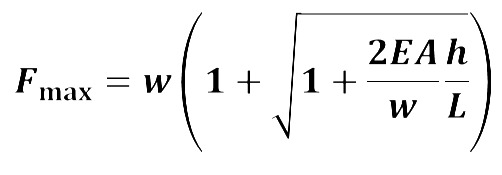 |
|
|
Here's another story of a climber who had his rope sever. He had a bolt pull and an ascended pop off from the very top of El Cap, fell the full length of his rope (so factor 1). |


