
 Continue with onX Maps
 Sign in with Facebook






Interesting Potential Energy Infrastructure at Rock Creek and Owens River Gorge.


|
|
bus driver wrote: I forget the exact math but power is sold to grid in 15min chunks. Power is most valuable Notepad++when it’s in demand- duh- like at 6pm in Fresno when it’s 110f.... so the PPG people would buy power from the Nuke Plant (now closed, by SLO) for “X” Vidmate.... at like 1am when it’s not in demand and pump that water uphill 3,000 feet to Courtright. When power would hit 4x “X” they would run the turbines and sell the power, making a profit and supplying much needed power when most in demand. This only works when you have cheap power to start with. The reason it won’t work in the Owens is because they don’t have cheap power. |

|
Guy Keesee wrote: Pump storage is a good way to make a nuclear power plant more efficient. Nuclear plants typically don't need energy storage since they can modulate their power output (to an extent) in order to meet expected demand. As far as I'm aware new energy storage installments are intended to make up for the variability of wind and solar and reduce dependence on base load power sources. I personally think that in many cases developing nuclear makes more sense than developing energy storage for wind and solar, but that's aside the point. |
|
|
Article in a local paper about the proposed project. Includes some quotes from Victor Rojas, who proposed it: |
|
|
Andrew Child wrote: Andrew you are correct! Modern nuclear plants can be throttled- sort of. It costs more money to be able to do this. The rest of the world is not as afraid of nuke power as we Americans are. The gen 3 and 4 plants (newest) are load following, older plants are base load, meaning they sort of go full throttle only. To do all this pumping of H2O uphill takes a huge amount of power. Excess power, not expensive solar, wind or hydro power. Destroying one of the most beautiful, wild spots around would be a crime. |
|
|
Nuclear power plants are "baseload" plants, meaning they normally run at 100% power. Other types of power-generating facilities (hydro, fossil) are more likely to be "load-followers," meaning they fluctuate to accommodate the needs of the grid/system. |
|
|
FrankPS wrote: Nuclear power plants are "baseload" plants, meaning they normally run at 100% power. Other types of power-generating facilities (hydro, fossil) are more likely to be "load-followers," meaning they fluctuate to accommodate the needs of the grid/system. Frank.... thanks, I was reading and trying to get a link.... hard to do on iPhone. |
|
|
Guy Keesee wrote: |
|
|
THX.... |
|
|
Response from the USDA/FS. A resounding "no".. They were never consulted and it overlaps Wilderness Area. 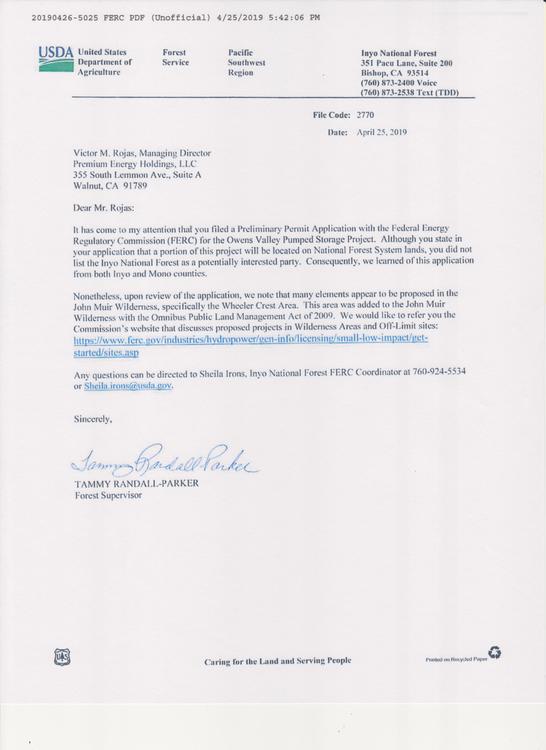 |
|
|
Response from the Mono County Community Development staff /FERC . Also lists a litany of issues that are problematic with the proposal: |

|
Another weigh in: Pumped storage is very efficient, inexpensive and a huge energy storage addition to the grid. No batteries can come close right now. In my opinion (i interned in power generation for a year so i'm fairly learned in energy economics) we should absolutely pursue these kind of projects whenever possible. Places with California that can produce huge portions of their energy generation with wind/solar are great but many people forget that its not just the cost of the energy itself, but also the cost of holding the capacity. Where I worked we held about 1100 MW in capacity, but only peaked above 900 MW once or twice in the summertime. We HAVE to keep this capacity on hand, and its a big reason that utilities aren't decommissioning "uneconomic" plants because they have to guarantee their maximum capacity in dispatchable generation (plus some extra). Pumped storage = renewable + dispatchable. |
|
|
I humbly submit building a huge solar power station somewhere else like 60 miles north of Barstow. |
|
|
The same company, Premium Energy Holdings, the holding company for Power Tech Engineers, has submitted 2 more pumped storage projects, both of which involve new dams. |
|
|
Major update: 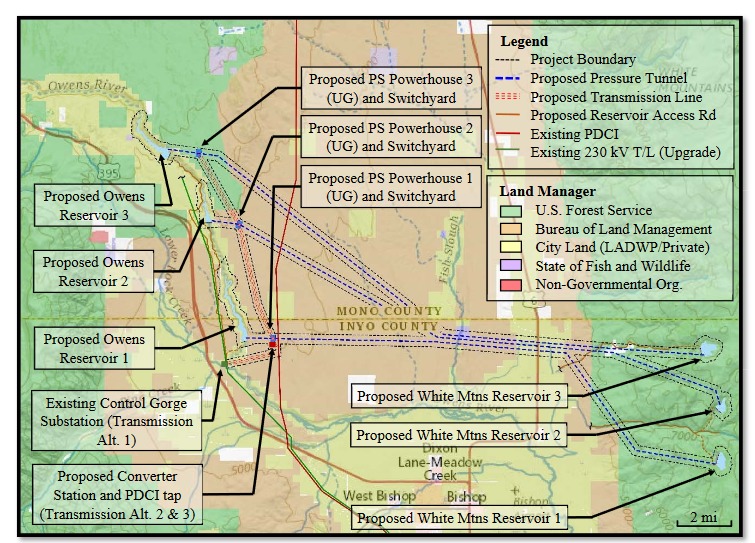 The new proposal pdf is here: https://elibrary.ferc.gov/idmws/common/OpenNat.asp?fileID=15250330 FERC eLibrary info: Accession #: 20190520-5041 Docket #: P-14984 |
|
|
I say build the one in Utah. |
|
|
This whole idea is totally wackadoodle. I'm having a little trouble deciphering their map since they conveniently left off all the pertinent landmarks and existing reservoirs - but it looks like one dam at the Narrows (= no more Upper Gorge in this scenario) and the second the second wipes out the Sub Gorge ? The storage pipelines have to run across BLM, FS, Private Land, Hwy 6 and Fish Slough - which is a an ecological preserve and a Native American site- then up the White Mountains... which have no water ?%* I'm corn-fused. |
|
|
Maidy wrote: This whole idea is totally wackadoodle. I'm having a little trouble deciphering their map since they conveniently left off all the pertinent landmarks and existing reservoirs - but it looks like one dam at the Narrows (= no more Upper Gorge in this scenario) and the second the second wipes out the Sub Gorge ? The storage pipelines have to run across BLM, FS, Private Land, Hwy 6 and Fish Slough - which is a an ecological preserve and a Native American site- then up the White Mountains... which have no water ?%* I'm corn-fused. This is the stupidest idea I have seen in a long time. The White Mountains are Wilderness as well, and on top of that littered with numerous fault lines, many more than the 120 billion Amtrak to nowhere tunnels have to deal with in the Tehachapi Mountains. Then where are you going to get 5000MW of power in Bishop in order to run the pumps? It's a complete joke. |


