
 Continue with onX Maps
 Sign in with Facebook






Question regarding a climbing book

|
So I picked up Donahue's Advanced Rock Climbing: Expert Skills and Techniques to use in a literature review for a school project, and I came across a picture that didn't seem right. To me it appears to be a klemheist but is labeled as a prusik hitch and I wanted to make sure I wasn't just nuts. 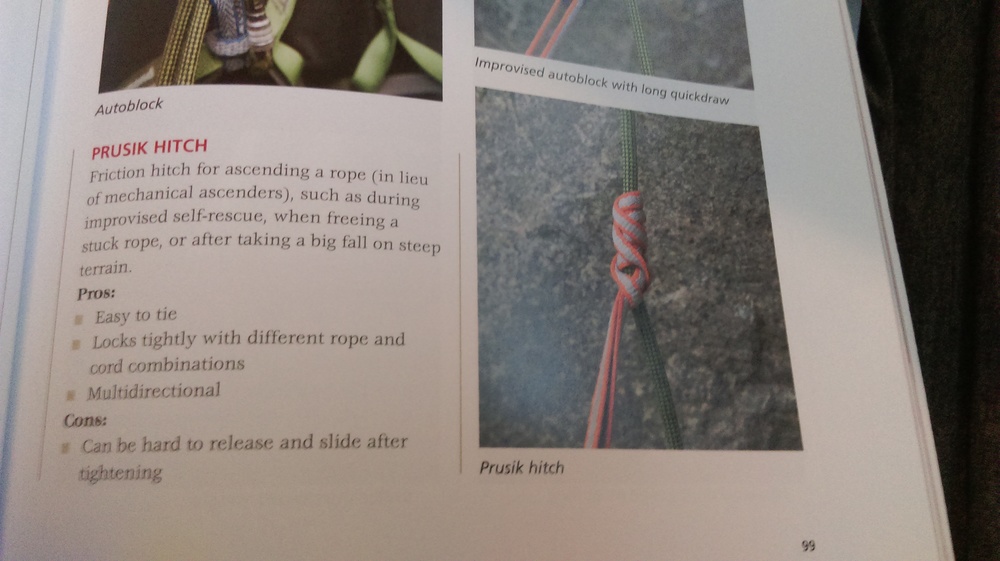 It has a few other mistakes including an unfortunate typo (says gear loop when it should say belay loop on pg 324) and another odd photo that depicts what might be a valdotain and calls it a french prusik (which I've always thought was another name for the autoblock). Still a great text, by far and I'm sure the next edition will be even better, but I just wanted to do a quick reality check before I start writing about it. Note: This is not intended to be an derogatory post towards the book or its author, I just wanted to make sure I'm interpreting the picture correctly. And Topher, if you see this, please be aware of the typo on page 324, it's in the paragraph labeled "clip in". I'm guessing you're already aware of it but just in case you weren't. |

|
Topher told me that in a rush to get it to the publisher’s release date it “missed” some editing. He’s corrected some of it in his blog. |
|
|
Malcolm Daly wrote: Topher told me that in a rush to get it to the publisher’s release date it “missed” some editing. He’s corrected some of it in his blog. Yes, I was aware of that given the whole thing with the barrel knot vs EDK. Is it safe to assume that photo is just another mistake that got missed in the rush is it really a prusik hitch? It really doesn't look like one to me, but I've only ever tied a prusik with cord and I know that sometimes webbing can look a little funky. |
|
|
Looks like a klemheist. |
|
|
klemheist fo sho |
|
|
your gonna dye |
|
|
www.treebuzz.com/pdf/climbing_hitches.pdf
Eli, |
|
|
Marty C wrote: www.treebuzz.com/pdf/climbing_hitches.pdf |
|
|
I'd call it an "enhanced" Kleimheist. I say "enhanced" because the top loop is wrapped twice around the other turns before the bottom loop is fed through it; the standard Kleimheist has only one such turn. |
|
|
rgold wrote: I'd call it an "enhanced" Kleimheist. I say "enhanced" because the top loop is wrapped twice around the other turns before the bottom loop is fed through it; the standard Kleimheist has only one such turn. interesting, that must be why it looked a little bit funky to me. I wonder whether or not that was intentional. |
|
|
over thinking it. Friction knott would suffice and get the author off the hook for which photo was used as long as the photo was of a friction knott. |
|
|
It’s definitely not a prusik and looks like a klemheist but hard to tell by the strange looking wraps. Get used to errors in climbing books. Every one I have read has many errors in them. Especially Chris Mac’s How to Bigwall book that has entire paragraphs repeated back to back. |
|
|
Just now seeing this as the author of the book in question - it's a Prusik hitch and labelled correctly, not a Kleimheist as speculated. When tied in thin webbing, a Prusik doesn't retain its shape the same way as it does with cord, but it still works - sometimes needs an additional wrap to stick if the webbing is new. If you want to check, tie a Prusik with thin webbing, weight it, and it will look just like the photo. |
|
|
topher donahuewrote: Well, I tried tying and weighting a prusik tied with a thin sling and never could get it to look like that. The two parallel strands diagonaling down are a tip-off; a prusik doesn't have that feature and doesn't collapse into that configuration. No matter how distorted the prusik gets under loading, there's only one strand diagonaling down as far as I can tell. A weighted kleimheist, on the other hand, looks a whole lot like the knot in question---see pics below. So I'm voting for a kleimheist with something like 90% confidence,---can't tell for sure without having the knot in hand to inspect. Perhaps the real question is why use a picture of a knot that is undetectable as a the knot and can't be used by anyone to tie the knot? 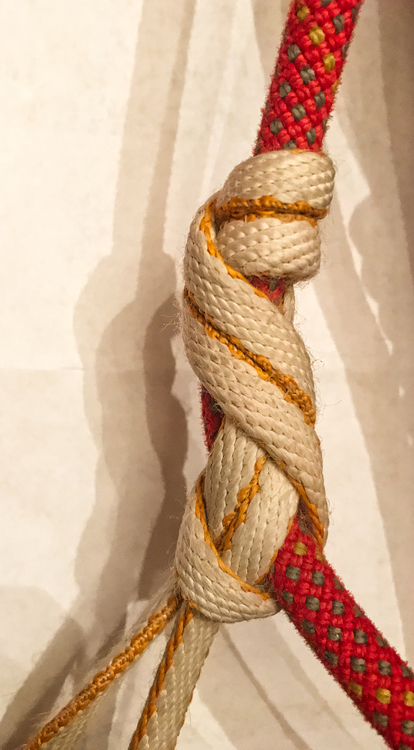 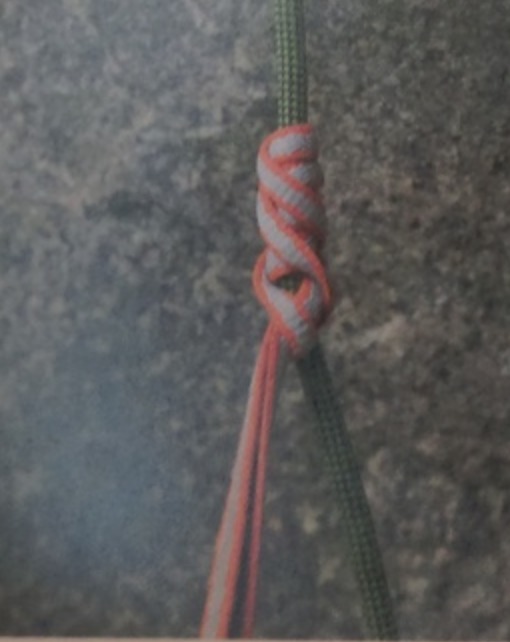 |
|
|
Based on the feedback here, it was a mistake to use that hitch as shown in the book because it could be confused with a hitch with a different name and I'll remove it in the next edition. Thanks for the feedback. As an advanced book, the goal was was to present the pros and cons of the different options, not to teach the basic knots and hitches. I intentionally took photos with equipment that most climbers have with them on challenging terrain rather than equipment that would be best for knot tying instruction but few of us actually carry while climbing. For example, I used webbing rather than cord because most climbers I see don't carry a Prusik-length cord, but almost everyone carries webbing. Again, thanks for the feedback and I've noted it in my record of changes for the next edition. |
|
|
While we have experts here, I have a question (think the OP's post has been addressed so I'm comfortable migrating the discussion a bit) When I've jugged up a rope using a sling hitch -- the sling tends to bite down harder and harder each time it's weighted. My hollow block cord doesn't do that as bad. Any tips for type of hitch or sling to use for smoother operation? Or maybe I should get the book ?!? Eli your teacher better appreciate the attention to detail you're puttin in to this !! |
|
|
jt newgardwrote: My favorite from my experience is the French Prusik - like a Kleimheist but clipping both ends of the sling to a biner rather than passing one loop through the other like a girth hitch - it releases easily when sliding it upwards while all the others tend to be difficult to release. See my photo from the book in question, Advanced Rock Climbing: Expert Skills and Techniques. If you're anywhere beyond a beginner, do check out the book. I interviewed a ton of climbers who are a lot better than I am and tried to really capture the ways expert climbers can make rowdy terrain quite safe and fun. No matter what method you use, always tie frequent backup knots in the rope below and clip into them as you go along - and experiment with it before you need it. 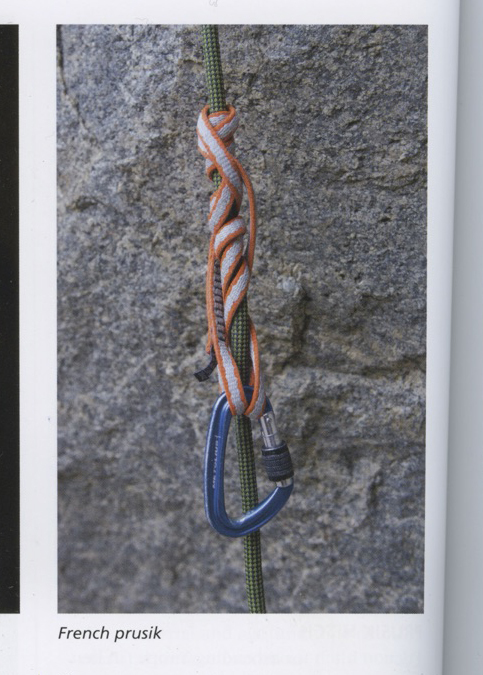 |
|
|
Took a look at the book's intro. Totally sold on the philosophy and bought a copy ! Does this mean the days of our 24+ hr push epics are over ? I have mixed feelings about this. haha .......... |


