
 Continue with onX Maps
 Sign in with Facebook






General Strength of Damaged Ropes


|
|
I'm putting together an opinion piece about fixed ropes left on this route on Little Bear Peak in CO. The fixed ropes are put there anonymously, and maintenance of the ropes is also a big mystery. The route sees much rockfall, so ropes left up there get damaged/cut in time. 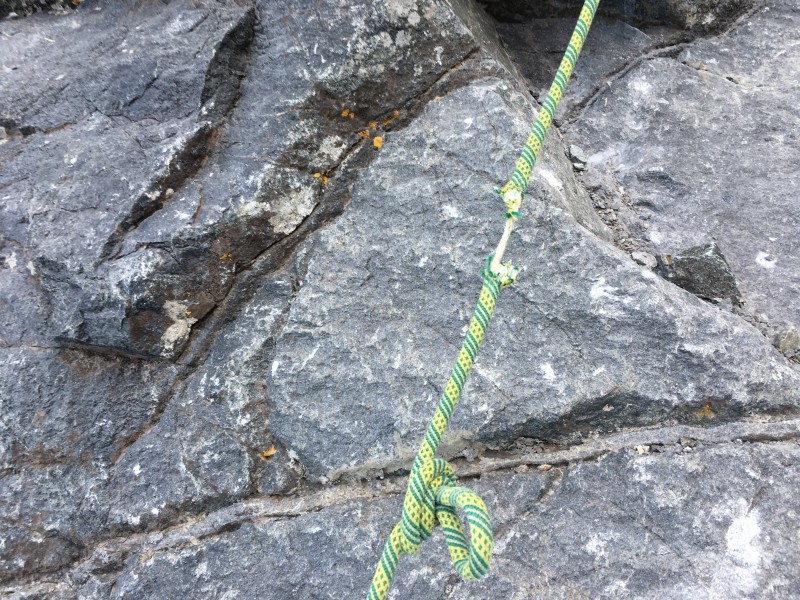 I'm wondering if I can put a number to how strong the rope is at the point the rope has been damaged, the sheath removed, and the core exposed (and mostly cut through, itself). I get that, "it depends", but I'm trying to basically figure out if it's foolhardy to batman up such a rope, or if yer just gonna die. Is there are math/physics that I can show the work on? Would you trust this rope? It would be nice if I could say, "in lab conditions, a rope like this would hold at most xlbs statically, which equates to a x lb dude slipping y feet on a y degree incline". I don't know if that's possible, and if not, that's an interesting point to add to the argument (the strength of a damaged rope varies too much to estimate). |
|
|
You're going to get widely varying responses. |
|
|
Wes Turner wrote: You're going to get widely varying responses. Indeed. This is a highly contentious topic. People take the use of these ropes very personally, as it's there choice to do so, or not. I'm OK with keeping that choice to the individual, but I'd also like to figure out the dangers in doing so. Safety in the mountains also gets very personal for those trying to give advice, as oftentimes we've lost those we've love to simple mistakes that were obvious in hindsight. In my research, I have not found an accident report (or even one similar) of someone using a damaged, fixed rope that then broken, causing them to fall, get injured/die. If there are any reports I should look at, I would love to see them. |

|
Long Ranger wrote: I'm putting together an opinion piece about fixed ropes left on this route on Little Bear Peak in CO. The fixed ropes are put there anonymously, and maintenance of the ropes is also a big mystery. The route sees much rockfall, so ropes left up there get damaged/cut in time. I would guess that particular rope wouldn't be able to hold much more than maybe static body weight - almost all of the core has been cut. By maybe static body weight, I mean a female climber, body weight around 120-140 lbs, might be able to gingerly weight this rope, and if she doesn't breathe, it will possibly not break. But if she so much as sneezes, it'll probably snap. It depends on the structure of the rope, how long ago the rope was cut, how much of the rope was cut, and how old the rope is in general. |
|
|
A simple knot (overhand on a bite, butterfly, etc) will easily isolate this damage and make the rope safe again... (i.e. remove the knot from below and make the knot higher to isolate the damage). |
|
|
|
|
|
Eric and Lucie wrote: A simple knot (overhand on a bite, butterfly, etc) will easily isolate this damage and make the rope safe again... (i.e. remove the knot from below and make the knot higher to isolate the damage). This.... ^ But only If you could get to this point without having to use the rope, I would do the same. |

|
this is drift, but what's your thesis? That fixed ropes shouldn't be left there? That fixed ropes need to be meticulously maintained? |
|
|
Eric and Lucie wrote: A simple knot (overhand on a bite, butterfly, etc) will easily isolate this damage and make the rope safe again... (i.e. remove the knot from below and make the knot higher to isolate the damage). Good point to add to my essay. Although, this will stop one from using an ascender/rappel device without removing it from the rope (not that the damage to the rope would make using that a bad idea to start). And hopefully one spots the damage before starting up! Visibility can be a bit less than ideal on the route. |
|
|
Long Ranger wrote: if you expand your search into other areas that use climbing ropes (ex. rope access), you may find some interesting reports (i don't know any offhand, but would recommend broadening your population) Long Ranger wrote: Good point to add to my essay. Although, this will stop one from using an ascender/rappel device without removing it from the rope (not that the damage to the rope would make using that a bad idea to start). passing a knot should be a basic skill, regardless of direction of travel |
|
|
Señor Arroz wrote: this is drift, but what's your thesis? That fixed ropes shouldn't be left there? That fixed ropes need to be meticulously maintained? Not sure yet. Because of that, I'm trying to gather data. I have ascended the route a few times before, but never have used the ropes. I descended using a different route (the traverse to Blanca). That's not a realistic descent path for all people, in all circumstances (say, a storm is coming quickly). Living close to areas with land stewardship groups that work closely with landowners, putting in fixed gear can be something that needs to be talked about. I don't believe this area has any sort of group like that. It's do what you want, although leaving fixed gear may fall afoul under strict LNT ethics (if that matters). I look at that rope and think it's so bad that it qualifies as an OBVIOUS hazard. Meaning that you don't have to be an experienced climber to see what's wrong in that picture. I don't know if it's so obvious to someone that doesn't know ropes. The argument distilled is sometimes, "I used the ropes, I didn't die. I don't know what the problem is" Funny thing in Maui is that my climber kids and I avoided those ropes like the plague and preferred to just climb the rock. But we have climbing skills most people there didn't. I feel that's a similar scenario here. Those that know, know better (and have the skills for an alternative solution). Those that do not may think the ropes are there for a good reason (rather than an opinionated view) and get on them. |
|
|
Señor Arroz wrote: this is drift, but what's your thesis? That fixed ropes shouldn't be left there? That fixed ropes need to be meticulously maintained? I think in some of these fixed-rope situations the damage might be obvious, but not located in a spot that is clearly visible, or maybe not clearly visible from the spot where the person would likely need to use the rope. |
|
|
Long Ranger wrote: A possibly interesting line of inquiry occurs to me. I suspect lots of the "hiker" class of people on this route probably assume that the ropes are somewhat official and sanctioned and maintained, just like the chains on Angels Landing or the cables on Half Dome (both NPS stuff). But the reality is that this is just ad hoc gear someone rigged and left. Pulling on that and hanging your life off of it is a dubious proposition. Yet, somehow, there are rigs like this all over the world. And, as you note, surprisingly few disaster stories. |
|
|
Would i trust it? no. Would I leave it without isolating the break? no. However, personally just out of curiosity I've taken a core shot rope, cut all but three of the core strands, and bounced around on it a foot off of the ground, and it seemed to hold just fine, so there's still a decent chance it might hold. |
|
|
having climbed little bear with the traverse once, as well as bailing on a west face route when a partner got hammerer by rock fall, my feeling is that fixed ropes absolutely do not belong up there. way too much rockfall to assume that a fixed rope left for any real length of time is in good shape. not to mention that a person using the rope could inadvertently cause rockfall due to the rope dragging over loose rock. just not a good idea. |
|
|
I have taken an old rope and cut through till there was only one little core strand and i could bounce test it very aggressively and couldn't break it, so the rope even when desheaved and 90% cut through is still pretty strong, would i trust my life to it? Hell no, but it's pretty strong, fixed ropes on areas with heavy rock fall is only really doable with steel cable like what is seen in the alps of course this is only suitable for scrambling and 5.easy terrain you certainly wont get an ascendor on steel cable. I'm not going to argue on the ethics of doing so though, I imagine it would be immediately shot down. |
|
|
Something else not mentioned here is that when you have a single strand like that it becomes much more vulnerable to being cut all the way through since it no longer has a protective sheath or backup strands. Also, anyone know how fixed lines behave in the sun? Or if the core strands have different UV resistance? I've seen plenty of crispy webbing but have had only limited experience with fixed ropes/rope anchors. I do recall one time early in my trad career I was out with a group and our leader had hiked out and replaced a tat rap anchor with some section of rope and the next day we went to rap down and discovered it had been 90% chewed through on the backside by some rodent the night before. Since then I've been extra wary of these setups. |
|
|
Lena chita wrote: This bears reiterating: there isn't an amount of skill or experience that allows you to see damage to a fixed line when that damage is above and behind a bulge. Descending is one thing because you can inspect the line as you go, but ascending, you're trusting your life to a whole lot of unknown rope. |
|
|
Long Ranger wrote: In my research, I have not found an accident report (or even one similar) of someone using a damaged, fixed rope that then broken, causing them to fall, get injured/die. If there are any reports I should look at, I would love to see them. Not exactly due to someone using a damaged, fixed rope that broke, but this accident last year is at least in the ballpark: rockandice.com/climbing-acc… |
|
|
A few core strands like that is sufficient to hold a person ascending the rope. A friend discovered such a sight when he ascended a fixed line in a cave once. He had not realized that seasonally water poured out of the portal where the rope was rigged, thus battering the crap out of it over the year. |
|
|
Long Ranger wrote: I'm putting together an opinion piece about fixed ropes left on this route on Little Bear Peak in CO. The fixed ropes are put there anonymously, and maintenance of the ropes is also a big mystery. The route sees much rockfall, so ropes left up there get damaged/cut in time. "I'm trying to basically figure out if it's foolhardy to batman up such a rope, or if yer just gonna die." No, yes. I figure if you see a little sheath missing, you can do it, but that's a hard thing to apprise from 100 feet below the problem. I often take lightweight binocs to scope an old fixed rope. But even then there are surprises. |


