
 Continue with onX Maps
 Sign in with Facebook






Is The Nose sandbagged?



|
Sean Post wrote: I do find it kinda puzzling that someone would write an article saying that the Tahquitz decimal system was unsuitable for Yosemite. In terms of rock type, quality, prevailing weather, and climbing style, Tahquitz is probably the most similar climbing area to Yosemite in the United States; I know Bob Gaines has written that Tahquitz was considered a "proving ground" for the valley by both the Chouinard/Robbins era climbers and the Stonemasters; it was sending Suicide Rock's "Valhalla" at 5.11a that got you into the Stonemasters club (once again, according to Gaines). I get arguing that a system invented for Tahquitz may not work well for the juggy overhangs at the Gunks or the sandstone of Moab, but here you're comparing one granitic dome in California to a bunch of other granitic domes in California. That being said, if rgold or anyone else can find that Summit Magazine article, I'd love to read it and will happily eat my words. I found a reference that could be it: Further Discussion on Climbing Classifications, Chuck Wilts, Summit, January, 1958, pp 16--17. But I couldn't find the text itself so don't know for sure. Best bet would probably be the AAC. Yosemite has glacier polish, and almost no climbs at the bottom half of the climbing scale, and far more in the way of chimneys and offwidths than Tahquitz, but I don't recall what Wilts' arguments were. Critically, though, the fact remains that it was that young hot-shot Royal Robbins who climbed the world's first 5.9 at Tahquitz and subsequently brought that rating system to Yosemite. So to say that the grading became more severe from Tahquitz to Yosemite seems at least a little disingenuous to me, considering that you're talking about the people that invented the grading system climbing in both locations Look up disingenuous and let me know whether you really mean to call me that. Robbins may have brought the decimal system to Yosemite, but he was far from the only one using it, and at the time Yosemite had contingents of Southern Californians and Berkleyites who didn't necessarily see eye to eye. . My overall point being that I think it's impossible, semantically, for certain climbs (the Nose or Open Book at 5.9, Fingertrip at 5.7 to name a couple) to be sandbagged due to the hand the creators of the system had in grading those climbs. If the Nose feels too hard (or too easy) to be a 5.9 to you, then you've just got to revise your definition of 5.9. There is hardly a pitch on the Nose with a grade given by the creators of the decimal system, so I don't see how the creators have anything to do with Nose free grades. I haven't done Fingertip, but I thought Open Book was 5.8 in 1970 by the standards of Yosemite that I had experienced, and was certainly 5.8 by Gunks standards. I'll leave it to others to sort out sandbagging vs soft grading, but it is well-known that the closed nature of the decimal system caused grade compaction at the upper grades, giving many climbs grades that were judged too low once the system opened up. Nontheless, some of those climbs kept their lower ratings. Thinking of these as the ratings the system creators had in mind is wrong, because it misses the compacting problem that was never intended by the creators. |
|
|
Yea, Rich is more than right here and the YDS in the Valley is still a mess when wide routes done in hiking boots were the hardest routes in the world at 5.9 and are hardly easier with TC Pros (think The Narrows on Steck Salathe, footwear has almost nothing to do with it). Human beings are not stronger at that style of climbing today than Robbins and Pratt were then and 5.9 chimney in Yose is still utterly a test. |
|
|
Harumpfster Boondoggle wrote: Tahquitz climber here. I just took my maiden voyage to the valley and can attest to the 5.9 test piece chimneys.... I always thought that climbing at tahquitz, suicide, josh and mount woodson the grades would be relatively they same everywhere I went. Geez was I wrong, but this feeling was almost entirely felt for only the wide stuff. Don't think there should be to much bickering about the grades especially by us gumbies. There is so much information out there now you know what your getting yourself into by reading before you climb a route. Leave the grades alone and respect what those dudes did before our time and enjoy the sand bag fuckery. |
|
|
rgold wrote: I've been telling all my buddies I have always thought open book was a soft 9 and would call it 5.8 but was always told that was "blasphemy" since it was the first 5.9. I'm sticking to my guns and calling it 5.8 - glad I'm not the only one of that opinion! |
|
|
Tahquitz has plenty of chimneys and offwidths (relative to its size, that is) although the point you make about glacier polish is a good one. I'd imagine the strongest argument would just be the fact that Yosemite is just so much bigger than Tahquitz, but then that would have more to do with the psychological difficulty of a climb rather than its "objective" difficulty. I'll have to get my paws on that Summit article when I get the chance--it seems pretty insightful. I would like to register my skepticism of it once again, though, since evidently Wilts referred to the decimal system used in the second edition of A Climber's Guide to Tahquitz Rock as the "classification that is used by the Sierra Club, for example, in A Climber's Guide to the High Sierra." This would tend to prove that this system was never supposed to be confined to Tahquitz. I'm not sure if A Climber's Guide to the High Sierra was using the version of the decimal system Wilts made in the first edition of A Climber's Guide to Tahquitz Rock, but it seems to me that would make sense. |
|
|
Sean Post wroteIn any event, the fact remains that the first grading of the Nose (to my knowledge) using any system came in 1964 with Roper's A Climber's Guide to Yosemite Valley, in which the free pitches were rated 5.9. Keep in mind that Roper had done the 3rd ascent of The Nose with Layton Kor and Glen Denny in 1963, and Royal Robbins had done the second in 1960. I would argue that this grading of The Nose is not subject to the grade compacting problem which rgold identified (which is absolutely a problem, more on that below.) Maybe not grade compacting, but when I did the Salathe-Steck in the late sixties, Pratt specifically warned me that Roper's grades were sandbags. Wilts' third edition of A Climber's Guide to Tahquitz Rock, published in 1962, contemplates 5.10 climbs. Considering that Roper's book came out two years later, I would imagine that he (and, by extension, Royal Robbins, who is obviously an authority here and someone whom I would have imagined Roper to have consulted in the grading of The Nose, since he was among the 10 or so men who had climbed the route by 1964) would have felt free to rate The Nose as 5.10 if he had felt it deserved the grade. It is true that 5.10 had arrived by 1964. It is also true that climbers were still very cautious about using it. Combine that with Pratt's communciation to me about Roper's propensity to undergrade and I'd guess some of those Roper 5.9's might have been sandbagged. I also heard Roper claim (ok, a Camp 4 campfire so no guarantees about mental state), that he couldn't climb 5.10, which might mean that if got up a pitch, it was automatically capped at 5.9. I've definitely seen this phenomenon at work with the grading outcomes of other individuals. As for how tough you felt Open Book to be, I'm not going to tell you how hard you thought it was; that's neither here nor there, and certainly some things may feel easier or harder to a given person based on expertise, body type, experience, what have you. I do think, however, that if it was the first 5.9 ever done, and that it was listed as the definitive 5.9 by the man or men who invented the very idea of what 5.9 is, then we have no choice to call it 5.9 since to say that it is not is to take a (rightfully) consensus-graded system and untether it from the idea of the definitive-climb-at-a-grade entirely. I got the idea from your previous post that you're not opposed to this (i.e. saying a climb is a standard at a grade) in theory, as you say it would have narrowed grading discrepancies, which I think we can both agree is the goal here. You missed my point, which was that there was a tendency for things to be graded more severely as one moved away from Tahquitz, the place where the system was born. I'm not saying Open Book should be regraded (I couldn't care less about that), I was just trying to point out that compared with other grades I had encountered on both coasts, it was relatively easy. Exemplars could have helped with this, but you have to understand that the climbing community didn't travel anywhere near as much as people do now, so parochial views on grades were not often subject to evidence that would raise questions. In regard to your comment about grade compaction, I absolutely believe that that is a problem, as any climber either has or will get unpleasantly surprised on a "5.9+" at some point. Certainly there are climbs in Yosemite which fit this compacted grading bill, and those probably ought to be regraded. Tahquitz's El Camino Real is a great example, and it has been regraded to 5.10a. I'm all for that. I do think, however, the grading of some climbs, due to their historical nature and significance to the YDS itself, is not up for discussion. I don't think anyone here is advocating for re-grading The Nose. And I'm not suggesting regrading anything, just commenting on the evolution of the system as it spread from Tahquitz. |
|
|
Sean Post wrote: I don't mean to be petulant here, but have you considered the absurdity of asking whether the grading of Yosemite is or isn't an accurate representation of the Yosemite Decimal System? Right, there are no sandbags in yos, it's impossible because of the name |
|
|
Harumpfster Boondoggle wrote:How can Serenity Crack be 5.10d and Generator Crack be 5.10c (easier)??? Truly compared with the tools of today, SC is 5.10a and GC like 5.11c...that's how far apart they are... No. I understand the point you're trying to make but let's not forget about skill or technique. I remember a conversation in the Valley long ago when one climber talked another about how hard offwidths are. The other climber's reponse was to the effect of how hard hand cracks would be if you didn't know how to jam. Think about how much more o/ws would be if every gym had a range of sizes to practice on. While I'd agree that Generator Crack is way more strenuous then the crux of Serenity, I think that Serenity was way more technical. |
|
|
Sean Post wrote: I do think, however, the grading of some climbs, due to their historical nature and significance to the YDS itself, is not up for discussion. I don't think anyone here is advocating for re-grading The Nose. This would be reasonable if there was some kind of objective way these climbs were originally graded. In reality, they were rated by fallible individuals that were more interested in sandbagging people to build their own mystique, the mystique of Yosemite or hide insecurities in an utterly subjective fashion. |
|
|
Fat Dad wrote: Its a complicated topic but the "compression of the grades" in wide will (hopefully) be addressed some day. |
|
|
Dana Bartlett wrote: Royal Robbins who climbed the world's first 5.9. Typical California parochialism. The Open Book was climbed in 1952. Cheers to Robbins, but the fact that this is celebrated as anything beyond a very local milestone is a testimony to the low standards and blinkered perspectives of the day. The world was overflowing with 5.9's by 1952. The first 5.9 we know about seems to be Oliver Perry Smith's ascent of the Teufelsturm in 1906. Routes at 5.10a appeared in 1910 in Germany and in 1914 and 1938 in the UK. In the US, Fritz Weissner climbed 5.9 at Ragged Mountain in 1935 (well, Vector is graded 5.8+ at Ragged, but it is harder than the Open Book so I'm counting it as 5.9). Herb Conn and Harold Goodro led 5.10b-c in 1945 and 1949, so even if we stuck with the US, which had a lot of catching up to do internationally, the Open Book was bursting through doors already long open. Meanwhile, the Dolomites had a 5.11c in 1934. |
|
|
C Archibolt wrote: I'll comment on the aid comparison, assuming that like me, you won't' be freeing the Nose. With Totem cams, I felt like C2 on the Nose was FAR more casual than C2 in Zion. The rock in Yosemite is bomber, compared to the sand trickling down most Zion cracks. Hah, yeah, I've been a little sketched on some of the aid routes I've done in Zion and Arches. Offset nuts and totems changed my life! Isn't C2 the required aid rating due to the existence of pendulums? I thought that was the standard rating for routes that use those techniques. |
|
|
I think all climbs should be regraded on the original scale of 5.0 to 5.9 |
|
|
Here are my observations of some of the other choice pitches of the Nose, from a regular dude, below average climber perspective... |
|
|
Jplotz wrote: from a regular dude, below average climber... Hate to break it to you, but if you're plugging gear on 5.11 a thousand feet off the deck, you're not a below average climber. |
|
|
rgold wrote: It only counts if it’s in Cali, Everyone knows that... |
|
|
Try climbing some of the single pitches at the base and I bet you'll answer your own question. |
|
|
"Sanbagging" happens either because routes are purposely graded low, or because a change in the perceptions of difficulty raises the grade (grade inflation) making the original grade "sandbagged." At this point, grade inflation has rendered most of Wilts original grade exemplars sandbagged, as illustrated by the image below from the 1962 Tahquitz guide, annotated with current MP consensus grades. 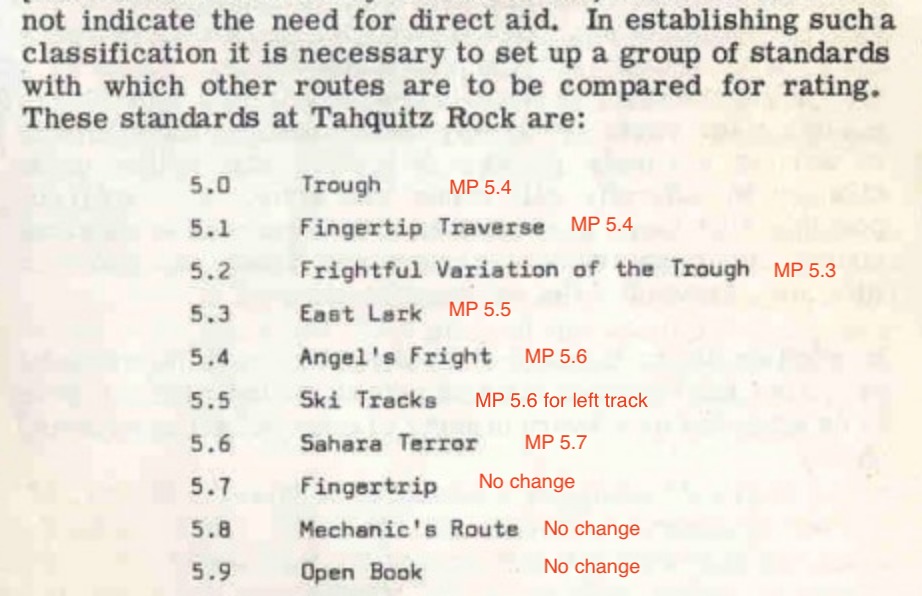 This makes it clear, from the perspective of regrading, that there is nothing sacrosanct about the original exemplars. It might also illustrate Wilts' concerns about the spread of the decimal system to other areas, with the effect that the original standards for climb difficulty might be ignored in favor of impressions from other areas where exemplars hadn't even been established, much less coordinated with Tahquitz. |
|
|
rgold wrote: "Sanbagging" happens either because routes are purposely graded low, or because a change in the perceptions of difficulty raises the grade (grade inflation) making the original grade "sandbagged." At this point, grade inflation has rendered most of Wilts original grade exemplars sandbagged, as illustrated by the image below from the 1962 Tahquitz guide, annotated with current MP consensus grades. That's really interesting... Have any of these exemplars changed over time? Have critical holds broken, or has the rock become significantly more polished? I'm curious if they've changed, or if they're essentially the same as they were when originally graded. |
|
|
For example, the crux pitches of Serenity crack and of the Rostrum are probably around what you're used to in LCC or City of Rocks. But in the Valley my sense is that these are both considered "benchmark soft" for their respective grades, .10d and .11c. |


