
 Continue with onX Maps
 Sign in with Facebook






Chamonix Anchor System?


|
|
Anyone have any idea what kind of anchoring system is going on at 5:40 through the end of the video? Seems like a quad would be more efficient, less cluttered, and possibly safer? |

|
Looks like an interesting iteration on a direct belay. Seems somewhat standard. The quad allow for too much extension, in the event of a leader fall, when using a direct belay. |

|
AKA the Banshee Belay. |
|
|
It´s just a normal Banshee belay (normal for Europeans anyway). I personally don´t usually bother with the sling at all and just use the rope in the same way. |
|
|
so, what's up with all the munters? |
|
|
Looks like a rat's nest to me. A quad or overhand on a coradalette just seems so much more simple, faster and better equalized. Realizing that perfect equalization is an ideal, not something achievable. But, always cool to learn something new, thanks for sharing, maybe after a more in depth look (when I'm not at work) I'll see the advantage. 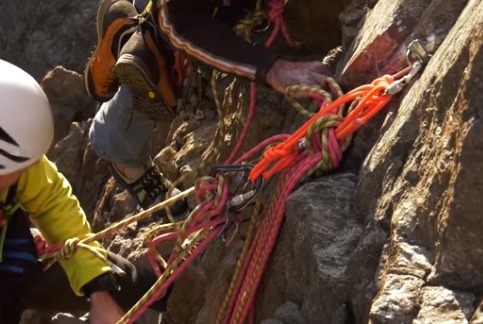 |
|
|
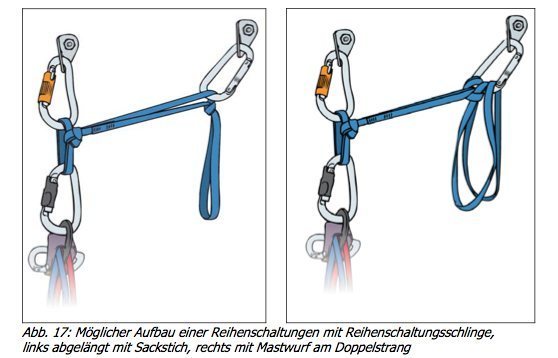 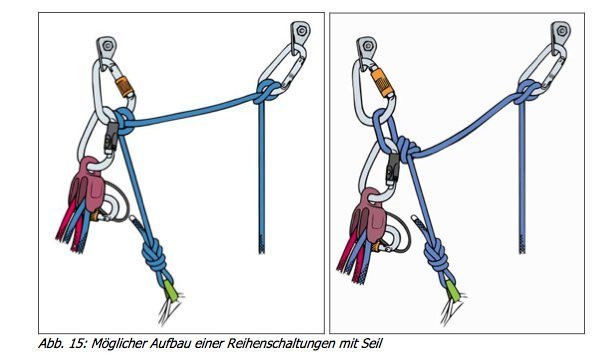 Courtesy of the DAV. I use the left lower method. If you think using a quad/cordalette is simpler and faster then you are banana´s. Equalisation is of no interest in this scenario or in the video, redundancy is all we are looking for. |
|
|
Jim Titt wrote: Yep. The obsession with equalisation is way over done in North America and it isn't only slightly less in the UK, Australia and other english speaking nations. Continental europeans do things bit differently lets say do things a bit differently... Lackadaisical grigri belaying while smoking a joint I'm not excited by, non equalised anchors are less of a concern. Having learn trad and equalisation I struggle to find good reasons to stop. Personally I'm normally using trad anchors and I'm normally equalising which probably takes me 30s-60s longer. But I'd have no problems with non equalisation of good gear. |
|
|
Funny thing is that the Cordalette method often promoted by most of the same American experts who also promoted the concept of "Equalizing" as one of the serene essentials . . . was not actually Equalizing. |
|
|
A more versatile variation which allows an attempt at equalisation is; 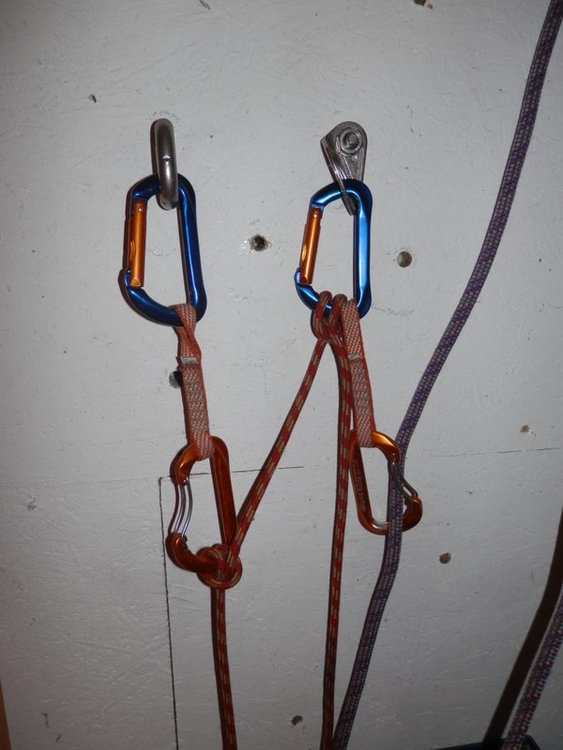 Which gives easy change over if you aren´t leading through (the second just clips in the opposite way round) and a re-direct/dummy runner (the rope on the right). Guide plate you can clip in anywhere you prefer and for lead belaying direct off the anchor you clip straight into one of the bolts (the guy in the video couldn´t as he was working with pitons and the eye is too small, bolts it is big enough). |
|
|
kenr wrote: Funny thing is that the Cordalette method often promoted by most of the same American experts who also promoted the concept of "Equalizing" as one of the serene essentials . . . was not actually Equalizing. Funny thing is that it was equalising to an extent. It certainly was equalising as much as any vaguely thoughtful analysis would suggest. (It ain't rocket science) For a two point anchor you can get pretty good results from basic geometry. (Three points you are always dealing with a statically indeterminate system.) Though some people got it into their heads that the equalisation was close to equal and then threw up their arms in Eureka discovery when if was found that it wasn't. (HINT: John Long, 2006: |
|
|
For a two bolt anchor, I use a double loop figure 8. It doesn't use up any gear, is very fast, and gives redundancy with some equalization. |
|
|
kemple sr. wrote: Simple. An accelerated mass give a greater impact force than the same force applied directly to the restraint. It is the same mistake the John Long made in his testing. It is how dropping a rock on your toe isn't the same as placing a rock on your toe. It is why seatbelts work. |
|
|
kemple sr. wrote: For a two bolt anchor, I use a double loop figure 8. It doesn't use up any gear, is very fast, and gives redundancy with some equalization. The belayer is being accelerated by the falling climber and stopped by a static piece of webbing and static load cell attached to the anchor. |
|
|
To be fair, the Cordelette system was developed with guide placed gear anchors in North America and not the nearly standard fixed anchors at the end of every pitch on guided routes in Europe. And noobs like this idea of "equalizing" their gear anchor because they don't have the experience to know their placements are good enough. |
|
|
I tend to go with what I learned which is some configuration of cordellete, although I convinced myself pretty early on that equalization wasn't really one of the things you get out of it - all you have to do is be a paranoid noob working your first hanging belay and start freaking out as you lean one way or another and watch the arms of anchor take differing amounts of load pretty clearly. However, one thing I tend to like about using a cord versus the clove-in-series style of some of these is that it gives you some control over the range of the loading angle on the pieces. If you are right up on it the pull angle can vary and that seems more likely to make your pieces want to wander but if you are extended a ways the effect of moving around is lessened by reducing leverage. |
|
|
Harumpfster Boondoggle wrote: To be fair, the Cordelette system was developed with guide placed gear anchors in North America and not the nearly standard fixed anchors at the end of every pitch on guided routes in Europe. And noobs like this idea of "equalizing" their gear anchor because they don't have the experience to know their placements are good enough. Well the TRE Sirius did the job fine (apart from some wear issues) but the patent was bought by Edelrid and screwed up big-time. Must be running off-patent soon so maybe I shall have a look..... The sling might be a Beal stitched cord sling but they don´t come orange and they are thicker than that one seems to be (8.3mm). It looks most like one of those snazzy Skylotec cipE slings which are 6mm Dyneema cord, 22kN and have no join, they are woven as a sling. |
|
|
Jim Titt wrote: My conception is something like an ATC Guide with more "assist" on the belay biner side but with a spring to improve handling (like the old Sticht plates). That way the function for bringing up the second is maintained and handling (less chance of a lock up short-roping the leader) is improved. Would have to figure out a way to improve lowering the leader after a lock up if you have assisted braking I guess. |
|
|
kemple sr. wrote: For a two bolt anchor, I use a double loop figure 8. It doesn't use up any gear, is very fast, and gives redundancy with some equalization. The peak force on the top piece is the sum of the force imposed by the faller and the force imposed by the belayer. That´s simple BUT the two peak forces don´t coincide normally, the two force peaks are offset in time due to frictional hysterises in both the rope and the belay device, somewhere of the order of 0.3-0.5 seconds for normal falls. The belayer peak leads the faller peak and so if you delay the belayer peak the sum of the forces increases, maybe 30% or so (all depends on the fall). Appliying the maximum belayer force as soon as possible is better than taking the time to accelerate the belayer six feet or so which inconveniently moves the two peaks closer together. |
|
|
Harumpfster Boondoggle wrote: My conception is something like an ATC Guide with more "assist" on the belay biner side but with a spring to improve handling (like the old Sticht plates). That way the function for bringing up the second is maintained and handling (less chance of a lock up short-roping the leader) is improved. Would have to figure out a way to improve lowering the leader after a lock up if you have assisted braking I guess. That´s exactly what a Sirius was, a guide plate with a handle to allow lowering and a spring to hold it off. The Skylotec slings are Dyneema-cored polyester so more robust than a straight Dyneema sling. |
|
|
Jim Titt wrote: Thanks for that, Jim. The Sirius seems complicated/expensive/bulky...how's about a DMM Pivot with Sticht-like springs and brake assist notches on the backside? Use a normal carabiner to create the handle for lowering the leader. Anodize the spring to make it sexy in a contrasting color. |


