Mountain Project Logo

A less bulky anchor: Replacing a cordelette setup with a 240cm Dynex runner - what am I missing?

Kevin Heinrich · · South Lake Tahoe · Joined Mar 2013 · Points: 446
But studies have shown that with repeated flexing aramid fibers break down more quickly (losing strength) than good old fashioned nylon. In fact, one particular study showed that when one section of Technora fiber cord was loaded with a 40 pound weight and flexed 180 degrees over an edge 1000 times, the material lost 50 percent of its strength, while nylon cord, in the same test, lost virtually no strength. Further research is warranted.

-Climbing Anchors Third Ed. pgs 82-83

David K · · The Road, Sometimes Chattan… · Joined Jan 2017 · Points: 434
John Wilder wrote:

As I recall, this was another thing I didn't love about it. The Technora core doesn't have the same lifespan as the nylon sheath- so a sheath inspection doesn't necessarily indicate that the cord is in good shape. I'd just replace it regularly on a set schedule so it's just not an issue. I do this with the tech web since it has a dyneema core- every two years like clockwork.

Shouldn't core damage show up as lumps or flat spots, though? I suppose it's less obvious, but I inspect my gear pretty regularly, particularly ropes and cords specifically because the damage can be less obvious. I don't put a price on safety but I don't want to spend money replacing gear that's still reliable.

On a related note, is this the tech web you're talking about? When I was looking up the specs for the PowerCord that I have, I noticed this which wasn't there when I bought the PowerCord. It's 5.4mm instead of 5.9mm and it has a dyneema core rather than a technora core, so I'm imagining it would be both lighter/smaller and more flexible, and at 15kN it's slightly weaker but still more than strong enough. The one downside is that it doesn't come in pre-cut cordalette lengths, and my experience with cutting dyneema slings is that it's annoying. I'm curious if you like it better than the technora stuff.

Bryan · · Minneapolis, MN · Joined Apr 2015 · Points: 482
Kevin Heinrich wrote: -Climbing Anchors Third Ed. pgs 82-83

Okay so 1000 load cycles may bring my 6mm dyneema cord from 20k to 10k which is only slightly less then the new strength of 7mm nylon cord when new. I'll keep using my sterling power cord. Really like that stuff. Interesting to consider though and more fuel for the analytic fire. I love how deep this climbing world goes.

baldclimber · · Ottawa, Ontario, Canada · Joined Jul 2015 · Points: 6
BryanE wrote:

Okay so 1000 load cycles may bring my 6mm dyneema cord from 20k to 10k which is only slightly less then the new strength of 7mm nylon cord when new. I'll keep using my sterling power cord. Really like that stuff. Interesting to consider though and more fuel for the analytic fire. I love how deep this climbing world goes.

The info above actually comes from Comparative Testing of High Strength Cord 3, but focuses on the highest cycle tested.  What's interesting to note is that the Technora cord is almost twice as strong as 7mm Nylon when brand new and never knotted, is weaker than 7mm Nylon after ~180 cycles and reaches minimum strength after ~600 cycles.  7mm Nylon shows no reduction in strength in the test.

AFAIK there have been no significant improvements to Technora and Dyneema when it comes to fatigue resistance and knot efficiency.  They are both significantly inferior to Nylon in that regard.  Whether that actually matters in the context of cords for climbing has been debated ad nauseum since the publication of those tests by Tom Moyer in 2000.

edited for clarity

Harumpfster Boondoggle · · Between yesterday and today. · Joined Apr 2018 · Points: 148
baldclimber wrote:

The actual report this was pulled from Comparative Testing of High Strength Cord 3.  Much more accurate to say the Technora cord is almost twice as strong as 7mm Nylon when brand new and never knotted, is weaker than 7mm Nylon after ~180 cycles and reaches minimum strength after ~600 cycles.  7mm Nylon shows no reduction in strength in the test.

AFAIK there have been no significant improvements to Technora and Dyneema when it comes to fatigue resistance and knot efficiency.  They are both significantly inferior to Nylon in that regard.  Whether that actually matters in the context of cords for climbing has been debated ad nauseum since the publication of those tests by Tom Moyer in 2000. 

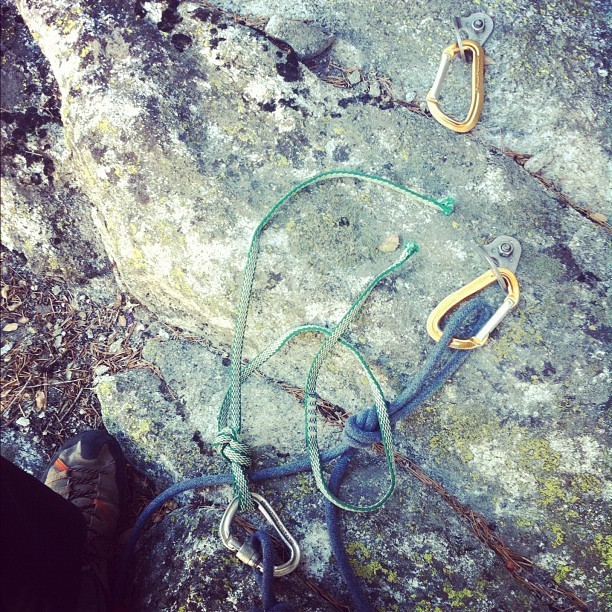
Credit: Mikey Schaefer

dynema sling used for fixing a rope that was then jumared....failed under body weight at the knot after cyclic loading from jumaring.

draw your own conclusions (albeit most slings we use do not experience this sort of cyclic use).

Me, I don't trust them for use alone for an anchor. Tying in with the rope too saved this climber's life.

Kevin Heinrich · · South Lake Tahoe · Joined Mar 2013 · Points: 446
BryanE wrote:

Okay so 1000 load cycles may bring my 6mm dyneema cord from 20k to 10k which is only slightly less then the new strength of 7mm nylon cord when new. I'll keep using my sterling power cord.

What I quoted from Climbing Anchors is not discussing dyneema (which is not an aramid fiber). Sterling Power Cord, however has a Technora core (which is an aramid) so would relate to what I quoted. Just clarifying!

Jeffrey Constine · · Los Angeles, CA · Joined May 2009 · Points: 674

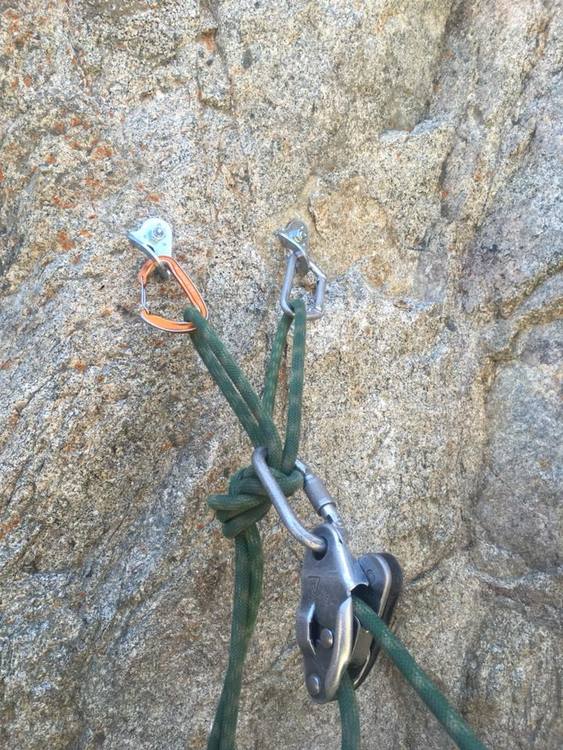
Simple and effective.

Jeffrey Constine · · Los Angeles, CA · Joined May 2009 · Points: 674

Simple, yea one locker on the anchor would be nice but ran out of gear 55m pitch.

Creed Archibald · · Salt Lake City, UT · Joined Apr 2012 · Points: 1,026

I've used this sling for anchors (in the 240 cm) size as well as the BD version. Both have held up well. Light and compact. Girth hitch for tree anchors. For gear or bolt anchors I just clip every piece and tie an overhand on a bite for the "mostly equalized" masterpoint. Quick and easy. If you are block leading, this makes a much cleaner transition than a rope anchor. If you have to bail, you have something to leave as rap anchors.

As for the photo above with the sling that broke from jugging, why even include the sling? I've never used a sling when I was setting up a fixed line for my follower to jug. I just put a locker on the bolt and tie the rope in a figure 8 on a bite, clipped to the locker, backed up by a clove hitch on a wire gate biner to the other bolt. 

Harumpfster Boondoggle · · Between yesterday and today. · Joined Apr 2018 · Points: 148
C Archibolt wrote: 
As for the photo above with the sling that broke from jugging, why even include the sling? I've never used a sling when I was setting up a fixed line for my follower to jug. I just put a locker on the bolt and tie the rope in a figure 8 on a bite, clipped to the locker, backed up by a clove hitch on a wire gate biner to the other bolt. 

To extend over the lip. 

BTW, the sling was not cut at the lip, it was cut (x2) at the knot (per report).

Otherwise, exactly how you describe so that the weight is on the Clove (easy to untie even after lotsa jugging on it by slipping it off the carabiner).

Nick Goldsmith · · NEK · Joined Aug 2009 · Points: 470

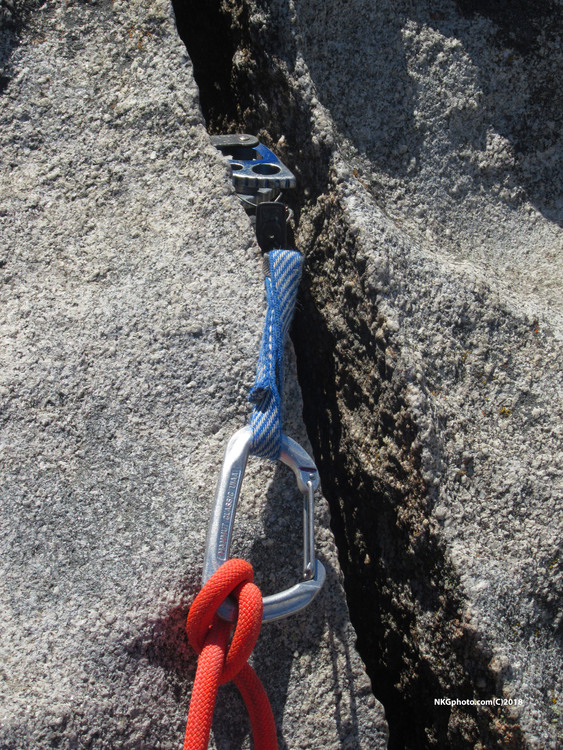
one and done. Big blue ;)

baldclimber · · Ottawa, Ontario, Canada · Joined Jul 2015 · Points: 6
Harumpfster Boondoggle wrote:
dynema sling used for fixing a rope that was then jumared....failed under body weight at the knot after cyclic loading from jumaring.

Me, I don't trust them for use alone for an anchor. Tying in with the rope too saved this climber's life.

I don't either.  Rope or 7mm nylon cord.

rgold · · Poughkeepsie, NY · Joined Feb 2008 · Points: 526

I use a dyneema cordelette for block leading,"guiding," and when climbing in a party of 3 with two followers climbing simultaneously.  Obviously, the anchor environment has to be ihspected for sharp edges and a rope-only anchor substituted if such things are present (or else move the anchor).  For swinging leads on multipitch, the rope-only anchor is better in every regard except that it uses up some rope length.

I would never use a thin dyneema sling to anchor a fixed rope.

A drawback of the thin sling is difficulty untying loaded knots.  Putting a carabiner (with a notchless gate) through the power point knot helps.

Harumpfster Boondoggle · · Between yesterday and today. · Joined Apr 2018 · Points: 148
rgold wrote: I use a dyneema cordelette for block leading,"guiding," and when climbing in a party of 3 with two followers climbing simultaneously.  For swinging leads on multipitch, the rope-only anchor is better in every regard except that it uses up some rope length.

I would never use a thin dyneema sling to anchor a fixed rope.

A drawback of the thin sling is difficulty untying loaded knots.  Putting a carabiner through the knot helps.

In a Cordelette function there may be enough redundancy and the knot is rarely tied in precisely the same place....but there is cyclic loading on the sling and knot over time (very different than when used for extending protection where they are rarely weighted) when weighting the sling. Particularly with a pre-tied quad that sees a lot of use.

Maybe you remember as I do, Rich, when spectra cord first came out we were hyped on it (early 80's) then there was a recall of all it in the entire country due to defect...apparently they have had it sorted for some time, but that experience that Mikey had has got me spooked again. He'd be dead if he hadn't backed it up.

I'll use it happily for regular slingage...but knotting it and cyclically loading it is no bueno until proven otherwise, imo.

rgold · · Poughkeepsie, NY · Joined Feb 2008 · Points: 526
Harumpfster Boondoggle wrote:

Credit: Mikey Schaefer

dynema sling used for fixing a rope that was then jumared....failed under body weight at the knot after cyclic loading from jumaring.

draw your own conclusions (albeit most slings we use do not experience this sort of cyclic use).

Me, I don't trust them for use alone for an anchor. Tying in with the rope too saved this climber's life.

Yeah HB, that is pretty damn scary.  But it isn't clear how the rigging was configured before the sling broke.  Although speculative, here's what it looks like to me: there's only one knot, so I assume the sling was just used to connect the fixed rope to the top bolt.  The relative size of the severed strands allows for two possibilities: (1) The green sling was clove-hitched to the carabiner in such a way that only one of the two strands was loaded. This doesn't seem right since the green severed strand still looks too long for that.  (2) An overhand on a bight was tied to shorten the green loop so that it would share the load.  I think this is more likely.

With either of these possibilities, the anchor position suggests that rope motions would have been abrading the knots under load against the rock.  That is a different and much more sinister situation than cyclic loading, which degrades strength over time but does not seem likely, looking at Moyers figures, to cause a rupture under bodyweight+ loads.  In other words, I don't think cyclic loading per se is the culprit here, rather it looks to me as if a knot was abraded under load until it failed. It is possible, although we can't tell from the picture, that the rigging had all the load on the green sling with the climbing rope unloaded until the sling broke.  If so, this would maximize the loaded abrasion effect.  

The potential for this kind of rubbing is why I said I'd never use a sling to anchor a fixed rope---some amount of abrasion is likely, depending on the rock configuration and whether the person jumaring swings around, and you want the full robustness of the climbing rope in this case.  (You might also want to pad the anchor!)

I think that the same sling used to rig a belay anchor is different, since the kind of loading and unloading that could cause a knot to move and abrade enough to break seems like a very remote possibility, as the absence of cases of belayers regularly plunging to their doom confirms, and as I said if there are worrisome edges, then it is back to the climbing rope as an anchor or look to re-rig somehow.  

So I'm still ok with the dynex cordelette for (really only modest) efficiency gains if the party isn't swinging leads, subject to careful evaluation of any feature that might compromise thin materials.  But I'm also ok with just using the rope in all cases---you really don't lose all that much time (less than a minute to build the second's attachment under the leader's for a 3-point anchor), and for two-point anchors (eg bolts) I don't think there is any practical time loss at all.

rgold · · Poughkeepsie, NY · Joined Feb 2008 · Points: 526

Well.  As you might know from other MP kerfluffles, I'm a believer in installed tethers, especially the latest adjustable ones made of dynamic rope.  So my standard practice would be to clove each person to the master point but also have them connected to one of the anchor pieces with their tether. I do this for rope-only rigging too.  That said, I'm not uncomfortable with having people just connected to the master point, nor would it bother me if someone wanted to back that up with a clove to one of the pieces.  If the team knows exactly what they are going to do and how to implement it, these variations are not going to slow anything down.

Nick Goldsmith · · NEK · Joined Aug 2009 · Points: 470

the petzl connect is a no brainer. works so well you would be silly to use anything else if you use a teather system. 

Harumpfster Boondoggle · · Between yesterday and today. · Joined Apr 2018 · Points: 148
rgold wrote:

Yeah HB, that is pretty damn scary.  But it isn't clear how the rigging was configured before the sling broke.  Although speculative, here's what it looks like to me: there's only one knot, so I assume the sling was just used to connect the fixed rope to the top bolt.  The relative size of the severed strands allows for two possibilities: (1) The green sling was clove-hitched to the carabiner in such a way that only one of the two strands was loaded. This doesn't seem right since the green severed strand still looks too long for that.  (2) An overhand on a bight was tied to shorten the green loop so that it would share the load.  I think this is more likely.

With either of these possibilities, the anchor position suggests that rope motions would have been abrading the knots under load against the rock.  That is a different and much more sinister situation than cyclic loading, which degrades strength over time but does not seem likely, looking at Moyers figures, to cause a rupture under bodyweight+ loads.  In other words, I don't think cyclic loading per se is the culprit here, rather it looks to me as if a knot was abraded under load until it failed. It is possible, although we can't tell from the picture, that the rigging had all the load on the green sling with the climbing rope unloaded until the sling broke.  If so, this would maximize the loaded abrasion effect.  

Per Mikey, and apologies if I get any of it wrong, there was zero effect from abrasion in this case.

The sling broke in two places, at the knot twice (hidden) with both of the free ends shown forming loops from the bolts to the master point.

The sling was used to extend the attachment over the lip shown so that the MP was free from abrasion. The sling's points of contact with the rock showed no wear.

This was used on a fixed line for one of his Valley projects and how many times it was jugged is not clear but it clearly goes from no visible damage noted from the last time the line was rapped, to catastrophic failure the next time it was jugged.

This makes me concerned for "quads" and other uses that leave a dynema sling knotted the same way repeatedly which is why I suggested that a dynema web-olette that is used slightly differently each time is less of a concern etc...but still makes me uneasy weighting and un-weighting knotted dynema (as it should) which might be any one used repeatedly for the same task.

Harumpfster Boondoggle · · Between yesterday and today. · Joined Apr 2018 · Points: 148
Kyle Tarry wrote:

Do you believe it is sufficient to clove the climbers directly to the masterpoint, and only to that point, or do you clove everyone to the masterpoint and an additional secondary backup point (such as once of the pieces/bolts)?

Keep in mind that when I dispense advice, fwiw, I dispense it for a lurking beginner audience and make it a one size all approach. A method that will keep newbies safe and also defeat complacency. Ergo, always connected twice to the anchor is sound policy, imo.

There are two most common general kinds of rigging accidents in climbing. Beginner accidents of ignorance/omission (ie not being clipped in properly) and experienced climber's accidents of complacency (doing things that are just "good enough, never had a problem" or not taking the time to double check systems).

Clipping in twice to separate points, an example of simple and easily done redundancy, is what prevents both from occurring.

rgold · · Poughkeepsie, NY · Joined Feb 2008 · Points: 526
Harumpfster Boondoggle wrote:

Per Mikey, and apologies if I get any of it wrong, there was zero effect from abrasion in this case.

The sling broke in two places, at the knot twice (hidden) with both of the free ends shown forming loops from the bolts to the master point.

The sling was used to extend the attachment over the lip shown so that the MP was free from abrasion. The sling's points of contact with the rock showed no wear.

This was used on a fixed line for one of his Valley projects and how many times it was jugged is not clear but it clearly goes from no visible damage noted from the last time the line was rapped, to catastrophic failure the next time it was jugged.

This makes me concerned for "quads" and other uses that leave a dynema sling knotted the same way repeatedly which is why I suggested that a cordelette that is used slightly differently each time is less of a concern etc...but still makes me uneasy weighting and unweighting knotted dynema (as it should) which might be any one used repeatedly for the same task.

Oh yeah---on close inspection you can see just the fuzzy tips of the severed loops emerging from the masterpoint knot.  A very peculiar break to have two strands fail independently like that, but I've already speculated more than is wise and am biting my lip now.

Guideline #1: Don't be a jerk.

Climbing Gear Discussion
Post a Reply to "A less bulky anchor: Replacing a cordelette se…"

Log In to Reply
Welcome

Join the Community! It's FREE

Already have an account? Login to close this notice.