|
|
Dallas R
·
Aug 3, 2018
·
Traveling the USA
· Joined May 2013
· Points: 191
rgold wrote: The way I do a "fireman's belay," I think there is a chance I could hold or at least substantially slow a climber who hasn't clipped one of the two loops in their device. When I get to the bottom of the rappel, I leave the rappel ropes in my device (with a bit of slack of course). If I have to weight the ropes for a fireman's belay, I jump and take in the slack. I started doing it this way after reading some tests that cast doubts on the ability of a fireman's belayer to stop a falling rappeller by just pulling on the ropes with their hands.
Using this method does not change the necessity of taking the precautions mentioned above for an inexperienced second, precautions that involve testing the integrity of their rap set-up before they weight it. This seems like a reasonable approach. Once you see the second person started down without issue it would only take a second to off the rope.
Floyd Eggers wrote: How many people at a time? You can set their device on the line before you rap, then fireman from below if you don't trust them.You can tie the ends of the rope together also if your afraid of clipping just a single strand by mistake. I have gotten away from pre-loading the second rapper. Too many situations where the stance was not in line with the rap route thus being creating an uncomfortable pull that they can't get away from until I am off the rope. It's best if each individual is responsible for themselves. I think I will try Rgolds solution to see how well that works.
|
|
|
rgold
·
Aug 3, 2018
·
Poughkeepsie, NY
· Joined Feb 2008
· Points: 526
Andy Bennett wrote: So sorry to hear about Dees fatal accident. My condolences to his family and friends.
As rgold notes, Dees’s accident joins many other tragedies in underscoring the need for climbers to have a system and always use it. Our brains are not wired to get even simple things right every single time, thousands of times in a row, in the absence of a system... System, absolutely. Check list, I think I've made it clear I'm far from convinced, but everyone will make their own choices about this.
|
|
|
rgold
·
Aug 3, 2018
·
Poughkeepsie, NY
· Joined Feb 2008
· Points: 526
Dallas R wrote:
This seems like a reasonable approach. Once you see the second person started down without issue it would only take a second to off the rope. If you are giving a Fireman's Belay, you should keep it on until the rappeler reaches the stance. You don't take off a belay in mid-pitch either.
I have gotten away from pre-loading the second rapper. Too many situations where the stance was not in line with the rap route thus being creating an uncomfortable pull that they can't get away from until I am off the rope. I've almost never encountered this as a problem. If it is, you can still mitigate possible errors by installing the rap device, so that the second just has to clip into it with their rap extension sling. More levels of backup are possible; I'll leave those to the imagination.
|
|
|
hikingdrew
·
Aug 3, 2018
·
Los Angeles, CA
· Joined Jul 2013
· Points: 38
Andrew Hess wrote: Forgive me if this has been pointed out (sorry, pun), but I don't see 'pointing and calling' as a checklist. Or maybe there are 'checklist' elements to it, but I see it primarily as a way to force attention to, in this case, the rigging chain. It forces actions to remain conscious and explicit. It also slowly down the process, which in this case is a good thing. I suppose checklists/acronyms do that to some extent as well (e.g., serene). But the physical/verbal elements of PnC seem to be a different thing.
Not expressing myself as well as I did in my head ( I hate when that happens). That's exactly what it's for; to enhance the checklist, especially things you've done a thousand times. Evidently the action of pointing and saying out loud what you expect to see will raise awareness when it's not what you see. I always do the partner check with P&C: "buckles, knot, buckles, biner" https://en.wikipedia.org/wiki/Pointing_and_calling
|
|
|
Old lady H
·
Aug 4, 2018
·
Boise, ID
· Joined Aug 2015
· Points: 1,375
All right, the girl's curious again, thinking about not having both strands clipped in an ATC.
If a short prussik is tied on both ropes as a backup, wouldn't that slow how fast the unclipped rope could run? And what would keep it from catching the ropes if you let go? Would the ATC just slide down?
As usual, just trying to picture this!
For myself, and also trying to teach really new climbers? Always be certain of the next bit to keep you alive before you undo the current bit keeping you alive. That starts at the car. Got the rope? Sheesh. Someone has shot back down, twice, for that one.
I talk to myself regularly. Out loud is slower than in your head, so is reading out loud. The one I use pretty much daily? "The car is locked". Sucks walking back the half mile to the parking lot when you start second guessing!
Best, Helen
|
|
|
Pavel Burov
·
Aug 4, 2018
·
Russia
· Joined May 2013
· Points: 50
Old lady H wrote: All right, the girl's curious again, thinking about not having both strands clipped in an ATC. Weight yer rappel system before unclip yer tether. Basically you always start your rappel been attached to the rappel station and unclip your tether on a go.
|
|
|
mbk
·
Aug 6, 2018
·
Unknown Hometown
· Joined Jul 2013
· Points: 0
Old lady H wrote: All right, the girl's curious again, thinking about not having both strands clipped in an ATC.
If a short prussik is tied on both ropes as a backup, wouldn't that slow how fast the unclipped rope could run? And what would keep it from catching the ropes if you let go? Would the ATC just slide down? Intuitively: yes.
Anecdotally: I know a few people who have been "saved by their autoblock". Of course, maybe those autoblocks were why they became complacent enough to need saving in the first place.
However, if I understand correctly, the recent accident in the Tetons may show that the climber can defeat the autoblock in an effort to regain control of the rappel.
So one possible strategy is: don't add the autoblock before ensuring the device is loaded correctly. Which is a shame, because I really like putting the autoblock on first, since it makes it much easier to load the device (and, intuitively at least, easier means less error-prone). Also, if you always put it on first, you are (again, intuitively) less likely to forget it.
|
|
|
mbk
·
Aug 6, 2018
·
Unknown Hometown
· Joined Jul 2013
· Points: 0
Nate Tastic wrote: I put it on first and test it's gripping. I know it always is...on my rope and how many wraps is required but, I don't know about other people's ropes, so its a good habit to always test it. Then do the same thing with rap device as suggested by others. Then double and triple check everything. Then remove tether and rappel. That is what I have been doing for quite some time, and probably what I will continue to do and recommend.
However, I am starting to wonder if maybe (like with football helmets), the safety increase is somehow offset by human factors.
|
|
|
Franck Vee
·
Aug 20, 2018
·
Unknown Hometown
· Joined Apr 2017
· Points: 260
rgold wrote: Whether you opt for a checklist or not, I think the backed-up tether test is essential. I know quite a few people who have, at one time, made exactly this threading error and have been saved either because they noticed it in time, or because their initial stance was not critically dependent on the support of the rappel lines, or because they had a tether allowing them to safely test the rap device integrity. To me this somewhat makes side discussions useless (about whether or not/how a prussik/autoblock may or not stop ropes pullings in opposite directions due to improper rap setup). Or at least missing the point somewhat. Testing a new system you just setup before committing to it solves the issue much better and is much less likely to fail than simply relying on whatever other safety measure you're using (and that you really should be using for other reasons...).
On one of the first longer climbing trip I took outside, I setup a rappel to clean a route with someone giving me a fireman belay. As I leaned back to rappel, I notice the atc was pulling in weird direction, kinda off to the right. The reason was that it was clipped in the plastic gear loop of my harness and not the belay loop. I don't think I have ever committed to a rappel without weight-testing it first by still being backed up by a leash ever since...
|
|
|
Serge S
·
Aug 20, 2018
·
Seattle, WA
· Joined Oct 2015
· Points: 683
For double-rope EDK rappels, I used to think longer tails made it safer (by allowing the knot to capsize more times before anything bad happened). Then I learned it's possible, with sufficiently long tails, to mistake one of the tails for a rappel strand and feed it into the ATC. This could, of course, pass the tether-protected load test but result in rappelling off the short end. I now practice moderation with EDK tails, but the point is it's difficult to make a complete list of things one needs to check.
There may be, in addition to all the other good advice on this thread, an argument for avoiding situations when you're on the wall tired (if safety is a high enough priority, which admittedly is a personal choice but a good assumption in the context of this thread).
|
|
|
rgold
·
Aug 20, 2018
·
Poughkeepsie, NY
· Joined Feb 2008
· Points: 526
Serge Smirnov wrote: For double-rope EDK rappels, I used to think longer tails made it safer (by allowing the knot to capsize more times before anything bad happened). Then I learned it's possible, with sufficiently long tails, to mistake one of the tails for a rappel strand and feed it into the ATC. This could, of course, pass the tether-protected load test but result in rappelling off the short end. I now practice moderation with EDK tails, but the point is it's difficult to make a complete list of things one needs to check.
There may be, in addition to all the other good advice on this thread, an argument for avoiding situations when you're on the wall tired (if safety is a high enough priority, which admittedly is a personal choice but a good assumption in the context of this thread). I do forearm-length tails. Never clipped them. They aren't usually near the place I'm engaging the rappel device, and forearm-length is short enough so that you couldn't fail to notice the incorrect installation. But, if you do set the rappel of on some much longer tails and then weight the rappel while still tethered in, you will pull the rappel rope through the anchor, making it immediately apparent that something is wrong. So I believe that accidentally rigging on long tails would be detected by the tether-protected load test.
|
|
|
David K
·
Aug 20, 2018
·
The Road, Sometimes Chattan…
· Joined Jan 2017
· Points: 434
Franck Vee wrote: To me this somewhat makes side discussions useless (about whether or not/how a prussik/autoblock may or not stop ropes pullings in opposite directions due to improper rap setup). Or at least missing the point somewhat. Testing a new system you just setup before committing to it solves the issue much better and is much less likely to fail than simply relying on whatever other safety measure you're using (and that you really should be using for other reasons...).
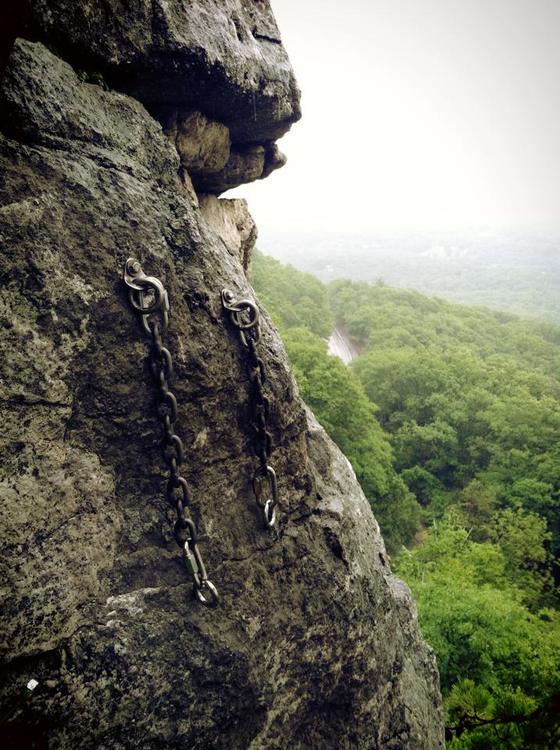
On one of the first longer climbing trip I took outside, I setup a rappel to clean a route with someone giving me a fireman belay. As I leaned back to rappel, I notice the atc was pulling in weird direction, kinda off to the right. The reason was that it was clipped in the plastic gear loop of my harness and not the belay loop. I don't think I have ever committed to a rappel without weight-testing it first by still being backed up by a leash ever since... Being able to weight your system has to be planned for, otherwise it's too easy for it to become something you skip half the time. For example, made a mistake today that resulted in me not testing my system while tethered before I rappeled. I arrived at an anchor that looked like this (but wasn't actually this anchor):
I tethered to the top rings, then threaded the rope through the bottom rings. My partner set up her rappel system and rappelled. I set up my rappel system, which is an extended rappel with a Prusik backup, and discovered that my tether, which was clipped to the top rings, was shorter than the combined chain and extended rappel system, so I couldn't weight the chain and extended rappel system. The next party had arrived at the station and clipped to the bottom and top chains, so there wasn't room for me to move my tether to the bottom chains. At this point I have a few options in order to be able to weight my system while tethered, all of which involved faffing while more climbers build up on the ledge, so of course I gave my setup another visual inspection and rapped. I learned from this that my tether has to be clipped close to the same level or below where the my rope is threaded to ensure I can weight the system before rapping--not something that had occurred to me when I set up on these longer chains.
|
|
|
Franck Vee
·
Aug 20, 2018
·
Unknown Hometown
· Joined Apr 2017
· Points: 260
David Kerkeslager wrote: Being able to weight your system has to be planned for, otherwise it's too easy for it to become something you skip half the time. For example, made a mistake today that resulted in me not testing my system while tethered before I rappeled. I arrived at an anchor that looked like this (but wasn't actually this anchor):
I tethered to the top rings, then threaded the rope through the bottom rings. My partner set up her rappel system and rappelled. I set up my rappel system, which is an extended rappel with a Prusik backup, and discovered that my tether, which was clipped to the top rings, was shorter than the combined chain and extended rappel system, so I couldn't weight the chain and extended rappel system. The next party had arrived at the station and clipped to the bottom and top chains, so there wasn't room for me to move my tether to the bottom chains. At this point I have a few options in order to be able to weight my system while tethered, all of which involved faffing while more climbers build up on the ledge, so of course I gave my setup another visual inspection and rapped.
I learned from this that my tether has to be clipped close to the same level or below where the my rope is threaded to ensure I can weight the system before rapping--not something that had occurred to me when I set up on these longer chains. Yeah similar silliness happened to me a couple times. I'd say the lesson you highlight should be generalized, partly for safety but mostly for efficiency and convenience. When setting up anything that involves a few strands of ropes/thethers etc., relative lengths and what overlays what should always be planned for. The rap setup you highlight is one example. Another that comes to mind is when as a leader you set yourself up to belay for above - you can make your life easier (or harder) depending on how the belay device is setup with regards to the anchors, and rope, the likely direction of the leader getting on the next pitch/if leads will be swapped or not, etc. I say it's partly about safety since needless clutter/fussing about may increase chances of mishaps...
|
|
|
Buck Rio
·
Aug 21, 2018
·
MN
· Joined Jul 2015
· Points: 16
Franck Vee wrote: Yeah similar silliness happened to me a couple times. I'd say the lesson you highlight should be generalized, partly for safety but mostly for efficiency and convenience. When setting up anything that involves a few strands of ropes/thethers etc., relative lengths and what overlays what should always be planned for. The rap setup you highlight is one example. Another that comes to mind is when as a leader you set yourself up to belay for above - you can make your life easier (or harder) depending on how the belay device is setup with regards to the anchors, and rope, the likely direction of the leader getting on the next pitch/if leads will be swapped or not, etc. I say it's partly about safety since needless clutter/fussing about may increase chances of mishaps... Totally agree with this...extra non-sense at belays makes everything harder to inspect and easier to make a stupid mistake. I also carry a PAS (Chain Reactor) to clip the anchor before weighting the rappel setup. If I am leading, I use long slings or draws, depending on the type of climb, to make a master point, and then clove hitch that with the rope on a William HMS carabiner. Then clip my PAS to either a shelf or one of the chains. If we are rapping, I'll pre thread the chains with my end of the rope while the second cleans for one rope raps. Or tie the ropes with a EDK or fisherman's (depending on the terrain) for double rope raps. Mostly use a 8mm tag line for longer routes (I know, half ropes). When second arrives I get them safe with a clove and PAS so we can set the rappel, then I prefer they rap first, so when they get down I can gauge the pull of the rope and the fall line, I also make sure both ropes are threaded in their device and locked etc... This also cleans things up at the belay. I can then weight the system while still on my PAS, and I will use a third hand (brake side) if the stance is small or awkward to start.
|
|
|
rgold
·
Aug 21, 2018
·
Poughkeepsie, NY
· Joined Feb 2008
· Points: 526
David Kerkeslager wrote: The next party had arrived at the station and clipped to the bottom and top chains, so there wasn't room for me to move my tether to the bottom chains. That's a super inconsiderate move by the other party. I would have gone all Euro Guide on them and clipped their gear for the tether test.
|
|
|
Serge S
·
Aug 21, 2018
·
Seattle, WA
· Joined Oct 2015
· Points: 683
rgold wrote: But, if you do set the rappel of on some much longer tails and then weight the rappel while still tethered in, you will pull the rappel rope through the anchor, making it immediately apparent that something is wrong. So I believe that accidentally rigging on long tails would be detected by the tether-protected load test. If you clip both tails yes, but if you clip one tail and one real rope, and the real rope is the one threaded through the chains, the setup will totally pass the weight test.
That said, I haven't heard of others making this mistake, so maybe it isn't that likely in real life. I doubt it would happen with tails shorter than 2-3ft.
|
|
|
Serge S
·
Aug 21, 2018
·
Seattle, WA
· Joined Oct 2015
· Points: 683
David Kerkeslager wrote:
I learned from this that my tether has to be clipped close to the same level or below where the my rope is threaded to ensure I can weight the system before rapping--not something that had occurred to me when I set up on these longer chains. Tangential to the main topic of avoiding fatal mistakes, but I can't resist commenting on this long-chain problem, as I've run into it a lot and it is one of my pet peeves with extended rappel as commonly taught.
I am not sure that your solution - "clipped close to the same level or below" - is always ideal. When the anchor has long chains and is above a comfortable ledge, clipping the tether to a low enough point to allow the weight test means you either have to hang off the chains with your feet below the ledge (which few people would do) or stand on the ledge with lots of slack in the tether (the common result).
My solution to this is to make the extension much shorter than is commonly taught - about half the typical length. That allows me to clip the tether to the bolts and still be able to weight-test the rappel with most chains. Unfortunately, this requires tuning the length of the 3rd hand prusik loop to be just right (~50cm circumference) - something not many people can be expected to do. Also, the popular Metolius PAS doesn't even have a clip-in point that close to the harness.
|
|
|
Serge S
·
Aug 21, 2018
·
Seattle, WA
· Joined Oct 2015
· Points: 683
Nate Tastic wrote: Could you just throw in another overhand knot towards the end of the tail? You're going to notice it or if you do rap off the tail you won't rap off the tail.
I realize this is a second knot that could get stuck on the way down but, other than that, is there any reason not to do it? Plus, it's a backup, is it not? Absolutely, but the problem with scenario-specific mitigations is that you have to first realize the scenario exists. This is why the general catch-all weight test concept is so appealing, and also why it is scary to discover scenarios not covered by it.
|

 Continue with onX Maps
 Sign in with Facebook