Mountain Project Logo

Multipitch Rappel

curt86iroc · · Lakewood, CO · Joined Dec 2014 · Points: 274

i don't disagree with you that it is unlikely to completely prevent a catastrophic accident every time.  however, out of 100 times, if the setup i described prevents a climber fall just 1 additional time than a baseline setup, that is a reduction in risk (albeit small).

to your point about the definition of a 3rd hand, i use it to mean any additional friction connection between the climber and the rope during a rap that the climber can control (location irrelevant). for some rap setups, its quite common for this to be above the device.

Darren Mabe · · Unknown Hometown · Joined Dec 2002 · Points: 3,669

A bit expensive, but if you really want to avoid a whizzing rope, leave draws on bolts or even gear clipped to the rap rope on the way down. When you pull the rope, it will gently fall through the pieces of gear. As far as getting your gear back, post up on MP that you left some pieces on a route and want them back, it's a common thing. 

Greg D · · Here · Joined Apr 2006 · Points: 908

Well, a friction hitch above or below the rappel device requires your hand on it to tend it. I believe some tests have shown that the panic reflex is to grab it harder which can release it and send you on your way. So I wouldn’t count on a friction hitch to keep you alive if you run out of rope.

 Personally, I don’t use auto blocks or knots in the end of my rope very often. This, of course, is the most risky way to do it and it scares the shit out of me so I am super aware.   My personal opinion is with all those back ups people tend to shut their brain off, lose awareness  and let their guard down.  That’s when the accidents seem to happen. Again just my personal opinion.

Edit to add. I always give my partners a fireman’s. It would be great if everyone does this. Obviously, this does not protect the first one down. 

Ģnöfudør Ðrænk · · In the vicinity of 43 deg l… · Joined Nov 2017 · Points: 2
Kyle Tarry wrote:

.... having an autoblock probably won't make a difference.


Agreed, it did not make a difference in my case.    I have rapped off the end of the rope while using a perfectly functional auto-block.

Pavel Burov · · Russia · Joined May 2013 · Points: 50
Greg D wrote: Well, a friction hitch above or below the rappel device requires your hand on it to tend it.

Nope. Never. You never put yer hand on a friction hitch. You put yer hand over or under it on yer rope(s) to slide the friction hitch down or up. Because if you put yer hand on the friction hitch you will grab it and thus it won't get tight.

I believe some tests have shown that the panic reflex is to grab it harder which can release it and send you on your way. So I wouldn’t count on a friction hitch to keep you alive if you run out of rope.

That's because people don't learn. Yet again. One never puts theirs hands on a friction hitch. Grab yer rope over or under friction hitch. It's kinda bare basics.

curt86iroc · · Lakewood, CO · Joined Dec 2014 · Points: 274
Kyle Tarry wrote:
  • There's no proof that it's even helpful in 1 out of 100 cases.  I'd argue that my post above suggests that is unlikely.

  • Telling a new climber that a system improves safety when it's a 1% (at best) improvement is just mental gymnastics, not helpful advice.  It's arguably harmful advice, if they become less inclined to do more effective things like knotting the ends or watching where the ropes land, because they (mistakenly) believe that the autoblock will save them ('cuz they read it on the internet).

I'm going to bow out of further discussion, but I would strongly recommend more caution in the future before advocation of dubious safety systems, especially to beginning climbers.

Thanks for your opinion. hope you stay safe.

Pavel Burov · · Russia · Joined May 2013 · Points: 50
Pavel Burov wrote:You put yer hand over or under it on yer rope(s) to slide the friction hitch down or up… Grab yer rope over or under friction hitch. It's kinda bare basics.
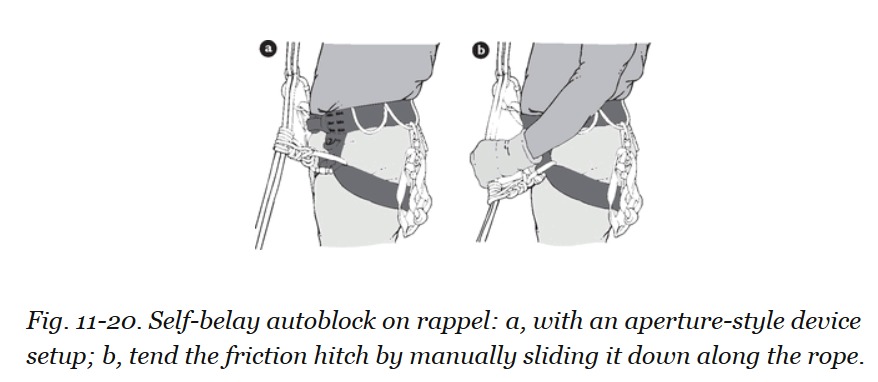
This is a screenshot from Freedom of the Hills.

Greg D · · Here · Joined Apr 2006 · Points: 908
curt86iroc wrote: i don't disagree with you that it is unlikely to completely prevent a catastrophic accident every time.  however, out of 100 times, if the setup i described prevents a climber fall just 1 additional time than a baseline setup, that is a reduction in risk (albeit small).
.

This is fucking hysterical. You think your set up could save someone’s life 1 out of 100 times. What the hell happened to the other 99? This is exactly the false sense of security that I’ve mentioned earlier.

curt86iroc · · Lakewood, CO · Joined Dec 2014 · Points: 274
Greg D wrote:

This is fucking hysterical. You think your set up could save someone’s life 1 out of 100 times. What the hell happened to the other 99? This is exactly the false sense of security that I’ve mentioned earlier.

 Personally, I don’t use auto blocks or knots in the end of my rope very often. This, of course, is the most risky way to do it and it scares the shit out of me so I am super aware

your risk mitigation process may work for you, but it doesn't for the majority of climbers. i'm not sure if you are aware, but risk management and analysis is not as subjective as you think.  There are actual established processes to define risk which generally consist of an analysis and mitigation strategies of a negative event.  If you are able to decrease factors such as likelihood of occurrence and severity, the potential negative impact of the event will decrease. If you apply this methodology to our rappelling discussion, the likelihood of rapping off the end of a rope is less with a properly managed 3rd hand than without. By definition, this is a reduction in risk. Here is some reading:

https://www.mitre.org/publications/systems-engineering-guide/acquisition-systems-engineering/risk-management/risk-mitigation-planning-implementation-and-progress-monitoring

https://hbr.org/2012/06/managing-risks-a-new-framework​​​

also, thanks for the strong language, but it doesn't help get your point across...just makes you seem argumentative.

Greg D · · Here · Joined Apr 2006 · Points: 908

Putting on a set up that makes you feel safer but actually does not is a really bad idea. That’s my point. And yes, I am argumentative

baldclimber · · Ottawa, Ontario, Canada · Joined Jul 2015 · Points: 6
Pavel Burov wrote:

(throwing a strong argument in support) As one could chase stuck ropes again and again rappelling off of non-knotted ropes ends reoccurs pretty rarely.

Very true: it reoccurs pretty rarely.  If you rap off the ends you'll probably die.  If you're lucky enough to have survived, somehow get well enough to climb again, and then rap off the ends again - then WOW!

Anonymous · · Unknown Hometown · Joined unknown · Points: 0
baldclimber wrote:

Very true: it reoccurs pretty rarely.  If you rap off the ends you'll probably die.  If you're lucky enough to have survived, somehow get well enough to climb again, and then rap off the ends again - then WOW!

I have done it 4 times... but than it was on purpose because the ropes barely reach the ground on this one route I normally just rap off the ends and drop 1-2 ft to hit ground.

rgold · · Poughkeepsie, NY · Joined Feb 2008 · Points: 526
ton wrote:

i wasn't addressing whether or not one SHOULD knot the ropes.  only that getting them stuck on the throw has no bearing on my decision making as to whether i'm going to knot the ends. because if i'm coming down from above, freeing a stuck rope is a fairly simple matter and one that happens all the time when the throw doesn't go all the way to the ground because of rock profile, or vegetation, or wind, or whatever.  knot or no knot. 

Well, yes and no.  If it is windy and the ropes blow sideways and the knotted ends jam, retrieving them will be very dangerous.  Maybe ten years ago this happened to a party at Red Rocks while i was there.  They had to be rescued by other parties, and might never have gotten their rope back; it was hanging up there for many days.  

A second really bad possibility with ropes whose ends have been knotted occurs when there are tall trees below.  If the rope is thrown or blows into the tree, the knot can be trapped in any "Y" branch formation.  The rappeller is then faced with a rope stuck out from the cliff and above any position they can rappel to. This has happened to me and the retrieval was scary; I personally will never knot rope ends if there are tall trees  the ends could end up in, but then I've spent at least 40 years rappelling without end knots or third-hand backups and perhaps have developed the appropriate habits of attention along the way.

A third possibility, which has also happened to me, is that one or both knots get caught at the full extension of the rappel, below the stance with the next anchor.  in this case, the rappeller has to rappel to nearly the bitter end of the ropes and then hang there to work on freeing the  knots with only inches of rope left, an uncomfortable situation with no room for any kind of error, and then prusik back up the ropes to the anchors.

The "alpine bomb" in the video strikes me as somewhere between worthless and a downright danger in the situations mentioned above.  For example, that thing will get caught in all kinds of tree configurations an ordinary knot would have pulled throuigh.  Saddlebagging is effective, but all you need is to mess up the length one coil in the saddlebag and you've got a clusterfuck.

I think one of the better approaches, if for any reason end knots are desired, is to clip both ends to the harness and throw or lower the rest of the rope down the pitch.  The end should be separately clipped, so that the rappeller can easily stop and undo the twists and shake out the kinks that often occur. This keeps the ends with the rappeller and out of mischief.

Zacks · · Unknown Hometown · Joined Apr 2015 · Points: 65

Rappel efficiency is largely about both you and your partner each doping a job and not waiting on the other person.  Also it is way faster to have a good middle marker, my multipitch rope is a bicolor sterling so its really easy to find the middle (but costs more money thats why this rope is not my everyday cragging rope)

The biggest time savings are good communication and teamwork with your partner (get a rhythm  and flow) and always say things like "ok the end is tied in" or "i'm on rap so you can drop the rope" that way you avoid potential safety errors from trying to go fast.  Also the bicolor makes us way faster.  And of course no replacment for experiance

Pavel Burov · · Russia · Joined May 2013 · Points: 50
rgold wrote:I think one of the better approaches, if for any reason end knots are desired, is to clip both ends to the harness and throw or lower the rest of the rope down the pitch.

Stack ropes in a bag and clip it with a double shoulder sling to your belay loop. Have done it several times on windy rappels or when rappelling less than vertical wall with lot of bushy ledges.

rgold · · Poughkeepsie, NY · Joined Feb 2008 · Points: 526

Yes, a bag works if you have one, which is not a given.  If you do use a bag, beware of kinks emerging and knocking the brake strands out of your hands.  A third hand backup is a really good idea here.

Pavel Burov · · Russia · Joined May 2013 · Points: 50

Also ropes really annoyingly twist around the sling. Yep, the third hand is a must in this scenario.

For awkward to rappel terrain we prefer single strand rappel with top rope belay on the second strand for the first. Others make a normal double strands rappel. The idea behind this method is the first can switch to climbing, traversing, swinging, etc any time. The drawback is obviuos — it takes more time in small (less than 4 climers equipped with less than 4 ropes) team versus double strand rappel with throwing both ropes at every rappel anchor.

Andrew Hess · · Brooklyn, NY · Joined Aug 2017 · Points: 0
Pavel Burov wrote: Also ropes really annoyingly twist around the sling. Yep, the third hand is a must in this scenario.

For awkward to rappel terrain we prefer single strand rappel with top rope belay on the second strand for the first. Others make a normal double strands rappel. The idea behind this method is the first can switch to climbing, traversing, swinging, etc any time. The drawback is obviuos — it takes more time in small (less than 4 climers equipped with less than 4 ropes) team versus double strand rappel with throwing both ropes at every rappel anchor.

I'd like to know more about this. Would you just clove the midpoint, then set up a munter/grigri/guide belay? It seems as if it would be easy to transition to double rope rap by just taking out the clove. 


Would you do this if you weren't sure where the next station is?

rgold · · Poughkeepsie, NY · Joined Feb 2008 · Points: 526

I like the single strand belayed rappel for the first and don't think it adds much time.  

A saddlebagging method that I've used---one I haven't seen others using---is to use a substantial rap extension and flake the rope over that in front of you.  The advantage is that you can lift the strands off the stack the stack, rather than pulling them out of a closed sling, and this makes it a bit easier to avoid the dreaded cluster.

Pavel Burov · · Russia · Joined May 2013 · Points: 50
Andrew Hess wrote:

I'd like to know more about this. Would you just clove the midpoint, then set up a munter/grigri/guide belay? It seems as if it would be easy to transition to double rope rap by just taking out the clove. 


Would you do this if you weren't sure where the next station is?

1. Arrange a standard double ropes belay.

2. Fix a rappel strand with figure 8 on the bite (or clove hitch it if you like to undo cloves).

3. Flake and throw the rappel strand.

4. Flake the belay strand for TR. Arrange the TR belay (Munter or GriGri or whatever else).
5. Hint. Clove hitch the TR belay strand.
6. Hint. The second can arrange theirs rappel config if there is enough slack in between rappel ring and both strands attachment points.
7. Rappel. Have a fair amount of slack on TR strand. Hint. Uz da Munter.
8. Arriving at the next station the first is to arrange a rappel station, attach to it, get off belay, pull some slack thru the rappel device, pull the TR strand, attach both strands with a decent slack to the station.
9. Obvious hint. Pull strand is the TR strand. No need to untie/tie-in again and again.

In a group of 4 the second brings two flaked ropes to start arranging the next rappel ASAP. The 3rd and the 4th are to rappel *fast* to have enough time to pull and flake two ropes.

Believe me or not, in a group of 4 this method is as fast as two strand rappeling.

Guideline #1: Don't be a jerk.

General Climbing
Post a Reply to "Multipitch Rappel"

Log In to Reply
Welcome

Join the Community! It's FREE

Already have an account? Login to close this notice.


