Mountain Project Logo

Shaking out vs. resting

Original Post
Detrick S · · Denver, CO · Joined Jul 2012 · Points: 147

I just watched a video of Alex Megos sending some really hard sh!t and noticed that he doesn't shake it out at all, he just lets the arm go limp to recover.

Is there a real benefit to shaking it out or is it all in my head?

Joseph Epley · · Keego Harbor, MI · Joined Feb 2017 · Points: 15

I read an article that mentioned some research showing an advantage to not only shaking out, but doing so while alternating between dangling the hand low and raising it above your head. Unfortunately I can’t remember where I read it at the moment. Maybe someone else will know what I’m talking about and post the source.

Sam Cieply · · Venice, CA · Joined Jun 2016 · Points: 25
kenr · · Unknown Hometown · Joined Oct 2010 · Points: 16,608
Detrick Snyder wrote: video of Alex Megos sending some really hard sh!t and noticed that he doesn't shake it out at all

Thanks for that very interesting observation.

Slightly related point is about
massage.
One of the key benefits for speeding and improving healing is supposed to be that massage increases circulation of blood through the injured area -- to bring in more nutrients and oxygen, and remove waste or toxic chemicals.

Yet it has proven diffficult to demonstrate improved healing from massage in well-designed well-managed clinical trials.
. . . (tho it's not difficult to find pain-reduction benefit from massage).

A possible inference from this is that the human circulatory system already does a rather good job at circulating stuff in and out of tissues that need it.
. . . (Not a surprising result from millions of years of animal / mammal survival competition).

The obvious survival/competition advantage of quick oxygen / lactate recovery during hand-to-hand fighting would suggest that evolutionary selection is rather strong for it. If "shaking out" had significant benefit, I might have guessed it would have become an unconscious "instinctive" procedure (like panting or shiverinng) -- not something we needed to "figure out" or consciously remind ourselves to perform.

Ken

P.S. I recall Adam Ondra in an inferview last couple of years, said that for his own climbing he did not think it was important to train endurance for statically hanging on with his hand. Rather he worked on strategies for switching hands frequently.

kenr · · Unknown Hometown · Joined Oct 2010 · Points: 16,608
Sam Cieply wrote:
http://trainingforclimbing.com/effectiveness-of-dangling-arm-and-g-tox-recovery-techniques/

Guess I'm missing something . . .
That article was so full of references to other people's research and to theoretical arguments, that I coudn't figure out in any detail what experimental trial the authors performed themselves.

What climbing move or sequence where the subjects resting from?
How long was the rest?
Were they comparing shaking versus non-shaking, or comparing two kinds of shaking?

How about pointing me at what paragraph on what page?
Maybe quote the first few words of the relevant paragraph?

Ken

Sam Cieply · · Venice, CA · Joined Jun 2016 · Points: 25
kenr wrote:

Guess I'm missing something . . .
That article was so full of references to other people's research and to theoretical arguments, that I coudn't figure out in any detail what experimental trial the authors performed themselves.

What climbing move or sequence where the subjects resting from?
How long was the rest?
Were they comparing shaking versus non-shaking, or comparing two kinds of shaking?

How about pointing me at what paragraph on what page?
Maybe quote the first few words of the relevant paragraph?

Ken

It is very in depth, and I think he’s trying to present it like a scientific article, though he admits to the imprecise nature of testing. Better resting positions always facilitate better recovery, and it’s impossible to test recovery across individuals with different rests. Whether or not you believe any of this “study”, I would look to the beginning and end for key points and relevant conclusions:

“Key Points and Practical Application:

In this study, the “G-tox” active recovery method proved superior to the commonly use dangling-arm shakeout during a 2-minutes mid-climb rest.
Using the G-tox recovery method facilitated faster clearance of blood lactate and other metabolic byproducts.
After a 2-minute recovery period, climbers using the dangling-arm recovery method experienced a 2% gain (recovery) in hang grip strength, while climbers using the G-tox experienced an 18% increase in grip strength.”
...
“It is concluded that performing the g-tox technique during recovery from rock climbing does accelerate forearm recovery in comparison to the traditional dangling arm shake-out. However, it must be expressed once more that the intensity of the recovery position is the key factor determining the recovery potential”.
kenr · · Unknown Hometown · Joined Oct 2010 · Points: 16,608

Yes but that quote with percentages starting with "In this study" is a summary result, not a description of the details of their experiment / trial.

My experience from reading lots of scientific papers in different fields (and hearing them discussed by experts at conferences) is that the details really really matter for assessing the significance and quality of the experiment / trial.

Matt Himmelstein · · Orange, CA · Joined Jun 2014 · Points: 194
kenr wrote: One of the key benefits for speeding and improving healing is supposed to be that massage increases circulation of blood through the injured area -- to bring in more nutrients and oxygen, and remove waste or toxic chemicals.

Yet it has proven diffficult to demonstrate improved healing from massage in well-designed well-managed clinical trials.
. . . (tho it's not difficult to find pain-reduction benefit from massage).

I can't figure out what a "well managed clinical trail" would look like for massage.  Can you make someone think they are getting a masage when they are not, or that they are not when they really are?  I know that there have been blind studies looking at acupuncture, and lots of other alternative therapies, and there have even been blind studies looking at "sham" surgery, where someoen thinks they are getting a surgical procedure, but I can't figure out how you could do that with massage.  I guess you could measure physical outcomes if you were studying things like muscle tears...

J Squared · · Unknown Hometown · Joined Nov 2017 · Points: 0
Detrick Snyder wrote: I just watched a video of Alex Megos sending some really hard sh!t and noticed that he doesn't shake it out at all, he just lets the arm go limp to recover.

Is there a real benefit to shaking it out or is it all in my head?

are you as Ripped-out fit as Alex Megos??

if not, you'll likely feel a real benefit.

it also depends on which part of your hand/arm/shoulder has actually gotten pumped out.

shaking is especially effective on the hands because thats where the majority of the capillaries are.

the G-Tox method also makes sense because of said capillaries. (it's easier for your heart to push arterial blood into them, than it is to pull venous blood out the other side.  gravity helps with this)

Sam Cieply · · Venice, CA · Joined Jun 2016 · Points: 25
kenr wrote: Yes but that quote with percentages starting with "In this study" is a summary result, not a description of the details of their experiment / trial.

My experience from reading lots of scientific papers in different fields (and hearing them discussed by experts at conferences) is that the details really really matter for assessing the significance and quality of the experiment / trial.

I know it’s long and boring, but he does describe his methods in the “Discussion and Conclusion” section, around halfway down the page.

Hamish Hamish · · Fredericksburg, VA · Joined May 2017 · Points: 15
Joseph Epley wrote: I read an article that mentioned some research showing an advantage to not only shaking out, but doing so while alternating between dangling the hand low and raising it above your head. Unfortunately I can’t remember where I read it at the moment. Maybe someone else will know what I’m talking about and post the source.

I remember reading that too, and it would have been well over a decade ago.  It’s my go-to method when pumped; no shaking but alternating hi/lo as you mentioned.  It uses gravity to help force circulation.  

Anonymous · · Unknown Hometown · Joined unknown · Points: 0

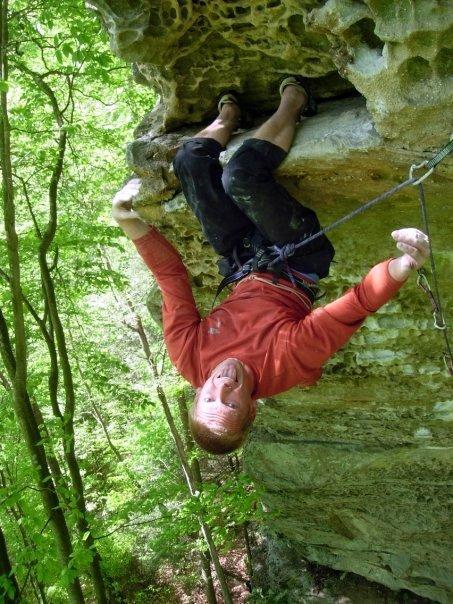
Here is the proper way to rest.

Detrick S · · Denver, CO · Joined Jul 2012 · Points: 147
J Squared wrote:

are you as Ripped-out fit as Alex Megos??

if not, you'll likely feel a real benefit

I imagine that even the great Alex Megos can get pumped on a 5.15c.

Sam Cieply wrote:
http://trainingforclimbing.com/effectiveness-of-dangling-arm-and-g-tox-recovery-techniques/

Thanks for the discussion, especially to Sam Cieply for posting the article.  Though it wouldn't have passed peer review in a scientific publication, there are some conclusions of moderate scientific rigor to be taken (just saying, some standard error bars would have been nice...).  

Perhaps the next study can examine the null hypothesis of "there is no difference between 'shaking out' and 'static resting' in otherwise equivalent alternate-hands resting technique".

reboot · · . · Joined Jul 2006 · Points: 125
Sam Cieply wrote: In this study, the “G-tox” active recovery method proved superior to the commonly use dangling-arm shakeout during a 2-minutes mid-climb rest.
Using the G-tox recovery method facilitated faster clearance of blood lactate and other metabolic byproducts.
After a 2-minute recovery period, climbers using the dangling-arm recovery method experienced a 2% gain (recovery) in hang grip strength, while climbers using the G-tox experienced an 18% increase in grip strength.”

Yes but what holds and what wall angle were those and how restful are the foot holds? A lot of world cup boulders swing their arms to de-pump between tries, which one could say is a more extreme version of G-tox, but you obviously can't do that on most routes. The very act of raising an arm shifts your COG/balance that on most steep routes makes it more stressful to hang on than keeping it low (there is a reason people try to clip at waist level than above head level). It's going to be a balancing act in practice.

Anonymous · · Unknown Hometown · Joined unknown · Points: 0
reboot wrote:

Yes but what holds and what wall angle were those and how restful are the foot holds? A lot of world cup boulders swing their arms to de-pump between tries, which one could say is a more extreme version of G-tox, but you obviously can't do that on most routes. The very act of raising an arm shifts your COG/balance that on most steep routes makes it more stressful to hang on than keeping it low (there is a reason people try to clip at waist level than above head level). It's going to be a balancing act in practice.

Although I won't say that is never a reason people clip at waist but extremely rare reason and I have never seen anyone do it for that reason. It is alot more likely that they are on a huge jug and can reach the next bolt they will clip or will wait to waist level if there is a better hold at that point.

Guideline #1: Don't be a jerk.

General Climbing
Post a Reply to "Shaking out vs. resting"

Log In to Reply
Welcome

Join the Community! It's FREE

Already have an account? Login to close this notice.