
 Continue with onX Maps
 Sign in with Facebook






Origin of the "bell curve" for route setting


|
|
Jim Titt wrote: ...what a gym setter needs to know to make the maximum use of a restricted resource. If three times as many V1 sends are made as V4 then you bolt your gym with this in mind. No. If the v1 climbers think they are so special that they should have X+4, 2X, or even 3(X^2) + 1 v1's (where X represents the number of v4's at that gym), then the gym manager or head route setter needs to ask them what, exactly, makes them so special compared to people climbing v4, and why they should therefore have more challenges, for them personally. |

|
Franck Vee wrote: I don't think it has changed much. redriverclimbing.com has overview stats. I took a screenshot. 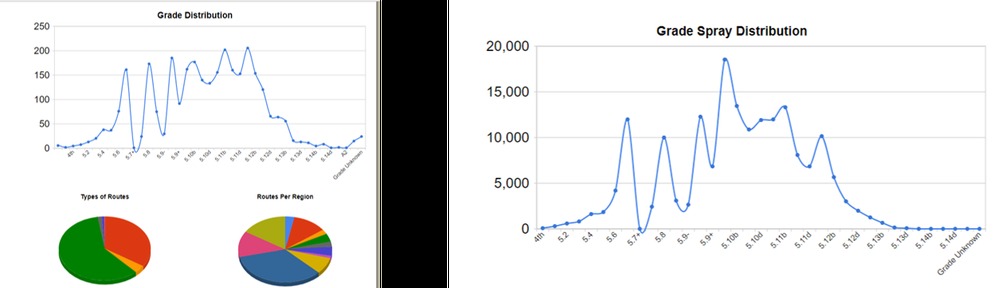 Notice that even though there are more 5.11b's and 5.12b's than 5.10 a/b/c/d available at the Red, there are FAR more ticks of 5.10a's than of 5.11b's or 5.12b's. And if they didn't break the 5.9's into 5.9 and 5.9+, the peak would be at 5.9, not even at 5.10a, thogh it would be close between 5.9 and 5.10a. rrc.com doesn't allow multiple ticks of the same route, the way mountain project does, so it isn't as if 5.12 climbers are just running laps on 5.10, and ticking every one of them. Anyone who's been to the Red, know that crags with a bunch of 5.10s are always mobbed. |
|
|
Lena chita wrote: That's a good illustration of why it's pointless to ask if the distribution is Gaussian, lognormal, Poisson or anything else. The question would make sense if climbing difficulty was an objective, precise numerical value, like height or weight, but it isn't; all we have are arbitrary category labels. And if you start combining or subdividing categories because they don't produce a nice, smooth distribution then of course you can get any results you want. As another example, imagine if grades were still the way they were in the 1960s or 70s, when the Yosemite system stopped at 5.9 or 5.10 and the British "Extremely Severe" hadn't been divided into E1, 2, etc. You'd get a left-skewed distribution, with a concentration at the top grade and nothing harder than that. Of course that's a silly example, but it illustrates why the original question doesn't really make sense. |
|
|
I can barely spell algorithm, so I didn't follow very much of this. I've been climbing for 42 years and I pretty much go out to have fun and enjoy beautiful places with my friends. |
|
|
JNE wrote: How bizarre! A gym has a limited number of possible routes/problems so you set them so the user rate is roughly equal. Nobody is going to set 6 problems that are V1 and 6 problems that are V17, the V17 problems will gather dust and the punters waiting to get on the V1´s will get pissed off and go to another gym run by someone intelligent. Hence the OP question regarding using the bell curve as an indicator of what route setters should provide. To which the answer is yes, there is data but the statisticians on MP can´t be assed to find it. |
|
|
JNE wrote: um... maybe you should try owning a gym. you'll realize that the routes are set for the customers. if you don't set for your steady customers... you'll soon find yourself out of money with that attitude.. generally people who project v5 and above also tend to go outdoors more.. and given that higher and higher difficulty routes are essentially all about working under more and more limited conditions... |
|
|
t.farrell wrote: Well I did earlier try to help by pointing out that UKC have a huge database, in fact if one bothered to Google "bell curve climbing grades" number one result is a thread on the very subject with a link to their data which I later posted direct to make things even easier. It´s https://www.ukclimbing.com/logbook/graphs.php#grade Someone else can do the grade conversions from the different systems they use if they can be bothered. |
|
|
J Squared wrote: I have been the head setter at a small gym that regularly got compliments like 'nice work', 'awesome problems', and 'thanks for the awesome gym experience' from regular as well as visiting climbers. We were specifically known for our setting, and we made that the main part of our brand. I had an even number of routes of each relevant grade range, with grade ranges (v0-v2), (v3-v4), (v5-v7), and (v8+), and a mix of styles. When climbers of grade X, whichever grade that was, would approach me and ask for a greater portion of the overall wall space be dedicated to their specific training, I would kindly explain to them that it was not how many challenges they had as a group, as each section of wall had a problem which was suitable for them and thus the wall space had been optimized with them in mind (i.e. they could all be in the gym occupying every inch of useable wall space at any given time), but how many challenges they each had as individuals and how this needed to be balanced with the other individuals who made up the (always changing) demographics in the gym. If this was still insufficient for these climbers training needs (such as if I had a group of them who always only tried problems once or twice, and all climbed in one grade cluster) I would set those grades more frequently and the surplus would be set to a lower standard, and yes, that happened. If the climbers refused to be satisfied unless they were socially dominating the gym, I always felt the business was better off without them. Also, in the summer months, when business was slow, I would definitely cater specifically to the active climbers. Lastly, yes, setting all those problems, especially when you thoroughly forerun every one of them, is like hard manual labor. At least it was always good for the climbing. |

|
Anon Anon wrote: When learning how to set climbing routes in gyms, setters are often told to set route difficulties according to a "bell curve". An example of this is mentioned on this page. I've talked here before about different backgrounds for approaching questions (i.e. as a physicist versus as an engineer versus as a (pragmatic) climber) usually because I want to approach something more from a engineering perspective than most climbers here. This is a case where the context indicates that the writer of the piece is doing the opposite. They aren't approaching it scientifically, they're approaching it colloquially, which is fine. They're still communicating something useful: they're communicating that there's a temptation for routesetters to want to set climbs for their own grade, when their clientele actually climbs a lot weaker than they do. The bell curve claim isn't literally talking about a specific Gaussian distribution, it's just talking about where the abilities of your typical gym customer actually lie. 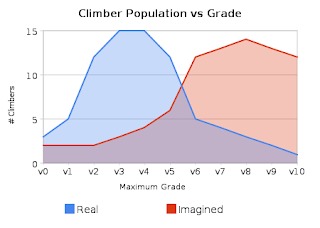 One of the colors in the legend on this graph from the blog post is literally labeled "imagined". I'm not sure why anyone would think this was making any sort of scientific claims. There may actually be some evidence of actually Gaussian distributions, in gym climber grades, but that's fairly irrelevant to what that blog post is talking about. |
|
|
David Kerkeslager wrote: That's a good point, but the other (blue) curve is labelled "real." From it's near symmetry, however, it is clear that it isn't based on "real" data, either. The OP asked if such graphs are "scientific" or "dogma." It clearly isn't scientific, but it also isn't any sort of dogma. It's just an illustration one routesetter put together to support his point that some setters are prone to setting too many hard routes. |
|
|
PRRose wrote: I don't think he put it together to support his point, I think he put it together to explain his point. That's a nitpicky difference in most cases, but it's an important difference if we're talking about making a scientific claim versus sharing your experience with routesetting. |
|
|
you might want to check into climb connect. however only user input is available, so if a complete newbie comes in they are less likely to log their activity than someone training for an objective. i dont know if you can petition them to get anonymous user data but you might be able to. |
|
|
Man, y'all are getting triggered by jargon. |
|
|
The data always looks a bit ragged because the in-between grades aren´t universally used so you´ll get less 6c+ than 6c and 7a for example, it´s worse with the V scale where if you look at say V5 there are 19944 sends, V5+ there are 76 and V6 gets 17667. A friend who deals with these things (he writes boulder guides for Europe) says you just split the intemediate grade numbers and add them to the full grade either side. |
|
|
Sure looks like a bell curve (or most of one) to me but then I´m an engineer! It´s certainly better though the problem as one can see is that the V grade starts so high it excludes a large proportion of ascents though it has been extended downwards with V0- VB VM and VE to try to match up with the Font grading a bit better (respectively f4, f3, f2+ and f2). Basically it´s just the way bouldering is where because it´s only difficulty only little kids find f3 "difficult" whereas a sport route of the same difficulty a normal climber would still probably rope up for it and call it a route, a trad route definately so. |
|
|
Aweffwef Fewfae wrote: it's generally unwise to trust blogs. You define that in a way that makes sense mathematically, but not in the real world. Or at least not in the way a gym that cares about climbers would need to think about it. The bell curve in question is about use of the problems. Yes everyone can climb V0 but not everyone does - because maybe you warmup doing something else and never bother. So the whole point of the gaussian is to figure how use is distributed accross grades, so that you can tailor setting to that end. |


