
 Continue with onX Maps
 Sign in with Facebook






Regulation vs. Wild and Free


|
|
Some thoughtful responses...and a distinctive lack of trolling! (What did I do wrong--this is MP right? Home of the trolls?) Again, my friends and I were going over this issue over beers last night...mainly, access and advocacy go hand in hand with overcrowding, potential destruction, and other--maybe more sentimental--losses. Adding to that is the fact that noobs exist, and people are foolish...and we are not going to see less climbers, hikers, mountaineers. It's not going back. So we can't duck this issue, stick our head in the sand, and hope it goes away. I think the easy answer is "well, i'll just go off far away from everybody," which is somewhat of a retreat...I guess its the more individualistic choice vs who we choose to be in society. Coming from Nevada, I know there are a ton of places people can get lost, but that used to be the same in the North Cascades...so, the question follows... We can say that humans will self regulate but this has never been the case--its why we invent and support institutions. Everyone wants to be in the Enchantments and enjoy the high granite. Everyone wants that Insta-pic. And who has more of a right to be there? Especially in wild places where the environment is actually fragile? I'm all for tearing the road out of the Valley, but that road and the tourism it brings are actually what helped keep Yosemite from being sold to the highest bidder... And yes, converting public land to private, even with heavy restrictions is unlikely to work, as those restrictions will have a slippery way of changing, depending on which corporation purchases the right gov officials. There are success stories, certainly (Muir Valley is one off the top of my head) but there are even more failures. Private landownership faces the same threats from lawsuits as public, and private owners will be less inclined to fight lawsuits and just decide its not worth it. While I enjoy alternative thinking to tackle major issues, I think Old Lady H is right...small scale private holdings among integrated community can do a better job than wholescale turnaround; for that, you need larger institutions that are ostensibly working for the public...otherwise, they are gonna scrapeaway Bears' Ears (though, caveat--sometimes that work in public interest can be deleterious--Hetch Hetchy?) Bureacracy and regulation are imperfect tools, and seem an anathema to the nature of climbing. But...as I wrote, I think they are part of the solution. Not everyone is going all the way out to climb Mongo Ridge on the weekend, but the do look hungrily at Prusik Peak...or Smith. Is the Mt Rainier permit system a good thing? Eh, maybe, maybe not...but it requires climbers to know what they are doing on the slopes of the Mother of Waters, therefore regulation requiring education. Should LNT classes be required before setting out into the wilderness? Then where does it stop? Will everyone on the mountain be required to have WFA/CPR? Can we create a system whereby if you enter into a Nat Park or Forest or BLM, you automatically assume the risk of being in those places? I'm guilty myself. Those groups of ten or twelve being foolish at Smith--I usually just leave the area. That's me shirking my responsibility, even having learned to climb in the older climber-mentor system. No one likes the climber who dispenses unsought advice, but...where do we even start? I guess that's the issue I'm struggling with, and I do enjoy that fellow climbers are thinking about it...the conversation is happening... |


|
Some thoughtful posts here, thanks! I am sitting within sight of a climbing area closed to development because of a major feud between climbers and a quarry, decades ago. The quarry won. End of story. The rock I will hopefully be climbing this weekend, our other local rock, is precisely that narrow strip of mixed ownership someone upthread was advocating dirtbag climbers "lease" and "manage", but mostly it is BLM and other public land. It is, and has been, "managed" thoughtfully by the locals, by working hard to stay low key. That means camouflaging hardware, educating climbers on raptor closures (EARLY this year-Face Canyon is closed!), maintaining trails, crag cleanup days, etc. But. It is adjacent to a road that is one of the main exits up to the mountains, and in a narrow canyon. What happens when, or if, the powers that be decide the road needs another lane? It's complicated. The photo is from a public lands rally at our Statehouse, last March (?). One of the largest in the country, even though it was sopping wet that day. And, not long after the Malheur mess. So yes, I am tweaking both sides. NONE of this happens in a vacuum. All parties must be considered, and we all need to pay attention and do what we can. Best, Helen 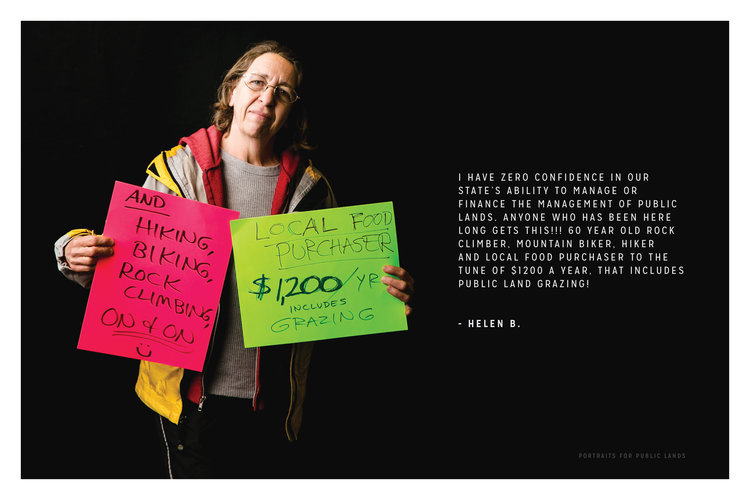 |
|
|
Russ Keane wrote: generally speaking Weyerhauser holds the keys in Oregon in the state and national forests. |
|
|
Regulations suck. Being told what to do/not to do sucks. But crags developed to the nth degree or loved to the point of unusable suck worse. I’ll take the feel and character of Eldorado and the Flat Irons with their regulations over the “wild and free” unregulated Clear Creek Canyon or North Table any day. There’s no way around it, crowded places need regulation. When an area becomes so popular as to need regulation, it’s better to embrace it and jump on the bandwagon early to most effectively protect and preserve the places we love (with the interests of climbing of course!). We all here tend to operate from the perspective of loving and protecting the land. Business tends to operate from the perspective of how much money can they squeeze from the land with minimal output. Just look to the mining industry if anyone that wants to see how private business operates in the wild. Go Exxon and BP! The only business people (or gov’t folk for that matter) that I would trust to run the wild is Yvon Chouinard and his team at Patagonia. |
|
|
Jonny d wrote: ^^^^^^^ $10 says that this guy LOVES Ayn Rand ^^^^^^^ |
|
|
kendallt wrote: No camping in either place and Eldorado is a state park so it has an entrance fee. The main reason the Flat Irons and Eldo have a better feel, for me, is that all fixed hardware installation has to be reviewed and approved by committees of climbers and then approved by land managers. Climbers that want to put up a route that requires fixed hardware in these areas have to submit an application detailing their proposal for each placement. Same process for replacing old bolts and fixed pins. So these two areas haven’t seen the proliferation of bolts that have inundated most of the Front Range crags and have helped maintained a lot of their origional flavor (or so it would seem, I wasn’t there in the early climbing days). |
|
|
Old lady H wrote: If states can't manage land, then how is it that every state I've ever lived in has state parks? They don't have the feds telling them what to do and they haven't managed to destroy those yet... |
|
|
Stagg54 Taggart wrote: I would venture a guess that the land used for state parks does not hold natural resources worth extracting. |
|
|
Stagg54 Taggart wrote: Visit any state forest in Oregon. Especially in the Willamette valley and all the way down the 5. |
|
|
Wow, did anyone else go back and read Francis Sanzaro's piece? |
|
|
Stagg54 Taggart wrote: State parks are almost all small, based around specific natural landforms (rather than vast ecosystems like most national parks), and tend to skew more on the side of developed visitation than wilderness resource preservation. The most notable exception to this would be the Daks in NY, which was specifically protected to preserve valuable watersheds for NYC. It's really not an example to show how all states would be responsible land stewards. |
|
|
kendallt wrote: Errr.... PMRP? Muir Valley? Those work overall pretty well. Muir Valley was privately own for a long time, and because the climber's coalition worked well with those owners, both were able to see they actually wanted a lot of the same things, or compatible things. PMRP is climber owned. I'm not sure many would call PMRP a debacle, at least not sport climbers who are the primary clientele... Neither would I call Roadside a debacle. That it was closed for a long time sucked, however now it is still accessible you just need to fill out an online form. Plus access is limited in terms of daily numbers, which can be good or bad depending how you choose to see it. For my part, I don't mind some crags with more limited daily access sprinkled in. You are almost guaranteed not to be swamped with newbies & guided groups. There is something to like there. I'm not saying that's my personal preference, but not I doubt it's worth being called a debacle... |
|
|
Stagg54 Taggart wrote: How many millions of acres were these state parks? Scale matters, sir. That's why I mentioned it. They still aren't exactly way up on State budget priorities. Apparently you are also forgetting the budget crises many states went through not all that long ago. Best, OLH |
|
|
There is this concept of Dunbar's number-- the number of individuals an average human can maintain a meaningful relationship with - and it is about 150. If you have a community/user group of about 150 or fewer, no external laws and elaborate written regulations are necessary, the group does, indeed, self-correct and function quite well. Groups much bigger than that inevitably fracture, because individuals lose the ability to connect to every member of this " tribe", and develp sub-tribes/factions. |
|
|
amarius wrote: I used to climb a lot in West Virginia. I am very much aware of that.. It is a shame what they are doing there... |
|
|
kendallt wrote: Just because the Feds own it, doesn't mean it will always be open to climbing...They could easily just turn around and decide to ban it. I would rather have land owned by climbers coalitions... |
|
|
Stagg54 Taggart wrote: That's a good point. At the end of the day, it's mostly a matter of the frequency of dumb accidents we're going to see (say, hordes of gym climber going outside thinking it's just like the gym, friends training friends trainings friends with diminushing quality, etc.), vs how much risk tolerance those government actors will have. Maybe accident rates won't increase that much, or not really at all. But if they do, we may start seing the need for permits etc. for things like single-pitch sport climbing *shrug*. Having land owned by climbers is a protection against that, to some extent. However, it's though to say whether or not those coalitions will have the clout to maintain ownership, and associated fees/costs, over the long run. I think ultimately, the question of crag ownership has no "definite good answer" - it may be best that a number of different approaches are used, with the hope that regardless of what the futur brings, some crags will be well equipped to stand the test of time. I also like the idea of having some climbers coalitions who struggle with the challenges of becoming owners of the land, but ultimately may be able to assist burgeoning coalition if needs be. Even if you think governement ownership is best, having some climbers-owned models to fall back on if things go south is reassuring. Seen that way, crag ownership is not much different from evolution - you'd rather have resilience through a mix of approach that bet everything on the one thing that seems to work right now... |


