
 Continue with onX Maps
 Sign in with Facebook






cordelette question - fig8 vs overhand


|
John Wilder wrote: Unless I'm missing something, you don't get a masterpoint with the bunny ears + clove. That's fine, but I prefer to have a masterpoint for a variety of different reasons.
You misunderstand. Minimalism is one of many benefits of using a rope anchor. Others, like I've already listed, are efficiency, and reduced impact force on the anchor if loaded. I value all of these. What I'm saying is that your system sacrifices one of these benefits without providing any additional benefits. And, I'm also saying that you characterizing your method as a "rope anchor" is a bit misleading as most people expect a "rope anchor" not to include anything other than biners and the rope. |
|
|
For those advocating for using the rope for all anchor applications on multipitch and not bringing a cordalette, what would you use in a self rescue scenario to escape the belay? Genuinely curious. |
|
|
Dan Evans wrote: First, ask yourself "Why do I have to escape the belay? Do I have to escape the belay? Can I use the terrain to help me?" I've never had to escape the belay in over 40 years of climbing. If I had to escape the belay when using a rope anchor, I'd replace the rope anchor with slings. Or simply untie myself since I use often use a direct isolation loop. If time was truly critical (and EMT training taught me to act quickly but not to rush) and I needed the rope for rescue I'd consider cutting, leaving the rope anchor intact and using the rest of the rope for rescue. But, I consider gear as expendable. Compare the "once I might have to do this" with 40 years of never having to do it. If escaping the belay is your sole reason for not using a rope anchor, I'd say you're trying to protect against something that never happens to most climbers and may never happen to you. (For the record, I generally use the rope when swinging leads and use a cord when leading in blocks) |
|
|
wivanoff wrote: If the whole point of using a rope anchor is to minimize gear carried, why would you have any slings handy while belaying a leader? I don't really have a strong opinion in the rope-vs-cordellete-vs-whatever debate, but I do find the many of the minimalist arguments seem to leave out some details that might matter.
That is really missing the point. Knowledge of techniques like self-rescue, etc. is insurance. As the saying goes, "you don't need it until you need it." And just because there is one example of someone that has not needed it does not mean that it does not have value. I've never had a major medical expense in my 40+ year life but I still carry medical insurance... |
|
|
Dave Kos wrote: Because I'm not a sport climber. Most multi-pitch trad climbers usually have a few extra slings. I think the person (Dan Evans) I was replying to was asking about not carrying a cordelette.
No, the question was: "For those advocating for using the rope for all anchor applications on multipitch and not bringing a cordalette, what would you use in a self rescue scenario to escape the belay? Genuinely curious." I was answering the question about what *I* would do. I do not present this as "the one true way". I know what to do. My partners know what to do. We see no reason to use a cordelette every single time for every single anchor because "this time" we "might" have to escape the belay. I never said you do not need knowledge of self rescue techniques. You ignored my comment about using the direct isolation loop, my whole second paragraph and my last paragraph about when I do use a cordelette, then claim I miss the point. For someone who has no "strong opinion in the rope-vs-cordellete-vs-whatever debate", nice way to pick and choose. |
|
|
Dave Kos wrote: In my experience, the vast majority of people building anchors with the rope are using a Direct Isolation loop or some other form of masterpoint which means that all you do is just untie and then you're free and out of the system. By the time you get back to anchor to release it and proceed with the rescue, you will have gotten to the leader and applied first aid if needed, among other things. Chances are, you'll be able to grab a few slings from the leader so you can then build the anchor out of slings if you want. And if not, you're probably opting not to rebuild the anchor with slings in order to save time because of a medical emergency. In which case, cutting the rope to free it is the best option because your partner's life is far more valuable than a few feet of rope or even an entire brand new rope. |
|
|
For the record, I realize that it is much safer and quicker to just call for a rescue as opposed to escaping the belay 6 pitches up, rope soloing up to an injured leader, then rigging a rescue spider for rappel down 6 pitches before running/calling for help. The self rescue lessons I took years ago, as well as the book I purchased all utilized a 7 mm cordalette for just about every scenario. I think the only scenario where we used the brake side of the climbing rope was to rig a 5:1. The more I think about it though, I suppose if you have spare nylon slings or prusiks (I carry dyneema unfortunately), you could fashion a PMMO with the climbing rope as well. Some of the above comments fail to mention transferring the load of a fallen leader from your ATC to an upward pull anchor. Simply untying from the rope only frees you from the anchor, not the leader's weight from your harness. Edit: And I also use the rope for the anchor quite a bit, especially when topping out or wanting to be closer to the edge of a large ledge so I can see/communicate with the follower. I just also carry a cordalette because I think they're worth their weight. |
|
|
Classic MP thread drift. From "What knot for the masterpoint" to "Just use the rope" to rescue scenarios. Not that it's a bad thing - some of my favorite people are (thread) drifters. |
|
|
Dan Evans wrote: This is correct, but the same is true regardless of how you build your anchor. As for transferring the load, it is technically possible to use the rope as a friction hitch on itself, although this is difficult and overly complex. However, anybody climbing multipitch ought to have 2 prusiks and material for a footloop on them anyways, so transferring the load isn't an issue. |
|
|
Chase Giltner wrote: Hi, it works as follows: the second carries 3 spare carabiners (these are called magic carabiners, because they save so much time). When he reaches the stance, he ties in exactly as the leader did, piece by piece. The leader unties from her carabiners, and off she goes. Simple. Which is fastest (cordelette or rope) depends on several factors. 1. how experienced is the second - if not, cordelette probably faster 2. are the anchor pieces simple, not more than 3 and in a radius of about 1 metre, then cordelette works well; if 7 pieces, or a tree 20ft back from the stance and a cam right by one's bottom, the rope will be quicker.
|

|
David Coley wrote: If it takes you 7 pieces and a tree to build an anchor it's probably time to go back to climbing school... |
|
|
AndrewArroz wrote: Haha, yeah, but you misread how the options are meant to be separated in David's post. |
|
|
The advantages of the method I've posted and Eli has reposted and that Dave has on his site http://multipitchclimbing.com/ as the DIL method is that it works on every type of anchor configuration, no matter how many pieces there are and how they are situated, in exactly the same way. If you want a master point you get it exactly where you want it, not where a very small choice of power point knots will put it, there are no struggles untying a weighted master point knot in thin material, you don't take time wrapping up and unwrapping a cordelette, and you manage the same as always even if you are out of slings. So basically one procedure for every possibility. It is even quicker if you don't insist on a master point (personally I rarely use them), because then you don't have to tie the butterfly loop but instead use the harness tie-in loop. So it is about more than adopting a minimalist gear perspective. Compare this simplicity and universality to ...there are a bunch of knots that can be used as the masterpoint knot. Obviously, an overhand or a figure-of-eight, but also figure-of-nine or figure-of-ten, particularly if you plan on taking many falls on on that masterpoint and you know that your cordallette has a history of being really a PITA to untie after stressing it. The figure-of-nine and figure-of-ten also have advantages that they eat up rope, so if you find you want your masterpoint higher, but don't want to throw cloves in, then tying those knots might help. Another issue is if you find that your masterpoint is too high, and you need more length, then sometimes (for two-piece anchors or a three piece anchor where you've not used your cordallette as a loop) you can use the figure-of-eight bunny ears knot to create your masterpoint. Of course, you have to be mindful of the fact that the figure-of-eight bunny ears knot is not as secure in the event one loop gets cut for the masterpoint... which, with all the variations and different knots and master points still not in the optimal position, still won't work if the anchor points aren't suitably near each other. And then there is the matter of not getting the cordelette arms the intended length and having a master point knot that will release unknown and unpredictable amounts of slack under load, and you have a system that is less likely to distribute loads optimally, a feature that will be made worse by the relatively static nature of some cordelette materials. The method I’ve suggested isn't complicated, it isn't messy, and it is as fast or faster than any of the other approaches. Once the pieces are ready to be clipped, about 60 seconds for power point version and 40 seconds for the non-powerpoint version, vs. about 80 seconds for a cordelette, counting unwrapping and rewrapping. Of course, different folks will get different timings (I’ve seen people takes a minute or more just to wrap up their cordelette, and I assumed the power point knot came undone without a struggle), but the real point is that there is little to no significant difference in deployment time. That said, no need to be doctrinaire; various particular situations can be more efficiently handled with additional gear. I think block leading is one of those, although with conventiently situated anchors an experienced second can build their anchor under the leader's anchor in 40 seconds (no power point needed), so there is very little penalty even in that case. (If the second is using an installed tether, then they can clip to the leader's rigging, pass over the gear sling, and set up their anchor while the leader is re-racking, with no time lost.) If the second is not so experienced, or if it is guiding situation, then the cordelette approach is going to be better. For me, the most frequent application of slings or a cordelette is when the belay anchor pieces are a long way from where I want to be situated as a belayer. In this case, a rope anchor has to be threaded differently, because all clove hitches have to be back at the belayer for optimal adjustability. But this typically requires a very large amount of rope---six times the distance from anchor to belayer stance for a 3-point anchor---and this is usually going to be impractical. Because of the possibility of a remote stance, the ability to encircle or loop over very big features, and the extremely remote chance of having to rerig a rope belay for some self-rescue scenario, I like to carry a quadruple-length thin webbing runner. I carry it on my harness, and use it only occasionally. It is light and compact, but I find it can be hard to untie the power-point knot when the anchor has been even moderately weighted. |
|
|
AndrewArroz wrote: I got fed up waiting for my buddy to build a belay on the fourth or fifth pitch of a route in the Dolomites so soloed on up to see what he was doing (it was 18 pitches so a bit of speed was desirable). He was trying to work out how to join up the 9 sad-looking old pitons in some way he´d read about (he was American). I just stepped 6 feet to the left, clipped the two-bolt belay there as a runner and continued without a word. |
|
|
David Coley wrote: |
|
|
Bingo.... We have a winner!! Keep it simple stupid. |
|
|
Jim Titt wrote: Bad case of tunnel vision, exacerbated by the fact that he probably never saw that many pitons in one place (or even on an entire climb) in the US. I've seen a bit of the opposite: otherwise competent European climbers connected to anchors that would probably fail if they sneezed. Setting up might have been fast, but breaking down could have been a hell of a lot faster. Using half ropes, I've occasionally set up four-point anchors---each rope connected to two anchor points. Never got anywhere near 7, not to mention 9 though. Pick the best 3 or 4 and be done with it. |
|
|
Hey Rich I'm curious how you would build the rope anchor with 4 or 5 pieces. I'm thinking you would just clove hitch them to the biner that is getting all the other clove hitches, but that would be 2 or 3 cloves on 1 biner which sounds like too much. I usually use a small lightweight locker for that and I don't think I could even fit 3 cloves on it, much less doing so without loading the gate. Would you add a second biner to do that? |
|
|
rgold wrote: Dang, you're right. Though I'm still hoping to someday be belayed off an anchor with 7 pieces AND a tree. |
|
|
For those of you who prefer pictures over text, here's one example of what I mentioned in my thread derailing post (way back on p. 1): 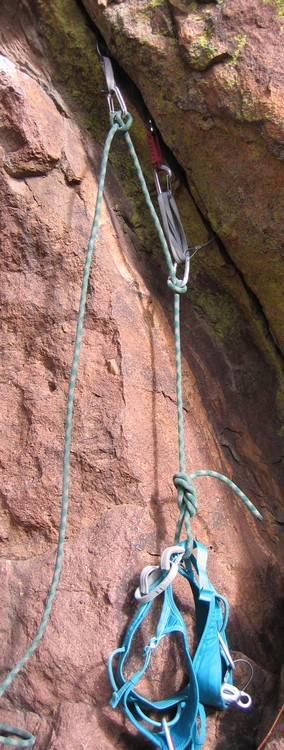 (Sorry about image size/quality: Left-click on it and it will be enlarged. One grey cam on the left, one red cam in the middle "equalized" with a nut on the right using a grey sling). Chase Giltner wrote: The only reason for that sling is to reduce the number of tie-in points from 3 to 2, which is something I have found convenient when block leading (not switching leaders). When the follower comes up, he ties one clove (or any other knot of choice) to each of the two tie-in points and (after reracking gear) the leader is ready to unclip and go. The only "cost" in the belay transition compared to a master point cordelette anchor is for the follower to tie one extra clove. Even when I build more complex anchors, I usually "cook it down" to two tie-in points, so the belay transition is "always" the same. Note: Make sure the follower clips in with his own biners. Messing around trying to reuse the leader's biners makes no sense as he needs those for the next anchor anyway. 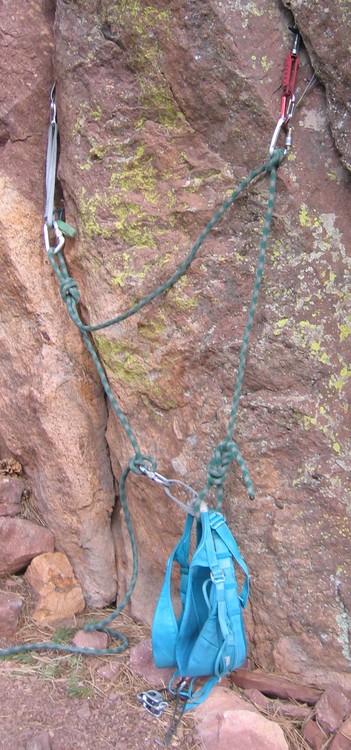 (Nut + green alien + grey sling on the left, red Friend + nut + biner on the right).
Edit: It is ultra important that the biner clipped to the harness in the last picture is NOT clipped to the fig-8 tie in. If the right hand tie-in point fails, the fig-8 tie-in would become "ring loaded" and can fail. (As Hamish writes in the subsequent post: Add a backup knot and that would prevent failure. But better yet, don't clip the fig-8 in the first place). |


