Continue with onX Maps
 Sign in with Facebook






Soft catch vs. hard catch video analysis



|
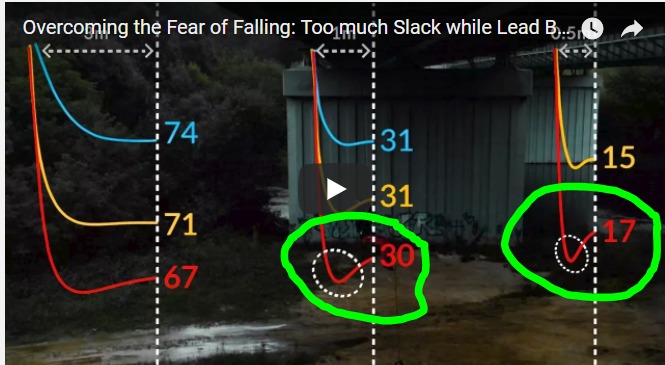
Jake Jones wrote: Creators of this video are concerned with forces that a climber feels when impacting THE WALL. That force goes as ~V*V, V being speed normal to the impacting surface. They use pixels per frame/second since that particular measure is directly proportional to velocity. |
|
|
Jake Jones wrote: If they were looking for the "impact" flet by the gear (i.e. the tension in the rope), you'd be correct. By taking the derivative of the velocity, you'd be able to determine the acceleration of the climber (and by taking mass into account, you'd have the actual forces involved.) The areas you have circled are the peak accelerations (or rather, decelerations) for those 2 falls, and would be the "impact" experienced by the gear and harness. However, from the video, it seems that the impact force they're concerned with is the impact with from the pendulum-swing into the wall. They don't have an actual wall here, but they stop their graph at an imaginary vertical line (the dotted line), and display the horizontal velocity at that point. They've done runs with different lateral offsets from the "wall", and with varying amounts of slack in the system. They then expand on this by including the hop for a soft catch. As mentioned upthread, and alluded to in the video, they're not worrying about the actual tension in the rope; it's the velocity with which you hit the wall that does the damage in a pendulum swing. |
|
|
|
|
|
amarius wrote: F = dP/dt. P is impulse, t is time. Force is not a constant. Force is a momental physical value. It exists (OK, it does not exist, but it does exist in a contex of some physical model) at exact point and exact time. |
|
|
Pavel Burov wrote: I agree that velocity in the direction perpendicular to the wall is the first thing to look at. However, a large component of the velocity parallel to the wall may result in spin being applied to the climber (who is not a point mass). That, in turn, may lead to smashed patellae, especially if the wall is hit during the upswing. |
|
|
brenta wrote: There is one more parameter to consider. In terms of climber just slept of and taking a fall deeper fall translates to more time to tuck themselves up. To my experience the most danger of being short while falling is everything comes in too fast pace - everything was fine, I was reaching that hold or slightly dynoed to that feature but then all sudden CRUSH! BOOM! BANG! And my heels are already were smashed into the wall. Absolutely uncontrollable. Hard catches are evil. |
|
|
brenta wrote: I was confused by the wording of the video, extra slack is not necessary for trad falls but a soft catch from a jump is essential. Shorter falls that lead to knot tightening or climber 'squishing' are indications that your gear is taking a higher load, these things happen much more with high fall factor falls. Spreading the deceleration for as long as possible is the name of the game for having gear hold. |
|
|
Jon Rhoderick wrote: Is this really true? I remember a post by rgold saying that with ATC style devices, jumping is not productive, and that the slight slippage of the rope through the device does a lot more to lower the peak force on the gear than jumping can. I think rgold has spoken multiple times about the phenominon, but this post from way back in 2008 is the only one I can find for now...
|
|
|
The entire premise to this study is a clean free-fall on a steep overhanging wall. All well and good to focus on a "soft catch" but in many climbing situations the belayer does not have the luxury to "make it soft". Aren't ledges more dangerous than slapping the wall sideways? |
|
|
Russ Keane wrote: On behalf of the people who made the video, I apologize. They CLEARLY were meant to make a 5-minute video that covers all situations that one might ever encounter in climbing. How dare they focus on one aspect and try to understand it in depth? Someone somewhere might be hitting a ledge right now... |
|
|
^^ Woah, ok..... I guess I'm not allowed to say something that might be relevant..... Enjoy your thread. |
|
|
Frankly, I am really surprised they only have one disclaimer about not climbing trad, and asking not to use their conclusions for trad climbing. They should've included big banner "NOT FOR TRAD CLIMBING" right there on the top of video. And, seriously, how dare they try and break down sport climbing fall into simple components, and not consider floppy climber model, tightening knot model, the many types of ropes available for climbing model, different belay devices model. And, since they did not talk about hip belay, we should ask YouTube to remove this video. |
|
|
They put in a ton of work and made a very useful contribution to a ongoing discussion about belaying for sport climbing. To the extent that their results seem to be justified scientifically, it is reasonable, as is common for all scientific work, to discuss their methods and analyze possible experimental and theoretical flaws. |
|
|
It was an interesting video, but I'm not able to take any actionable conclusions from it. A soft catch may reduce the risk of injury, if you do it perfectly, in the right situation? The squirrel was cute. |
|
|
Tim Lutz wrote: What I took from the video was that a soft catch's effect on the outcome is not absolute. |
|
|
amarius wrote: I would think the issue is not whether it is sport or trad, the issue is wether the climb is overhanging or not. 98% of all gym climbing is overhanging, so that's where soft catch shines with an "always" rule almost appropriate. 98% of all outdoor climbing is NOT overhanging, so need a little more thinking before blindly applying soft catches and an "almost never" rule is more appropriate (oooh, now I'll get flamed!). Watch for those ledges and slabs. |
|
|
man, i totally agree. i think people are trying too hard to find the one silver bullet solution when there isn't one. |
|
|
My sentiments are close to the previous two posts. Within the confines the pair had set for their experiments and test runs, they did a credible job. I certainly learned a few things after watching parts of the video four times. However, one thing to bear in mind is the lower the fall factor, the greater the rope can absorb the kinetic energy generated by the falling climber. I doubt that we saw anything greater than a factor 0.40 fall in the video. What the video does not address is the scenario of lighter belayer, heavier climber which is almost always the case for me. I keep the extra slack to a minimum but not to the point of short roping the leader until after 5th or 6th clip or about 50 feet of rope out if the climber outweighs me by 15# or more. As for jumping, sure if the terrain is overhung and there is no danger of ground/ledge fall, I gladly get lifted close to the 1st piece to get in a soft catch. But in recent memory, I had to make two semi hard catches with the climber between the second and third bolts. I did not dare to give more slack or jump for fear we would collide mid-air. In both cases, the climber did not crater nor hit the rock/wall. Everyone was safe and uninjured. This is a scenario definitely not addressed in the video but quite real day-to-day. Every catch is unique and at least slightly different from the previous one and the next one. To treat every catch using the same set of simple rules is nor optimum nor realistic. |
|
|
The video was interesting and has value. But.... The entire premiss was to determine "speed" and how it may affect one's "impacting" the wall, as this can cause injury. But, they commingle speed and velocity in their energy equation inappropriately. Speed is vague, whereas velocity has direction. Any pendulum has a horizontal component and a vertical component. So, the velocity relative the the wall one is about to impact is what's of importance. So, if the climber is going to impact a vertical wall, the horizontal "speed" is what matters, not the total velocity and total energy. Likewise, if the climber is going to impact an overhanging wall, its "speed" perpendicular to the wall is what is most important. Hence, the use of the energy equation is not implemented appropriately. For example, at the instantaneous level, a pendulum, say starting at "3 o'clock" and falling toward "6 o'clock" has a horizontal component of 0% and a vertical component of 100%. At 6 o'clock, the exact opposite is true. Stated another way, there is no horizontal "speed" at 3 o'clock and no vertical speed at 6 o'clock. But, the video misses several more important components of reality, yet, makes some blanket conclusions. If the wall is vertical, the initial horizontal component will be necessarily small. Hence, final horizontal component will be small (unless the leader pushes off the wall). But, they test a fictitious distance from the wall and draw conclusions. On the other hand, if the initial horizontal component is large (very overhanging wall), the final horizontal component will be large. Contrary to the video of "top rope" scenarios, any true lead fall where the leader is above the last protection point (excepting horizontal component of a climb out a roof will produce a much greater vertical component than they demonstrate. Additional slack in the system will always result in a total greater energy. In some cases, this will result in greater vertical "speed" and vertical energy. In some cases, this will result in greater horizontal "speed" and horizontal energy, or a combination of both. |
|
|
Oh. And the video confirms what I've been saying for years. Sure, jumping can reduce force, impact, hard catch, etc. But: 1 The belayer must be watching the leader very closely. 2 The belayer must be in a ready position to jump. 3 The belayer must time the jump within a fraction of a second. If not timed correctly, it didn't help. It may make things worse. |