
 Continue with onX Maps
 Sign in with Facebook






I want to learn trad climbing



|
It is almost impossible to do much multipitch climbing and always avoid being in the position of taking a potential factor 2 fall. Moreover, from the point of view of anchor load (as opposed to belayer control), there are worse things than a factor 2 fall, namely a high (but less than 2) fall-factor fall onto the belay anchor with the rope clipped to the belay anchor. Moreover, the "break even point," after which rope clipped to belay anchor causes a higher anchor load than a direct factor 2 fall, is surprisingly close to the belay anchor (I think, IIRC, before the leader's feet are level with the anchor clipping point). |
|
|
Yeah agreed it is impossible otherwise you would never leave the anchor. The meaning of what I was saying did not come across clearly. Climbing above your skill level immediately above the anchor is an example of a potential for factor 2 that is easily avoidable. With experience obviously one can make better judgement calls, but specifically as a trad n00b this makes perfect sense to me. |
|
|
Abdullah Mourad wrote: ^^^ This We talked at length in the car, on the ground and on the wall about making good judgements and that technically you only need one perfect piece/bolt to protect you, everything from there is an exercise in mitigating risk. In the SERENE methodology, solid is your number one requirement for anchor/gear placement and you balance your decisions (situationally) from there, often making trade-offs. Placement is like tying knots: more bad ones isn't better than the right one, but if you can't get the right one, mitigate risk as best you can while being efficient. Remember, acronyms and somewhat arbitrary rules/guidelines are there to teach you and form good habits. We are nOObs and are working from theoretical to practice to safe application to the point of muscle memory while pushing yourself (within reason, as you are personally comfortable.) It was almost comical how long it took us to place gear in our ground school compared to John walking up and popping in a perfect placement and walking away. We can debate the theory of what will take a factor 2 fall and how likely that is... but at our stage (and anyone starting really) you should simply, outright avoid that risk entirely. "No" is an acceptable decision at this point. As we improve, we will have to be comfortable with each others' risk level because we are not alone on the wall (pun intended). Ultimately, the person on the sharp end is in charge, so communication and understanding expectations (trust) is key. The three of us are still processing all the knowledge John passed down to us. Ultimately , being a good student means listening, asking questions, and practicing. |
|
|
rgold wrote: Rich, as ever, is a teacher and great resource to us all. The scenario right at the anchor will put you in position to take some of the worst falls possible and can never be totally avoided on multi-pitch routes. This is why we do build strong anchors capable of handling such loads and practicing good SERENE habits. What we were trying to communicate during the day is that you must be aware when that risk is present and take every step to minimize it, not the least of which is **don't fall**. Both leader and belayer have to be especially attentive at this time with no sketchy moves on either person's part. This is a climbing skill and experience dependent way of staying safe and using the judgment to exercise especial care moving away from the anchor, rather than a "systems" method that is applied blindly with little regard to the actual climbing you have chosen to attempt. Starting out the guys have to climb within their limits, especially right above the belay. Falling is not an option, though we are prepared for it. In a nutshell: we will build our anchor to withstand a potential FF2 event. But we will also approach the pitch (particularly when less experienced) with a traditional "the leader shall not fall" approach (climbing well under our limit) particularly when the fall is especially dangerous (right off the belay on a multi-pitch route), rather than a gym or sport climbing perspective that seems to welcome pitching off from nearly anywhere and with the belayer's feet on the ground. Kinda hard to put succinctly into a few sentences, we kinda had to massage this point over the day to communicate the gist. |
|
|
Anonymous wrote: This video was posted earlier in the thread, Nate: http://dmmclimbing.com/knowledge/slings-at-anchors/ That demonstrates how seemingly short falls onto the anchor itself generate extremely high loads partly due to the lack of stretch of sewn slings. Dynema is worst of all, Nylon next best (more stretch), tied nylon slings even better (knot absorbs energy too), the rope itself being extremely good as well as a cordelette but it does depend on just how the rope is used etc... This is an example of why belaying the leader off of a PAS is a bad idea as it takes a lot of stretch that the rope itself would have to absorb energy. A couple of posts above it the Petzl video that shows all of the forces that take place during different "factor level" falls. Note one of the principal components of a soft catch is the belayer being lifted by the falling leader. The longer the leash the belayer has, or the amount of energy that leash can absorb via stretch, is a big part of minimizing forces on all the pieces of the protection system. I hope that addresses some of your questions and that Rich adds his perspective as well. |
|
|
Anonymous wrote: I have not read the entirety of this thread, but this: I can't tell you how many times i have left the belay and not unclipped my clip-in point (daisy, cordolette, web-o-lette, da'rope, etc) in the belay. (Almost) Guaranteed FF2. Unclip before you start climbing. |
|
|
Anonymous wrote: We'll have to wait for Rich to clarify exactly what he meant as I can't be sure. Other than that, there are some (not named as far as I know) situations that due to rope drag prevent the full length of rope out from absorbing fall energy like it should or of course, gear failure etc that can cause severe Fall Factor events. The video covers that situation above where you fall onto a PAS or such at the belay. |
|
|
Anonymous wrote: Yes. A relatively short fall onto the anchor (not much rope out, so high fall factor) will hit the anchor with a load higher than a factor-2 because of the near load-doubling of the pulley effect. |
|
|
Nate, just use your imagination. Not just multipitch, think the general idea: FF2 can happen anytime you get above the only point you are attached to and can fall below that point, somehow. There's a PAS thread on here, and falling on static anything is discussed. Get yourself above where it's attached, and you can then also turn it into a higher fall factor. Mess up getting ready to rappel into a canyon, pitch over, FF2. Clip in direct with a sling or something longish to hang for some reason, mid climb, forget to unclip it... Mess up setting up a top rope, with your tether between you and the cliff or below you... Set up an anchor, low to the ground, stand up, trip off the thing and pitch over... Climb, as I have, to the top of a single pitch climb, with the anchor on a big flat ledge. Mantle up (beached whale move for me), at which point you are sitting on the ground above the anchor. Mess up while tethered... Most all of the examples I came up with are times when you have overridden the safety of the climbing rope, for a tether of some sort. Overriding the rope, climber, belayer system should be cause for paying more attention. Cleaning an anchor, futzing with something unexpected, nearing an edge for whatever reason. Just my two cents. I find it loads easier to think of the simple thing, then try to remember the zillion ways you could accomplish the various mess ups. Best, OLH |
|
|
Worthy read someone else posted. I might quibble about all the (apparent) locking biners being used but I am an old crank that way :) https://www.climbing.com/skills/learn-this-build-a-climbing-rope-anchor/ |
|
|
This was posted by John Long an hour or so ago in another thread about anchors: John Long (Author of Climbing Anchors and Yose Legend, bold emphasis mine): "The arguments about HOW to rig anchors go on and on and tell us little. By and large, in this day and age, the anchors found on most popular climbs are bomber, so rigging is of little concern providing basic protocols are followed. If you wanted to have one hard and fast rule per anchors that will never go out of style, it is this: The quality of any anchor basically boils down to the relative security of the primary placements. If you strive to make those bombproof, and rig the array in a simple and an appropriate way (the cordellette is usually "good enough"), you will almost certainly be secure enough. The way we operate AROUND an anchor per tethers, daisy chains, how we belay and with what tool, what protection is featured, how we work with force vectors and fall factors, and all the rest - this stuff comes in various flavors relative to location, popular gear and techniques of a given area, and many mutable factors. What doesn't change, ever, is the fact that if you rig an anchor off shitty primary placements, no means of rigging that anchor is going to save your life if the anchor gets bombed on. So always go for bombproof placements, rig them as well and as simply as you can, and work out the fine points according to AMG standards and you almost certainly will live to climb another day. And ALWAYS double-check the system. By and large, what people complain about is the behavior and style of working WITH an anchor per all your personal gear and systems. As said, these often get updated, and what they do in Switzerland is NOT at all what we might do in Yosemite. One size does not fit all - except in the case of securing bombproof primary placements, and double checking." |
|
|
Thanks John (Tut). I've been following that thread too, and purchased John Long's book. The quotes above stood out and reminded me of the anchor I built in our on the ground session. I ignored the bomber vertical crack placement and worked off the convenient shitty horizontal crack and built a marginal (at best) anchor. Even though I admitted I knew better. Good lesson in placement being more important than just working for efficiency. |
|
|
EricL wrote: That little session we had at the boulders was really good I think. One super easy crack for Abdullah, a tricky horizontal one for you to sort out, and then a tricky thin crack for Jake. All had their lessons and were a great starting point for discussion/learning. :) |
|
|
Spent some time this past Saturday at Cosumnes Gorge playing around with placements and building anchors using the rope. Getting better at spotting better placements earlier, which is also leading me to be faster at building the whole thing. I am enjoying (conceptually) the Yosemite anchor from the link above. Once I've built that anchor specifically is it necessary to anchor myself into 2 additional points (not including the clove hitched rope) or is the initial strand from my rope enough that I should be "good to go" once I clip in with a sling (either to the power point or an individual piece). My common sense tells me the latter is correct, but I want to make sure I'm not overlooking something. |
|
|
Abdullah Mourad wrote: Don't clip in with a sling. Only use the rope. You want the stretch of the rope to limit forces on the anchor in a high fall factor event. A PAS or Dynema sling will put significant additional stress on the anchor in a high fall factor event. When using placed gear only, I most commonly equalize myself (clove hitch in series) and belay off my harness loop, this way the anchor takes the equalized load if the second or leader falls. If its bolts, then I am more likely to equalize it into a figure 8 and belay off that and the anchor. But every case is a little different depending on just where (ie what height) I find all of the anchor placements. Ideally you are standing, but sometimes you have to sit etc. |
|
|
King Tut wrote: If I'm understanding correctly, you are referencing the "clove hitch anchor" from here - https://www.climbing.com/skills/learn-this-build-a-climbing-rope-anchor/ . So the only thing attaching you (and your partner while he's climbing) to the anchor is your single clove hitch from your tie in point to the single (bomber) piece, which is then connected to the 2nd and 3rd pieces. If your climber falls then everything goes on that first piece, which should be fine since it's a bomber piece. Do I have that right? |
|
|
Abdullah Mourad wrote: Not precisely. In the pictured anchor #1 The figure 8 is used to clip the belay device for belaying the second. It is equalized to two pieces. The belayer is anchored to the 3rd (lowest) that is equalized "in sequence" so that if the bottom most fails the second catches it very quickly. By playing with your Clove Hitches it can be very close to perfectly equalized. So ultimately, both climbers are held by 2 equalized pieces with a third for a back up. If there was any reason to worry about a likely severe upward pull (hard climbing right above the belay) I might add a fourth down low for directional stability (assessed in situ on a case by case basis). Eventually you have to be efficient in your anchor construction because you can't dump 4 cams at the end of every pitch. That ends up being 8 cams just for the anchors, 4 for the belayer, four for the leader at the end of the pitch. And you won't have anything left to lead on....One reason I pretty much never want to leave home without a double set (and sometimes triples in some sizes on an all gear multi-pitch route) is that I can make anchor construction that much faster rather than having to play with nuts, sling flakes etc. Efficiently setting up the anchors is going to make a lot of time difference on longer routes. |
|
|
First anchor he names the "Yosemite Anchor" and the 2nd one the "Clove Hitch Anchor", which sounds to me like what you are describing. The concept makes sense though and keeps the anchor very simple. I will play around with it next time I head out. Thanks for the tips! |
|
|
Returned home to a very nice thank you gift from the guys: 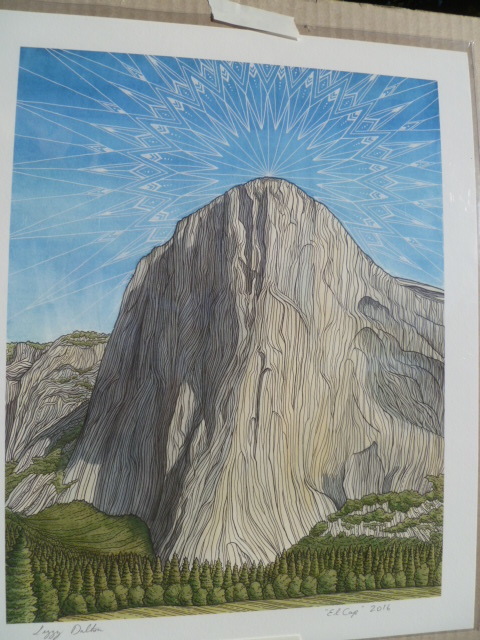 A beautiful archival print of El Cap by Lizzy Dalton. TY guys. Garsh :) |
|
|
King Tut wrote: Our pleasure! Thanks for taking the time out to take a couple of noobs out! |


