|
|
Clint Cummins
·
May 27, 2016
·
Palo Alto, CA
· Joined Jan 2007
· Points: 1,870
No backup, no knots in ends, no helmet.
Has worked fine for 45 years of climbing.
If I need to stop (to clear tangled strands, etc.),
I just wrap the rope around my leg.
I prefer to use a rappelling method with fewer steps.
This means I can focus my attention more on not making mistakes.
It's a personal choice to use a backup; if my partner does it, that's fine.
Similarly, the choice of knot to join ropes is a personal choice.
On granite I prefer the rewoven figure eight.
My longtime new route partner prefers the EDK.
So we each tie our favorite when we are the person doing the knot.
|
|
|
acrophobe
·
May 27, 2016
·
Orange, CT
· Joined Jul 2010
· Points: 0
Jason - I also use the Alpine Up, and have been doing so for a few years. I use it on double 8.5s, and have found that it has locked up 100% of the time when I release the lever. I still keep my brake hand on the ropes.
Full rope length, free-hanging raps can start off pretty jerky, but if you push inward on the release lever at the correct angle this can be overcome.
Sometimes I climb on a partners doubles, and have no trouble with the raps. Not sure why, since mine are the same thickness and newer.
|
|
|
Nick Goldsmith
·
May 27, 2016
·
NEK
· Joined Aug 2009
· Points: 505
auto block every time. that loop of cord lives on my leg loop ready to go.
|
|
|
Anonymous
·
May 27, 2016
·
Unknown Hometown
· Joined unknown
· Points: 0
On single pitch sport routes it is useless especially with 70m or 80m ropes. I usually carry a Shunt on multi pitch climbs that makes life a lot easier ascending a rope in emergency or as an auto block. I would not use it to solo toprope there are better devices out there.
In my opinion knots at the end of the rope is the best way to prevent repelling of the end of my rope. An auto block will stop you but i don't see how it will stop you if you run out of rope.
My rule is if I see the rope on the ground I don't back it up. If I don't see it, I use a knots at the end of the rope and back it up above the belay device unless I extend the belay device .
|
|
|
Billcoe
·
May 27, 2016
·
Pacific Northwet
· Joined Mar 2006
· Points: 936
Rarely, but I have. 40 some odd years climbing here.
|
|
|
Andrew A.
·
May 27, 2016
·
Southbridge, MA
· Joined Dec 2012
· Points: 20
Watch rappelling accidents on YouTube and your mind will be changed. Something happens and a half second later you're on the ground. I will always back up my raps after seeing how quickly it can go wrong.
|
|
|
djh860
·
May 28, 2016
·
Unknown Hometown
· Joined Dec 2014
· Points: 110
Took my brother on his first multi pitch climb. On the rap down his foot slipped on a bulge and he was spun quickly and slammed his shoulder on the rock. I thought oh I've killed my brother. To his credit he hung on. I have backed up 99% ever since
|
|
|
M Mobley
·
May 28, 2016
·
Bar Harbor, ME
· Joined Mar 2006
· Points: 911
DesertRat wrote:Interesting the dichotomy I see between posters on MP and out at the crags. Yep,always is. Great observation.
|
|
|
Dustin Stotser
·
May 28, 2016
·
Unknown Hometown
· Joined May 2014
· Points: 371
DesertRat wrote:Interesting the dichotomy I see between posters on MP and out at the crags. The amount of people that I see backing up their rappel when I'm out climbing is pretty slim. The amount of people commenting on here makes it seem that everyone does it. Interesting point though it's based on a few assumptions. The first being that the MP community is a representative sample of the climbing community that you see. The second assumption is equating the whole climbing community again to the one you see. The final assumption is that a representative sample of MP users respond to forum posts regarding safety.
So though it's an interesting observation, your conclusions are unfounded as they rely on too many assumptions. Don't mean to pick on you, but I just wanted to point out how misleading anecdotal evidence can be.
Edit: To answer the OP's question. The vast majority of my climbing experience is at single pitch crags with walls 30-90' with clear views of the landing area and few hazards. Therefore, I've only ever backed up rappels using a fireman's belay since it's almost always an option.
|
|
|
Nick Goldsmith
·
May 28, 2016
·
NEK
· Joined Aug 2009
· Points: 505
I do a lot of new routeing, trundeling, aid climbing etc. Once you get used to the auto bloc it is no cluster at all. It lives on my leg loop and has multiple uses. Quite often gets used as a sling when i run out on long pitches. Saying a leg loop is fine is like saying you don't need a nice shiny new cam because you have a piece of old rope tied in a knott that you are going to jam in a crack....
|
|
|
JK- Branin
·
May 28, 2016
·
NYC-ish
· Joined Nov 2012
· Points: 56
Sometimes. Sometimes not. It depends.
|
|
|
Ted Pinson
·
May 28, 2016
·
Chicago, IL
· Joined Jul 2014
· Points: 252
Almost always autoblock. Literally takes 5 sec and has already saved my ass.
|
|
|
Adam Stackhouse
 ·
May 28, 2016
·
Unknown Hometown
· Joined Jan 2001
· Points: 14,185
·
May 28, 2016
·
Unknown Hometown
· Joined Jan 2001
· Points: 14,185
Clint Cummins wrote:No backup, no knots in ends, no helmet. Has worked fine for 45 years of climbing. If I need to stop (to clear tangled strands, etc.), I just wrap the rope around my leg. I prefer to use a rappelling method with fewer steps. This means I can focus my attention more on not making mistakes. Yup!
|
|
|
Old lady H
·
May 28, 2016
·
Boise, ID
· Joined Aug 2015
· Points: 1,375
I extend my ATC, and back up with a prussik, because that is by far the most comfortable/manageable/safe option for ME, for a lot of reasons.
Here, on our local single pitch very vertical local cliffs, I almost always see people just shoot down the rappell with no backup, firemen's or otherwise. Ditto with the gym staff coming down off the balcony. To me, that's a great opportunity to get really fast tying that hitch, and could be the tiny thing that keeps a bigger outdoor trip from becoming an epic (trying to tie something when it's dark and cold and the hike out is two hours).
RGold and I had a conversation in one of these "disaster" threads, where he pointed out that an unconscious rappeller hanging on a friction hitch, versus a fireman's belay, puts the rest of the party in a serious pickle, so that is an actual safety argument that could be made.
Respectfully to all, as far as I can tell from accident reports, if an injury/sudden illness is severe enough I am unconscious, I am pretty much dead or going to be dead before any serious medical attention can get there. I haven't been to either place, but, off the top of my head, Squamish, and Pocatello, Idaho are the only places where the climbing might be mere minutes from EMS.
So, there is a reason why these techniques are lumped into "SELF rescue", at least in my head. How will you get out of this nightmare while your best friend is bleeding out on the other end of the rope? This is what we all want to avoid, by anticipating our own stupid mistakes, and being at least slightly prepared for horrible surprises.
For myself, it is almost useless to think about me rescuing you in the big ticket scenario, and far more useful to just consider broken ankles, bee stings, weather turning on you, or even just that burrito from last night. That I can certainly do, by having just a few extra skills, and a minimal bit of stuff on my harness to work with. If that skill and the prussik/purcell are used regularly to rappell, then they are there for a long, long list of other useful applications.
I know a single prussik holds my weight just fine, because I've done that. I know one of my cords needs two wraps, the others need three, on a doubled rope, to ascend, because I've messed around with it. I know I can descend with those Purcell's, cause I've done it. Helluva workout up or down, but I can actually do it, which is also good to know. I may never need to escape a belay, but maybe there is reason to hand off to someone else?
Sorry this sorta set me off, but I am one of those who finds the whole gamut of this interesting, fun and rewarding, not just all about me climbing a rock and my fabulous style while I do so.
Best, H.
|
|
|
Noah Yetter
·
May 28, 2016
·
Lakewood, CO
· Joined Jul 2015
· Points: 105
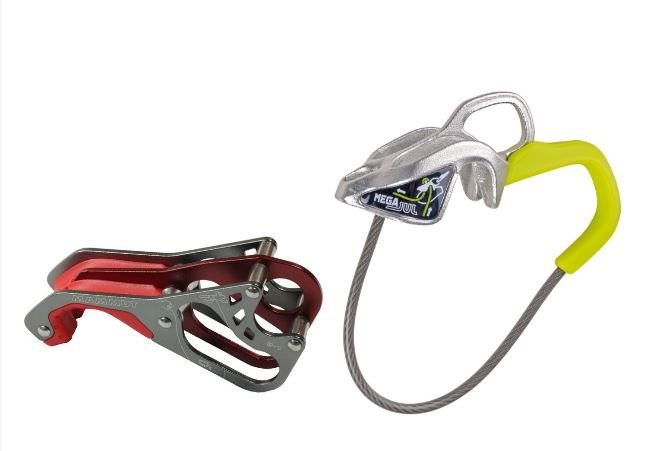
Every single time. Unless you're using a locking device -- Mega Jul, Smart Alpine, Alpine Up, etc. -- there's just no reason not to.
|
|
|
William Thiry
·
May 28, 2016
·
Las Vegas
· Joined Dec 2011
· Points: 739
Using an autoblock in rappelling situations that could be sketchy (loose rocks, overhangs, high probability of rope snags) is a very good idea. In a straightforward rappelling situation where issues are very unlikely an autoblock is really just a waste of time.
|
|
|
Clovehitch
·
May 28, 2016
·
Unknown Hometown
· Joined Nov 2015
· Points: 5
I'm just going to leave this here...
(I know someone referenced it before)
But I am still WILDLY amazed that people still haven't adopted these types of devices. For the amount of people who drink the grigri kool-aid - yet the community as a whole doesn't (at least in the popular sense) see the overwhelming advantage to these types of autolocking devices is beyond me.
These are literally tube styles devices with all the extra benefits. autoblock for belaying a second, and (semi) autolocking for rappel and lead belay. yes, there is a learning curve - but if people are willing to learn the curve of a prussik - why?
|
|
|
William Thiry
·
May 28, 2016
·
Las Vegas
· Joined Dec 2011
· Points: 739
Looks good, Clove. I'll look into it!
|
|
|
Old lady H
·
May 28, 2016
·
Boise, ID
· Joined Aug 2015
· Points: 1,375
Clove, "learning curve" for how the prussik works is seconds after you see it in action, maybe 30 minutes to tie it, if you also have to learn double fisherman's for a cord?
That said, I hope to have a chance to mess around with an Alpine up (AHEM, you know I am speaking to you, Trevor). I'm not popping out money for any of these until I know how well they will work for me.
|
|
|
Brian L.
·
May 28, 2016
·
Unknown Hometown
· Joined Feb 2016
· Points: 90
Clovehitch wrote:(semi) autolocking for rappel Maybe I am wrong, but my understanding of these devices is they only lock AFTER a catch. Meaning they wont reliably lock if you lef go of the rope.
This seems like a bad idea to rely on as a backup for rappel, as there are situations where you may not be aware enough to keep ahold of the rope and lock the device.
Someone please correct me if I'm wrong?
|

 Continue with onX Maps
 Sign in with Facebook