
 Continue with onX Maps
 Sign in with Facebook






HELP! Trying to build an Indoor Hybrid Campus Board/Woody
|
|
TL;DR: I need the correct specs to fit a woody (10' x 8') and campus board (6' x 8') 4' off the ground in a 13' x 11' x 10' room. Would it be safe/sturdy if I combined both of them together or should they be separate?   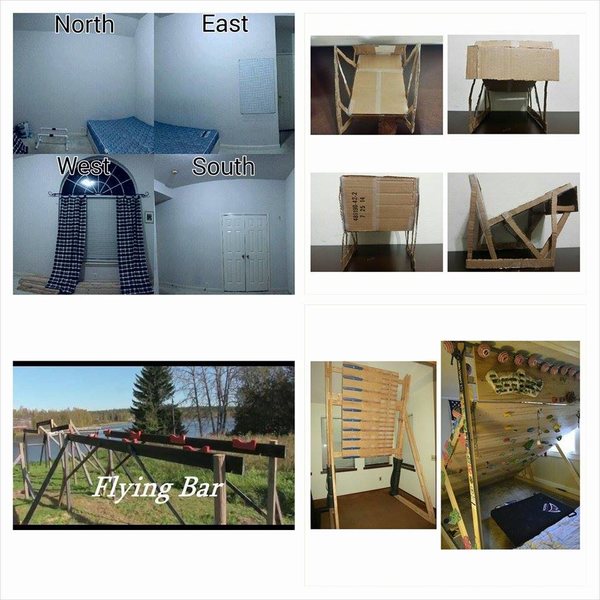   Here's a rough draft of my submission video: youtube.com/watch?v=1NAOa7L…  |

|
I don't know much about ANW obstacles, but I built a freestanding woodie in a small room with similar dimensions. With an 8-foot ceiling, about the best I could do while leaving room for the door and some storage was a 45-degree wall 4'x10' with a 1' tall kicker panel at the bottom. I went as steep as I did because I wanted to maximize my vertical climbing distance, but for training purposes anything much steeper than 45 degrees limits you to roof jugs, not very useful. |
|
|
Michael Swanson wrote:I don't know much about ANW obstacles, but I built a freestanding woodie in a small room with similar dimensions. With an 8-foot ceiling, about the best I could do while leaving room for the door and some storage was a 45-degree wall 4'x10' with a 1' tall kicker panel at the bottom. I went as steep as I did because I wanted to maximize my vertical climbing distance, but for training purposes anything much steeper than 45 degrees limits you to roof jugs, not very useful. One thing I would think about is making sure you have extra space AROUND your equipment to allow for leg swing/dynamic movement, walking around, stretching, etc. Be realistic about the space you actually need, not just fitting equipment in like a jigsaw. When I designed my wall I used a free 3D-modeling program called sketchup to make sure that what I wanted was realistic for the space I had. That might help in your case. Thanks for the website! I'll be sure to check it out. I used sketchbookx on my phone to make the "jigsaw puzzle". I'm considering making my wall at least 55 degrees to facilitate the use of the Nicros HIT system: |
|
|
I suppose it just depends on what your training goals are. I was aiming for something that trains more climbing-specific strength rather than campusing roof jugs (I put HIT strips on my wall too, they're awesome), and the 45-degree wall seems like a good sweet spot for my personal training. But if you are after something geared more towards campusing, then I am sure the setup you have will work great. I don't do any campus training myself, so I can't speak to that specifically. |
|
|
Michael Swanson wrote:I suppose it just depends on what your training goals are. I was aiming for something that trains more climbing-specific strength rather than campusing roof jugs (I put HIT strips on my wall too, they're awesome), and the 45-degree wall seems like a good sweet spot for my personal training. But if you are after something geared more towards campusing, then I am sure the setup you have will work great. I don't do any campus training myself, so I can't speak to that specifically. You're working with a pretty tight space constraint, my biggest advice having built a couple home walls myself is just take the time to design it properly beforehand so you know exactly how it will all go together. But I'm an engineer by trade, that's just how my brain works. Thanks for the advice. I'm no engineer or carpenter, so I decided to just build two campus boards that each have three rows to work with. Outside of the typical 1.25", 1", and .75" campus rungs, I wanted to add 5 sloper rungs, 6 domes, 10 pinches, and 10 pockets too. The pinches and pockets will share the final row. Also, I'm adding 40 eye bolts to campus up odd objects like baseballs, softballs, pipes, and cones too. |
|
|
PlanchePRO wrote: Also, I was wondering, how do you determine the angle of a campus board and woody? I want my campus board to be at 15 degree angle. I still might build a 55 degree woody outside instead. There's a couple ways to do it, one is to use an inclinometer app on your phone. It uses your phone's accelerometer to measure the angle of a surface. Basically a glorified bubble level. This is more helpful in the construction phase. |
|
|
Michael Swanson wrote: There's a couple ways to do it, one is to use an inclinometer app on your phone. It uses your phone's accelerometer to measure the angle of a surface. Basically a glorified bubble level. This is more helpful in the construction phase. Something that may help a little more in the design phase is Atomik's wall angle tool , it is based on simple trigonometry. For example, if you wanted a campus board 6 feet tall and overhanging 15 degrees (105 on their chart), your board would overhang about 1'8" according to that chart. You could get closer using the actual equations for right triangles, but honestly this will get you close enough. Atomik and Metolius both have some awesome resources for building climbing walls, if you haven't seen them already I would encourage you to look into the information they have on their websites. Don't use an app that directly measures angles and distances like that. I have one on my phone that uses a pretty complex algorithm, and seems decently accurate for using a phone as a protractor, but its always pretty off in precision. Spend $7 and get yourself a swanson speed square, it will be invaluable with the construction of your wall, and anything for that matter. With a speed square, and a knowledge of basic algebra you don't need anything fancy like a smart phone that is wrong. |
|
|
Eliot Augusto wrote: Don't use an app that directly measures angles and distances like that. I have one on my phone that uses a pretty complex algorithm, and seems decently accurate for using a phone as a protractor, but its always pretty off in precision. Spend $7 and get yourself a swanson speed square, it will be invaluable with the construction of your wall, and anything for that matter. With a speed square, and a knowledge of basic algebra you don't need anything fancy like a smart phone that is wrong. Watch a 10 minute video on youtube on how to use the speed square. You can also use it as a saw guide to get perfect cuts. Agreed. I wasn't thinking about HOW you actually make the cuts, simply how you measure an existing wall. Once I had a design I was happy with, I used a compound miter saw to make the cuts, which made cutting at the angles I wanted pretty trivial. But using a speed square is a pretty cheap and simple solution. |
|
|
Michael Swanson wrote: Agreed. I wasn't thinking about HOW you actually make the cuts, simply how you measure an existing wall. Once I had a design I was happy with, I used a compound miter saw to make the cuts, which made cutting at the angles I wanted pretty trivial. But using a speed square is a pretty cheap and simple solution. I love a chop saw(miter). But when it comes to building apartment room sized woodies, all you need is a skill saw, a tape measure, a pencil and a speed square. When you start cutting trim, furniture, and cabinets is when you need a chop saw and table saw. |
|
|
Eliot Augusto wrote: I love a chop saw(miter). But when it comes to building apartment room sized woodies, all you need is a skill saw, a tape measure, a pencil and a speed square. When you start cutting trim, furniture, and cabinets is when you need a chop saw and table saw. TO OP: A hammer, skillsaw, square, tape measure, and pencil are the tools I spend 95% of my time using as a carpenter. The other 5% are when I need to assemble quickly or make specialized cuts/measurements. And really, the other 5% make things a lot easier but aren't needed at all. Don't waste money buying something fancy. If you have questions post em here. But, if you've got it no reason not to use it. How much heavier is medium density fiberboard compared to plywood? Is it okay to use MDF instead of plywood? My first board that I've built is 6' x 4' made of 3/4" MDF and the frame is made of 2" x 4". My dad decided to get MDF because it was cheaper. It will be elevated 4' off the ground similar to [this]( rockclimberstrainingmanual.…;h=1388).  |
|
|
PlanchePRO wrote: How much heavier is medium density fiberboard compared to plywood? Is it okay to use MDF instead of plywood? My first board that I've built is 6' x 4' made of 3/4" MDF and the frame is made of 2" x 4". My dad decided to get MDF because it was cheaper. It will be elevated 4' off the ground similar to [this]( rockclimberstrainingmanual.…;h=1388). Here is a [picture]( i.imgur.com/JFhUreS.jpg). The first row is my completed board. (I still need to put the A-truss support on). The second row is a frame of the next campus board(s) I want to build. Instead of a 6' x 4, I'll build three 6' x 1.33', so it's not as bulky as the 6' x 4' and it's easier to lift up. Or should I just keep it a solid 6' x 4'? The third row is the A-truss design I want to use with 6 support legs instead of the typical four. My dad says the second design might sway because it's too narrow. Is that true? Is it okay to use 1/2" plywood instead of 3/4"? The bolts and nails that come with the sloper dome and campus rungs I've bought are 3/4" inch. How do I measure and cut the support legs and base so the board will have a 15 degree overhang? How long should both of the A-truss legs be? I know I could get the speed square, but I'm just really unsure and not confident enough to do it. Sorry. MDF is basically glorified particle board. It's cheaper and lighter than plywood. I personally wouldn't use MDF over plywood. OSB is on the border. When you're climbing an overhanging wall it isn't unreasonable to have all of your weight pulling down on a single hold. Your tee nuts / screws are only going to have about 1/4" of contact surface at most on the side of the board that doesn't have any holds. It might not happen this week or next month, but eventually you will pull your fastener out of MDF. OSB is similar, but it uses small wood chips so its better than MDF, but not as good as plywood. Use OSB if you can't get plywood. |

|
if you are going to spend the time, effort, and money - use 3/4" plywood. |
|
|
What do you guys think if I just used 10' x 4' plywood? Would it more stable since the plywood would be on the ground? Would my knees catch the wood on the way up? |
|
|
I agree with Slim, I have worked quite a lot with both MDF and ply and for anything structural would go with ply. MDF is inferior structurally, was designed for furniture and cabinettry, not as a structural building material, is significantly heavier than ply, and the dust when cutting/working is truly horrible! You should wear a dust mask for cutting anything. but MDF is really atrocious! |
|
|
mountainhick wrote:I agree with Slim, I have worked quite a lot with both MDF and ply and for anything structural would go with ply. MDF is inferior structurally, was designed for furniture and cabinettry, not as a structural building material, is significantly heavier than ply, and the dust when cutting/working is truly horrible! You should wear a dust mask for cutting anything. but MDF is really atrocious! diffen.com/difference/MDF_v… comptonlbr.com/weight-sheet… I got it cut at Home Depot. I have a stationary miter saw that only cuts planks. We decided to just scrap the board and get plywood instead. Lesson learned. Anyway, for the freestanding campus board, should I a 10' x 4' so the plywood will be on the floor, or a 6' x 4' so it's elevated off the ground? |


