|
|
John Byrnes
·
Aug 18, 2014
·
Fort Collins, CO
· Joined Dec 2007
· Points: 392
Sorry if this has been discussed before. I searched for it and got no good results.
I witnessed this Saturday. Two experienced climbers doing a sport route when the leader fell. Instead of getting caught somewhere near the 40' mark, the leader falls to within 10' of the ground.
The Gri-gri II has a 'mode' where the climber's rope can get hooked behind the release-handle-hinge (RHH). That's the black round part where the release handle is attached.
This happened during the fall, and the Gri-gri didn't lock on the rope. The belayer, surprised, then clamped down with his brake hand, the rope pulled out from behind the RHH, and things came to a stop.
I've had this happen to me but not during a fall. After hanging (cam engaged/RHH up) my leader was "pulling-up" on the rope. I grabbed his rope and jumped to take out the slack and stretch. Since then, I've learned I have to be more coordinated with the new Gri-gri.
I've never heard of this happening with the original Gri-gri. While the two designs are extremely similar, the GGII doesn't have as much metal to keep the rope in the channel when the cam is engaged (RHH up).
I think this is what happens but I'm open to other theories:
1) The climber falls, the rope goes tight and the cam locks, lifting the RHH. The belayer is moved in the direction of pull. Alternatively, the belayer may miss-time his jump if he jumps to soften the catch.
2) If the belayer has a hard grip on the climber's rope, his body-movement can cause a momentary loop to form, which gets behind the RHH before the spring can lower it.
This explain both my experience ("pulling up") and the fall I saw.
Perhaps this is another reason to NOT wear a glove on the left hand, or if you do, handle that side of the rope gently. Your thoughts?
|
|
|
Alex McIntyre
·
Aug 18, 2014
·
Tucson, AZ
· Joined Jan 2011
· Points: 561
The rope getting hooked behind the release handle engages the cam and makes it a pain to release and pay out more slack, not the other way around. This has been discussed a few times. Something else must have been at play in this situation.
|
|
|
rocknice2
·
Aug 18, 2014
·
Montreal, QC
· Joined Nov 2006
· Points: 3,847
John Byrnes wrote:This happened during the fall, and the Gri-gri didn't lock on the rope. The belayer, surprised, then clamped down with his brake hand, the rope pulled out from behind the RHH, and things came to a stop. So once the belayer actually gripped the brake strand, the fall came to a stop?
|
|
|
Paul H
·
Aug 18, 2014
·
Pennsylvania
· Joined Feb 2013
· Points: 5
Alex McIntyre wrote:The rope getting hooked behind the release handle engages the cam and makes it a pain to release and pay out more slack, not the other way around. This has been discussed a few times. Something else must have been at play in this situation. ^ This. I've had the rope stuck behind the handle and can attest to the fact that it locks up the Grigri - not the opposite. Curious to hear what else could have caused it
|
|
|
camhead
·
Aug 18, 2014
·
Vandalia, Appalachia
· Joined Jun 2006
· Points: 1,240
rocknice2 wrote: So once the belayer actually gripped the brake strand, the fall came to a stop? This is just armchair speculation, but it sounds to me like the rope got caught behind the lever, the belayer probably pulled the rope to get it unstuck, while not having his brake hand on, and then the brake failed to engage because he was still gripping the rope above the device with his hand, after getting it unstuck.
Which comes down to the reason for about 99% of gri gri "failure" accidents: the belayer is gripping onto the rope above the device, while his brake hand is not on, and the brake does not engage. This is, repeat after me, USER. ERROR.
|
|
|
David Coley
·
Aug 18, 2014
·
UK
· Joined Oct 2013
· Points: 70
As others had said sounds like the upper hand held the rope.
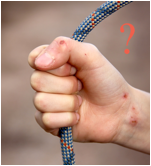
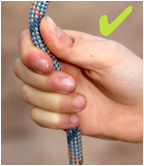
"Be careful not to stop the cam activating by taking the force of the fall through your upper hand. Your upper hand needs to either let the rope slide through it without friction, or the hand has to move up with the rope, or it needs to let go. One way of ensuring you don’t grip too hard is to only grip with the ends of your fingers and thumb. Your lower, brake, hand should grip normally and must never let go during the fall."
i.e. try not to do this with the upper hand:
but do this: I think I'm right in saying that a Grigri locks because of the inertia of the lower (brake) rope. Once this rope is moving through the device it finds it harder to lock off.
|
|
|
John Byrnes
·
Aug 18, 2014
·
Fort Collins, CO
· Joined Dec 2007
· Points: 392
Let me see if I can address all the questions.
I witnessed the fall, over my shoulder, from about 30' away. The belayer's actions I described were related to us (small group) immediately after the incident.
When it happened, like most of you, I immediately suspected that the belayer had grabbed the climber's strand with his gloved left hand, preventing the device from locking. When asked, the belayer said he did NOT do that. (I wish now I had examined his glove!)
He showed us, by lifting the handle and putting the rope behind it. He said the device did not lock up until he gripped the brake-strand hard and the rope popped back around into the normal channel.
I agree with all of you who say having a loop will engage the cam. When this happens you can't move the rope in either direction. When it happened to me belaying, I couldn't take in slack and when my climber pulled-up, I ended up sitting on the ground, OOF!
I think that Camhead's idea of the belayer gripping the rope hard with his left hand was the root cause. This would make it more likely for a loop to get behind the handle, but it was still the left hand that prevented it from locking.
I disagree with the idea that the cam locked and the belayer, pulling hard with his left hand, managed to disengage it. It happened too fast, too seamlessly, for that and it's really hard to grasp a skinny rope hard enough once the cam is fully engaged.... unless you jump, so maybe there is a possibility. (I didn't see the belayer jump.)
So from what I see here, the consensus is that the belayer was mistaken about the cause of the problem, and the failure was due to a well-known cause. If anyone has experience or information to the contrary, I'd like to see it.
|
|
|
Mike Bond
·
Aug 19, 2014
·
Kentucky
· Joined Aug 2009
· Points: 3,639
|

 Continue with onX Maps
 Sign in with Facebook