
 Continue with onX Maps
 Sign in with Facebook






can someone point me in the right direction please.


|
|
Having a hard time finding the thread that talks about impact forces on last piece relative to the amount of rope payed out. I've got to school some fool. |
|
|
Ryan N wrote:Having a hard time finding the thread that talks about impact forces on last piece relative to the amount of rope payed out. I've got to school some fool. Fall factor? |


|
Alright! Way to step up, 20 kN. That's a great link. |
|
|
Freedom of the hills book |
|
|
Force on the top piece should be roughly 2X the impact force on the climber due to the pulley effect. |
|
|
Not fall factor. |
|
|
If h is the height of the fall before the rope comes taut, l is the length of the rope between belay and climber, and p is the amount of slack paid out, the fall factor changes from h/l to (h+p)/(l+p). Therefore, if h/l is greater than one, paying out slack decreases the fall factor, and if h/l is less than one, paying out slack increases it. |
|
|
OK, here are some threads to look at: |
|
|
Are you asking if paying out slack would decrease the force on the top piece? If so, then the answer is no for fall less than a FF=1 and it is easy to calculate by using fall factors. If the FF is greater than 1, then paying out slack would theoretically decrease the force on the upper piece. |
|
|
if catching a fall "softly" then the force on the gear should be less, rather than being caught with a grigri etc. |
|
|
Ryan N wrote:The question was asked if paying out more slack on a sketchy piece of gear would lessen the overall force of the fall if the distance between last piece was constant? No, that is an urban legend that has been discussed a number of times on rockclimbing.com. Feeding slack out only increases the impact force. Allen Corneau wrote:Force on the top piece should be roughly 2X the impact force on the climber due to the pulley effect. If you were falling on a pulley that was 100% efficient, that would be true. But carabiners are quite inefficient and so the load on the top piece is more like 1.6:1 instead of 2:1. Normally the breakdown is that the belayer will see 60% of what the leader sees and the top piece will see 160% of what the leader sees. But that is highly dependent on how much friction is produced on the carabiner attached to the top piece. |
|
|
keep in mind that when people on the intrawebs talk about "fall factors" and the theoretical effects on gear, etc ... they are talking about PERFECT scenarios 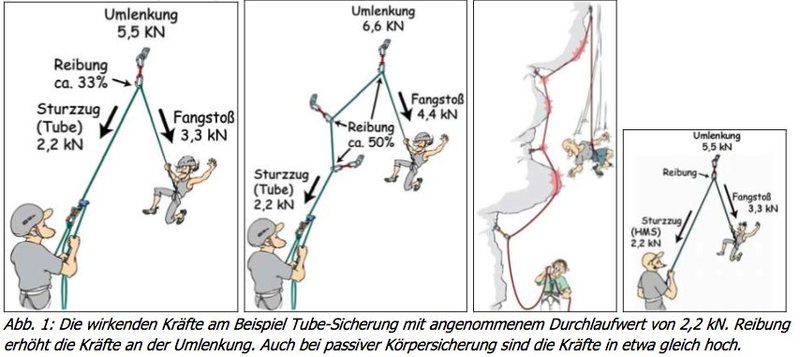 without some serious testing or theoretical models that can account for this, and not just simple math ... all this intraweb discussion IMO is basically a cr@pshoot when compared to real world scenarios  add in the different types of ropes and belay devices and it gets even more fun  what a bit of slack can give you is allow you the time to react ... ive had people basically sit down when ive fallen on a tight rope and blow out gear (with an ATC) ... vs. people who let themselves get pulled up a bit and the same gear in the same exact placement held (with a gri gri) ... of course this is all anecdotal ... but youll find all this out when you whip over and over again on gear ... not through intraweb arguments  this of course increases the forces on the gear ... i usually use a stetchy rope to offet this, and get my belayers to give me some slack  i encourage people to go out and take clean, backed up whippers on their own gear and find out if theres any difference |
|
|
Thanks guys |
|
|
Heres this baby for you. |
|
|
Eli Buzzell wrote:Heres this baby for you. myoan.net/climbart/climbfor… That thing is way off. |
|
|
Greg D wrote: That thing is way off. For starters, it computes the fall factor as (distance from anchor + length of rope) / length of ropeinstead of twice distance from anchor / length of rope. |
|
|
Just wanted to expand a little on what 20kN said above, and point out a small arithmetic error. 20kN forgot to add 3' to the fall distance on the fourth example, so it should be 16' total rope out, 20' fall, giving a fall factor of 1.25 on the last example. What he (she?) said after that is true about a fall with a factor over one and feeding out slack. Here's a generalized version to demonstrate how the concept works rather than a few discrete examples. |
|
|
Here's a preview image, since the subscripts didn't post properly. Why you no allow subcripts, MP?  |
|
|
here's a question for Bearbreeder - (with all the real world experience) how much force does a femur shave off? |
|
|
MountainProject nerds strike again! |
|
|
You might find this interesting: amga.com/resources/various/… |


