
 Continue with onX Maps
 Sign in with Facebook






Impact (Kn) absorbing knots?


|
|
rgold wrote:Clyde, the reference for my comment is From Measurement of Dynamic Rope System Stiffness in a Sequential Failure for Lead Climbing Falls, J. Marc Beverly and Stephan W. Attaway, ... "We were able to make accurate measurements of the system stiffness and show that knots play an important role in system stiffness. The figure-8 follow through knot absorbs an equivalent of nearly 1.5 m (5 feet) or rope for the first impact force. After that the knot is 'hardened' and has less absorptive ability....Although not of practical use on bolted sport routes, this could have major consequences when falling on questionable anchor points." They also looked at knot behavior in the multi-point anchor paper. |
|
|
Phil Lauffen wrote: I've wondered about this problem. Is this a legitimate reason to use a different knot for an anchor attachment? Shouldn't there always be some dynamic characteristics in the anchor build? Tying in with a clove hitch is dynamic (unless you're in the habit of climbing multipitch climbs with static line, i suppose). |


|
rgold wrote:Clyde, the reference for my comment is From Measurement of Dynamic Rope System Stiffness in a Sequential Failure for Lead Climbing Falls, J. Marc Beverly and Stephan W. Attaway, mra.org/services/grants/doc…, Recommendations section, page 22: "We were able to make accurate measurements of the system stiffness and show that knots play an important role in system stiffness. The figure-8 follow through knot absorbs an equivalent of nearly 1.5 m (5 feet) or rope for the first impact force. After that the knot is 'hardened' and has less absorptive ability....Although not of practical use on bolted sport routes, this could have major consequences when falling on questionable anchor points." The testing used a belay without slippage. Much, perhaps not all, of the CAI testing used real belayers. Perhaps once the rope starts slipping through the belay device, as it invariably does in those tests, the further effect of knot-tightening is inconsequential. Lots of other interesting results in the Attaway-Beverly paper, the main one being an affirmative conclusion about the oft-debated issue of whether climbing ropes recover in the fractions of seconds between sequential anchor failures. For those whose memory goes back this far, Ken Cline's shock wave analysis on rec.climbing seems to have been confirmed. I just found and read this on AMGA website articles. Interesting read! |
|
|
Here's
some testing from the BD QClab related to the impact force reduction from loosening a knot. They found that loosening the knot had very little effect in tests with a fall factor of 0.24 with an 80 kg test weight. |
|
|
Kevin Cossel wrote: Here's some testing from the BD QClab related to the impact force reduction from loosening a knot. They found that loosening the knot had very little effect in tests with a fall factor of 0.24 with an 80 kg test weight. Thanks for that link, Kevin. The BD results seem pretty plausible to me. As a quick estimate I note that the fall energy absorbed is (force) X (distance). I don't see how the force on the knot could exceed the rope tension, and the rope will stretch several feet while knot tightening is probably much less than an inch. This leads me to think that the energy absorbed by tightening of the knot could be only a small percentage of the total. Is there an absorption mechanism I am missing here? |
|
|
Larry DeAngelo wrote: Thanks for that link, Kevin. The BD results seem pretty plausible to me. As a quick estimate I note that the fall energy absorbed is (force) X (distance). I don't see how the force on the knot could exceed the rope tension, and the rope will stretch several feet while knot tightening is probably much less than an inch. This leads me to think that the energy absorbed by tightening of the knot could be only a small percentage of the total. Is there an absorption mechanism I am missing here? I am still pondering this whole idea that the way a fig 8 knot is tied could have a significant role in reducing the impact on me or my protection in a fall...The study "Sequential Rope Failure" is making me think too hard on this. I need to get out, not fall and if (when)I do fall my protection would have been placed with enough skill to hold me!!! |
|
|
CalmAdrenaline wrote:I was wondering if anyone has ever experimented, or know of knots that would potentially absorb impact forces in a fall scenario, much like a screamer? A Tarbuck knot? j/k ;) |
|
|
The thing to remember is that any knot you apply to a rope automatically decreases the strength of the rope by 1/3rd. As for a "knot" that allows for shock absorption there is none. The only type of "knot" that can come close to what you are talking about is a prussik that slides. Especially a Purcell Prussik. The Purcell Prussik is designed to somewhat slide during a shock loading event to be able disperse the force and heat generated over a short portion of the rope decreasing the chance of the rope from exploding at it's weakest point during the event. That point has been found in several well studied drop tests by Rigging For Rescue to be occurring at the point where the rope makes contact at the carabiner, especially when this system has been used as a daisy chain connecting type device. This is why the Purcell Prussik systems are becoming so popular lately. The spectra made daisy chains specifically are way more prone to exploding at it's weakest point during a significant enough shock load, due to its lower melting point, than say the spectra/nylon combo or your typical Purcell Prussik made of 6mm cordalett. Just something to think about as well... |
|
|
DurangoMedic wrote:The thing to remember is that any knot you apply to a rope automatically decreases the strength of the rope by 1/3rd. In the context of knots in climbing ropes, which is the subject of the current discussion, this consideration is irrelevant, first because climbing ropes almost never break, second because when they do, they never break at the knot, and third because, no matter what, climbers have to tie knots to connect themselves to the rope. DurangoMedic wrote: As for a "knot" that allows for shock absorption there is none. The only type of "knot" that can come close to what you are talking about is a prussik that slides. Since "shock absorbtion" is an undefined term, this statement cannot be assigned a truth-value. But testing shows that the non-sliding figure eight knot absorbs fall energy, and that absorbtion is the subject of the thread, so if DG is referring to fall energy when he speaks of absorbing "shocks," his statements are, unfortunately, false. Larry DeAngelo wrote: Thanks for that link, Kevin. The BD results seem pretty plausible to me. As a quick estimate I note that the fall energy absorbed is (force) X (distance). I don't see how the force on the knot could exceed the rope tension, and the rope will stretch several feet while knot tightening is probably much less than an inch. This leads me to think that the energy absorbed by tightening of the knot could be only a small percentage of the total. Is there an absorption mechanism I am missing here? The BD tests are not relevant to the question of knot energy absorbtion. BD only considered whether loosening the knot after a fall has an effect on energy absorbtion, and even there the results are confounded, first with the effects of rope stiffening after a fall, and second with the fact that a carabiner had to be placed in the knot in order for it to be untied after the first drop. |
|
|
this is more to do with tethering systems, but ...  |
|
|
Back my younger days when ropes were a bit on the stiffer side and a harness was hemp cord wrapped many times around the waist the Tarbuck knot (a sort of Prusik) was developed. I don´t think anyone but Ken Tarbuck trusted it or thought it was in any way worthwhile! |
|
|
wivanoff wrote: A Tarbuck knot? j/k ;) I've heard of a Purcell Prusik used as a PAS but that's not what you had in mind. Bad form replying to my own post... |
|
|
To address the original post - knots that absorb energy,   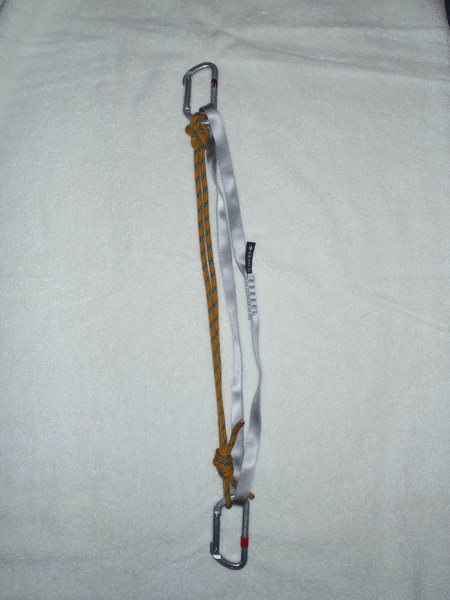 |


